Identifying the Impact of Digital Media Habits on Family Cohesion
DOI:
https://doi.org/10.61838/kman.aftj.5026Keywords:
digital media habits, family cohesion, qualitative research, communication patterns, emotional connectionAbstract
Objective: This study aimed to explore how digital media habits influence family cohesion, communication patterns, and emotional relationships among Colombian households.
Methods and Materials: This qualitative research employed a phenomenological approach to understand the lived experiences of families in the digital era. The study involved 21 participants (12 women and 9 men) from various regions of Colombia, selected through purposive sampling to ensure diversity in family structure and digital engagement. Data were collected through semi-structured interviews focusing on patterns of digital media use, emotional interactions, and family communication. Interviews were conducted until theoretical saturation was reached, recorded with participants’ consent, and transcribed verbatim. Data analysis followed Braun and Clarke’s six-step thematic analysis framework using NVivo 14 software to code and categorize responses systematically. Credibility and trustworthiness were enhanced through member checking, peer debriefing, and maintaining an audit trail throughout the research process.
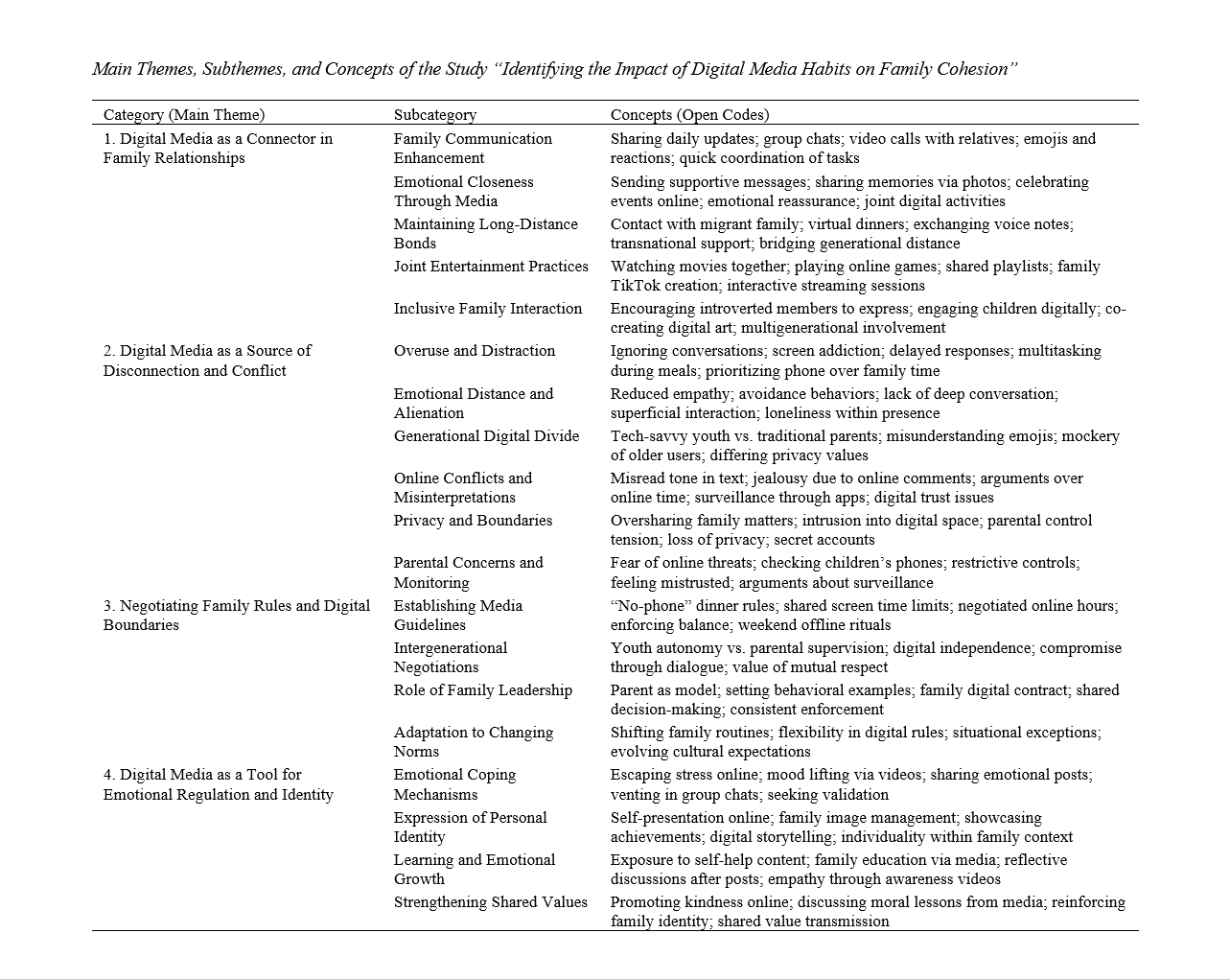
Findings: Four major themes emerged: (1) digital media as a connector in family relationships, (2) digital media as a source of disconnection and conflict, (3) negotiating family rules and digital boundaries, and (4) digital media as a tool for emotional regulation and identity. Results revealed that digital media enhanced communication and emotional closeness when used collaboratively but created conflict, emotional distance, and generational tension when overused or unregulated. Families that established flexible digital rules and engaged in shared online activities demonstrated stronger cohesion and mutual understanding.
Conclusion: Digital media plays a dual role in shaping family cohesion—both strengthening and fragmenting relationships. Intentional, balanced, and reflective digital engagement can transform technology into a medium for emotional connection and shared growth rather than disconnection. Promoting digital literacy, family dialogue, and adaptive boundary-setting is essential to maintaining cohesion in the digital age.
Downloads
References
Ana Clara Araujo de, S., Valadares, A. E. M., Gomes, G., Barros, G., Leonardo Miranda do Espírito, S., Nunes, P., Carneiro, S. F., Nascimento, S., Cruz, T. d. C., & João Ronaldo Tavares de Vasconcellos, N. (2025). Screen Time and Its Impacts on Youth Health and Brain Development. Asian Journal of Education and Social Studies, 51(9), 1206-1220. https://doi.org/10.9734/ajess/2025/v51i92450
Asante, S., Shamow, A., & Bang, E. J. (2025). An Examination of the Relationship Between Social Support Networks and Opioid Misuse Among American Indian/Alaska Native Populations: A Systematic Review. Healthcare, 13(16), 2072. https://doi.org/10.3390/healthcare13162072
Chatterjee, E., S., N., Mishra, M., & A., A. (2025). A Sociological Study of Social Media’s Impact on Family Relationships Among Urban Youth. International Journal for Multidisciplinary Research, 7(2). https://doi.org/10.36948/ijfmr.2025.v07i02.42682
Gustavo Vicentis de Oliveira, F. (2025). Application of Digital Technologies in Health Literacy in Situations of Social Isolation: A Systematic Review. Revista Fluminense De Odontologia, 3(68), 215-231. https://doi.org/10.22409/ijosd.v3i68.63219
Kemboi, L. K., Mutisyia, M., & Macharia, E. (2024). Family Social Work Interventions Model to Promote Family Cohesion Among the Users of Social Media in Uasin-Gishu County, Kenya. IOSR Journal of Humanities and Social Science, 29(9), 54-63. https://doi.org/10.9790/0837-2909035463
Li, J. (2025). The Impact of Social Media on Parent-Child and Peer Relationships. Journal of Education Humanities and Social Sciences, 51, 95-101. https://doi.org/10.54097/tddeqp60
Lotfi, A. G. (2024). The Impact of Social Networking Sites on the Family Cohesion of Algerian Society: Risks and Pros. Revista De Gestão Social E Ambiental, 18(11), e08687. https://doi.org/10.24857/rgsa.v18n11-129
Luhmann, M., Buecker, S., & Rüsberg, M. (2022). Loneliness Across Time and Space. Nature Reviews Psychology, 2(1), 9-23. https://doi.org/10.1038/s44159-022-00124-1
Masih, M., Suleman, S. A., Khan, M. H., Sahito, Z. H., & Shahid, S. S. (2025). The Future Classroom: Integrating AI and Social Media for Adaptive Learning. Ijss, 4(3), 98-111. https://doi.org/10.63544/ijss.v4i3.150
Pereira-Castro, M. R., Pinto, A. G., Caixeta, T. R., Monteiro, R. A., Bermúdez, X. P. D., & Mendonça, A. V. M. (2022). Digital Forms of Commensality in the 21st Century: A Scoping Review. International journal of environmental research and public health, 19(24), 16734. https://doi.org/10.3390/ijerph192416734
Santarén, V. R., Frutos, S. F. d., Idrovo, Í. V. J., & Costales, Á. S. (2025). Internet Y Redes Sociales: Necesidad De Refuerzo Del Empoderamiento Digital en Personas Mayores. Telos Revista De Estudios Interdisciplinarios en Ciencias Sociales, 27(3), 809-816. https://doi.org/10.36390/telos273.01
Şimşek, E. E. (2025). The Use of Digital Technology by Parents From the Perspective of Children. Turkish Academic Research Review - Türk Akademik Araştırmalar Dergisi [Tarr], 10(1), 54-69. https://doi.org/10.30622/tarr.1603562
Singh, S. K. (2025). Social Media and Knowledge Sharing: Impact on Academic Development in Public Universities of Kanpur. Journal of Information Systems Engineering & Management, 10(3s), 97-109. https://doi.org/10.52783/jisem.v10i3s.362
Tanyag, I. P., & Tanyag, R. D. (2025). Gadget Dependency and Its Effects on Family Relationships: A Comprehensive Review. Cognizance Journal of Multidisciplinary Studies, 5(3), 242-253. https://doi.org/10.47760/cognizance.2025.v05i03.019
Wartberg, L., Krämer, M., Potzel, K., & Kammerl, R. (2022). Problematic Use of Video Games, Social Media, and Alcohol: Associations With Mother-Child Relationship. Psychopathology, 56(1-2), 117-126. https://doi.org/10.1159/000525148
Zhang, C., & Zhu, B. (2025). Digital Gratification: Short Video Consumption and Mental Health in Rural China. Frontiers in Public Health, 13. https://doi.org/10.3389/fpubh.2025.1536191
Zhou, Z., & Cheng, Q. (2022). Relationship Between Online Social Support and Adolescents’ Mental Health: A Systematic Review and Meta‐analysis. Journal of adolescence, 94(3), 281-292. https://doi.org/10.1002/jad.12031
Downloads
Additional Files
Publication Timeline
- Submitted
- Revised
- Accepted