Comparison of the Effectiveness of Emotionally Focused Couple Therapy and Schema Therapy on Emotional Exhaustion and Attachment Styles in Women with Marital Conflict
Keywords:
Emotional exhaustion, attachment styles, emotionally focused couple therapy, schema therapy, women, marital conflict.Abstract
Objective: The present study aimed to compare the effectiveness of Emotionally Focused Couple Therapy (EFCT) and Schema Therapy on emotional exhaustion and attachment styles (secure, avoidant, and ambivalent) in women experiencing marital conflict.
Methods and Materials: This study employed a quasi-experimental design with three groups (two experimental groups and one control group) and three measurement stages (pretest, posttest, and 45-day follow-up). The statistical population consisted of women with marital conflict who referred to family and couple counseling centers in Isfahan during spring 2025. Forty-five participants were selected using purposive sampling based on inclusion criteria and randomly assigned to an Emotionally Focused Couple Therapy group, a Schema Therapy group, or a control group (n = 15 per group). The EFCT intervention was conducted in nine 90-minute group sessions held twice weekly, whereas Schema Therapy was delivered in twelve 90-minute group sessions twice weekly. The control group received no intervention. Data were collected using the Emotional Exhaustion Questionnaire and the Attachment Styles Questionnaire and analyzed using repeated measures analysis of variance with Greenhouse–Geisser correction and Bonferroni post hoc comparisons in SPSS-26.
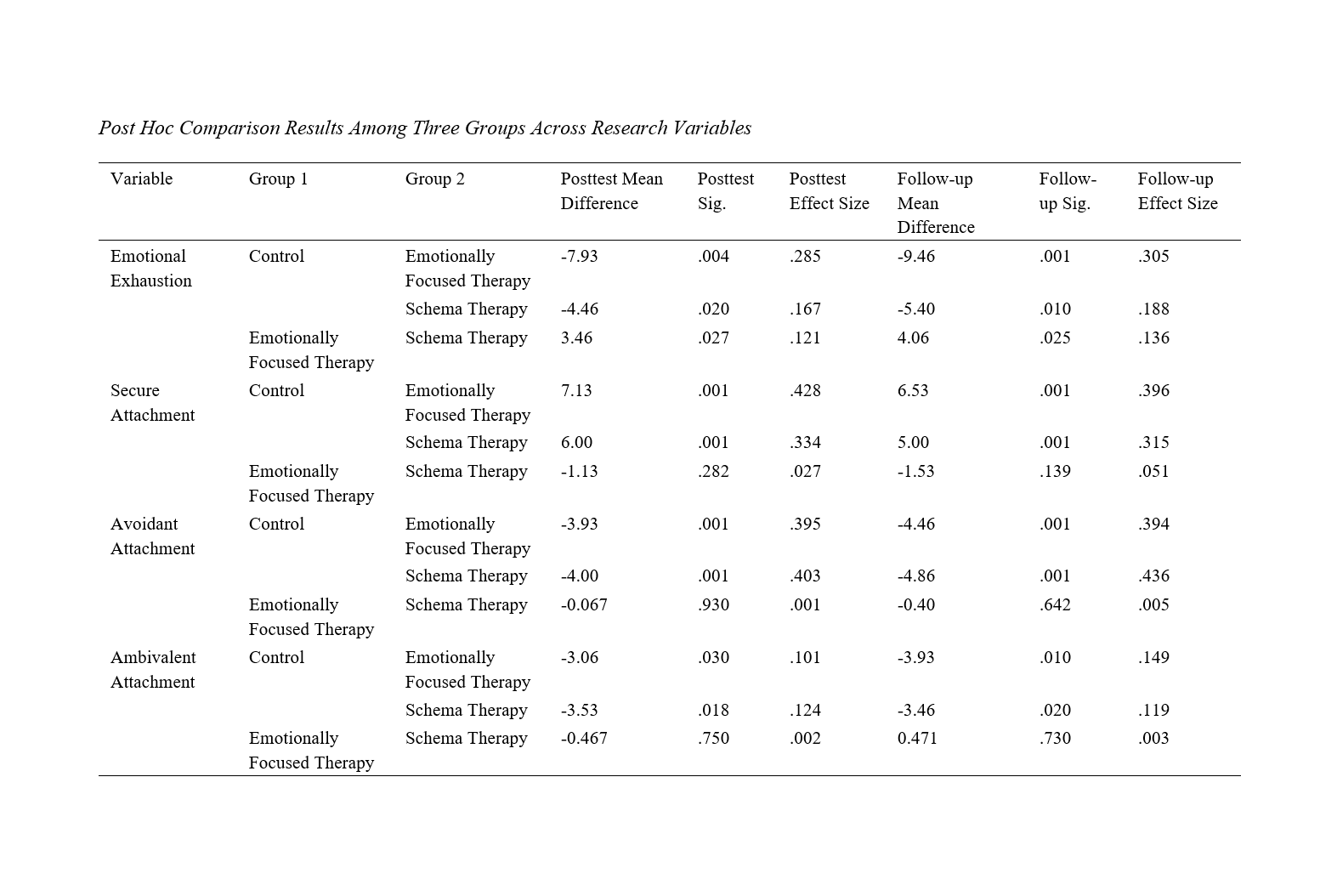
Findings: Repeated measures analysis indicated significant between-group differences for emotional exhaustion, secure attachment, avoidant attachment, and ambivalent attachment (p < .001). Significant main effects of time were observed across all variables (p < .001), demonstrating meaningful change across pretest, posttest, and follow-up stages. Significant time × group interaction effects confirmed differential change patterns among groups (p < .001). Post hoc comparisons showed that both EFCT and Schema Therapy significantly reduced emotional exhaustion and insecure attachment styles while increasing secure attachment compared with the control group at posttest and follow-up (p < .05). EFCT demonstrated significantly greater effectiveness than Schema Therapy only in reducing emotional exhaustion at posttest and follow-up (p < .05), whereas no significant differences were found between the two interventions in attachment style outcomes (p > .05).
Conclusion: Both Emotionally Focused Couple Therapy and Schema Therapy were effective interventions for reducing emotional exhaustion and improving attachment security among women experiencing marital conflict, with treatment effects maintained at follow-up; however, EFCT showed superior effectiveness in alleviating emotional exhaustion, suggesting its particular suitability for couples presenting with relational burnout and affective depletion.
Downloads
References
Abooee Mehrizi, M., Mousavi, S. F., & Bagheri, F. (2021). Comparison of Mindful Self-Care, Attachment Styles, and Relationship Maintenance Strategies in Married Individuals With and Without Marital Conflict. Quarterly Journal of Counseling and Psychotherapy Culture, 11(41), 181-210. https://qccpc.atu.ac.ir/article_10747.html?lang=en
Adlparvar, E., Safaei Rad, I., Erfani, N., & Jadidi, H. (2022). Modeling Marital Conflicts Based on Attachment Styles: The Mediating Role of Early Maladaptive Schema Domains in Women on the Verge of Divorce. medical journal of mashhad university of medical sciences, 65(1), 203-217. https://mjms.mums.ac.ir/article_20523.html
Akhavisamarin, Z., Ebrahimi, S., Shakeri, R., & Shokouhi Rad, M. (2022). Structural Equation Modeling of Academic Adjustment Based on Academic Self-Efficacy Mediated by Emotional Exhaustion in Students. Journal of Educational Psychology Studies, 19(45), 1-13. https://jeps.usb.ac.ir/article_6966.html
Alexandru, A. M. (2022). Attachment Styles, Alexithymia and Interpersonal Relationships. Studia Doctoralia, 13(1), 23-34. https://journals.unibuc.ro/index.php/sd/en/article/view/1303
Aleyasin, S. A., & Mahmoudi, S. (2024). The Effectiveness of Schema Therapy on Attachment Styles and Cognitive Emotion Regulation in Individuals with Dark Personality. Scientific Journal of Social Psychology, 11(67), 111-127. https://www.magiran.com/paper/2608044/?lang=en
Arens, A. K., & Morin, A. J. (2016). Relations between teachers' emotional exhaustion and students' educational outcomes. Journal of Educational Psychology, 108(6), 800. https://doi.org/10.1037/edu0000105
Arntz, A., Jacob, G. A., Lee, C. W., Brand-de Wilde, O. M., Fassbinder, E., Harper, R. P., Lavender, A., Lockwood, G., Malogiannis, I. A., Ruths, F. A., Schweiger, U., Shaw, I. A., Zarbock, G., & Farrell, J. M. (2022). Effectiveness of Predominantly Group Schema Therapy and Combined Individual and Group Schema Therapy for Borderline Personality Disorder: A Randomized Clinical Trial. JAMA Psychiatry, 79(4), 287-299. https://doi.org/10.1001/jamapsychiatry.2022.0010
Bernstein, D. P., van Wijk-Herbrink, M. F., & Kersten, T. (2022). Forensic Schema Therapy and SafePath: Individual- and Milieu-Therapy Approaches for Complex Personality Disorders and Externalizing Behavior Problems. In Clinical Forensic Psychology (pp. 587-608). Palgrave Macmillan. https://doi.org/10.1007/978-3-030-80882-2_30
Bosmans, G., Braet, C., & Van Vlierberghe, L. (2010). Attachment and symptoms of psychopathology: Early maladaptive schemas as a cognitive link? Clinical Psychology & Psychotherapy, 17(5), 374-385. https://doi.org/10.1002/cpp.667
Bowlby, J. (1973). Attachment and loss: Separation (Vol. 2). Basic Books. https://books.google.com/books/about/Separation.html?id=CoKpgqpF78QC&source=kp_book_description
Burgess Moser, M., Johnson, S. M., Dalgleish, T. L., Lafontaine, M. F., Wiebe, S. A., & Tasca, G. A. (2016). Changes in Relationship-Specific Attachment in Emotionally Focused Couple Therapy. Journal of marital and family therapy, 42(2), 231-245. https://doi.org/10.1111/jmft.12139
Chen, H., Richard, O. C., Boncoeur, O. D., & Ford Jr, D. L. (2020). Work engagement, emotional exhaustion, and counterproductive work behavior. Journal of Business Research, 114, 30-41. https://doi.org/10.1016/j.jbusres.2020.03.025
Chen, K. Y., Chang, C. W., & Wang, C. H. (2019). Frontline employees' passion and emotional exhaustion: The mediating role of emotional labor strategies. International Journal of Hospitality Management, 76, 163-172. https://doi.org/10.1016/j.ijhm.2018.05.006
Cheraghi Seifabad, N., Ehteshamzadeh, P., Asgari, P., & Joharifard, R. (2021). Comparison of the Effectiveness of Mode-Deactivation Schema Therapy and Emotion-Focused Couple Therapy on Increasing Secure Attachment Style and Reducing Avoidant and Ambivalent Attachment Styles in Couples with Marital Conflict. Applied Counseling, 10(2), 73-98. https://jac.scu.ac.ir/article_16559.html?lang=en
Collins, N., Clark, C. L., & Shaver, P. R. (1996). Attachment styles and internal working models of self and relationship partners. In Knowledge structures in close relationships: A social psychological approach (pp. 25). https://www.taylorfrancis.com/chapters/edit/10.4324/9781315806631-3/attachment-styles-internal-working-models-self-relationship-partners-phillip-shaver-nancy-collins-catherine-clark
Davarnia, R., Zahrakar, K., Moayeri, N., & Shakrami, M. (2015). Investigating the Efficacy of Group Emotionally Focused Couple Therapy in Reducing Women's Marital Burnout. Journal of Medical Sciences of Islamic Azad University, Tehran Medical Branch, 25(2), 132-140. https://www.magiran.com/paper/1412649/assessing-the-performance-of-emotionally-focused-group-couples-therapy-efct-on-reducing-couple-burnout-in-women?lang=en
Dinmohaamadpour, M., Tavanaei, S., Kabiri, E., Hajiyousefi, E., Beki Ardekani, E., & Mohebian, M. (2024). The Effectiveness of Systemic Family Therapy on Marital Conflicts and Marital Burnout of Couples. Iranian Evolutionary Educational Psychology Journal, 6(2), 157-169. https://www.magiran.com/paper/2729188/the-effectiveness-of-systemic-family-therapy-on-marital-conflicts-and-marital-burnout-of-couples?lang=en
Dong, S., Dong, Q., & Chen, H. (2022). Mothers' parenting stress, depression, marital conflict, and marital satisfaction: The moderating effect of fathers' empathy tendency. Journal of affective disorders, 299, 682-690. https://doi.org/10.1016/j.jad.2021.12.079
Fathi, A., Alipour, A., & Malekirad, A. A. (2024). Comparison of the Effectiveness of Emotionally Focused Couple Therapy and Gottman Couple Therapy on Marital Burnout and Depression in Infertile Couples. Journal of Arak University of Medical Sciences, 26(2), 35-44. https://www.google.com/url?sa=t&source=web&rct=j&opi=89978449&url=https://www.sid.ir/fileserver/jf/146-283134-x-1168237.pdf&ved=2ahUKEwjXmrH72e-SAxWlU6QEHeyDOPAQFnoECBsQAQ&usg=AOvVaw2S5ZIixd6aOG-qg38Pq76Z
Ferreira, A. I., da Costa Ferreira, P., Cooper, C. L., & Oliveira, D. (2019). How daily negative affect and emotional exhaustion correlates with work engagement and presenteeism-constrained productivity. International Journal of Stress Management, 26(3), 261. https://doi.org/10.1037/str0000114
Ghafourian Mohebi, F., Alivandi Vafa, M., Rasouli, R., & Ramezani, M. A. (2025). Comparison of the Effectiveness of Emotion-Focused Therapy in Both Couple and Individual Formats on Experiences in Close Relationships-Relationship Structure (Attachment Security) of Couples with Extramarital Affairs. Clinical Psychology and Personality. https://cpap.shahed.ac.ir/article_4834.html?lang=en
Ghaznavi Khezrabadi, F., & Niknam, M. (2019). The Effectiveness of Emotionally Focused Couple Therapy on Attachment Style and Sexual Satisfaction of Couples. Journal of Birjand University of Medical Sciences, 26(3), 213-225. https://doi.org/10.32592/JBirjandUnivMedSci.2019.26.3.103
Greenberg, J. A., & Goldman, R. H. (2013). Barbed suture: A review of the technology and clinical uses in obstetrics and gynecology. Reviews in Obstetrics and Gynecology, 6(3-4), 107-115. https://pubmed.ncbi.nlm.nih.gov/24920976/
Hashemizadeh, F. S., Atashpour, S. H., & Farhadi, H. (2025). Comparison of the Effectiveness of Paradox Therapy with Scheduling and Matrix of Acceptance and Commitment Therapy on Family Adaptability and Mental Well-being of Women with Couple Conflicts. Journal of Cognitive Psychology and Psychiatry, 11(6), 106-122. https://doi.org/10.32598/shenakht.11.6.106
Hawke, L. D., & Provencher, M. D. (2011). Schema theory and schema therapy in mood and anxiety disorders: A review. Journal of Cognitive Psychotherapy, 25(4), 257-276. https://doi.org/10.1891/0889-8391.25.4.257
Hazan, C., & Shaver, P. (1987). Romantic love conceptualized as an attachment process. Journal of personality and social psychology, 52(3), 511. https://doi.org/10.1037/0022-3514.52.3.511
Jackson, J. B., Carrese, D. H., & Willoughby, B. J. (2023). The indirect effects of financial conflict on economic strain and marital outcomes among remarried couples. International Journal of Stress Management, 30(1), 69-83. https://doi.org/10.1037/str0000277
Johnson, S. M. (2009). Attachment theory and emotionally focused therapy for individuals and couples: Perfect partners. In Attachment theory and research in clinical work with adults (pp. 410-433). The Guilford Press. https://psycnet.apa.org/record/2009-02347-016
Johnson, S. M., Bradley, B., Furrow, J., Lee, A., Palmer, G., Tilley, D., & Woolley, S. (2005). Becoming an emotionally focused couple therapist: The workbook. Brunner/Routledge. https://books.google.com/books/about/Becoming_an_Emotionally_Focused_Couple_T.html?id=R0euzBbO8MMC
Johnson, S. M., & Greenman, P. S. (2006). The path to a secure bond: Emotionally focused couple therapy. Journal of Clinical Psychology, 62(5), 597-609. https://doi.org/10.1002/jclp.20251
Jonge, J. D. (1995). Job autonomy, well-being, and health: A study among Dutch health care workers https://cris.maastrichtuniversity.nl/en/publications/job-autonomy-well-being-and-health-a-study-among-dutch-health-car/
Liu, D., & Vazsonyi, A. T. (2024). Longitudinal Links Between Parental Emotional Distress and Adolescent Delinquency: The Role of Marital Conflict and Parent-Child Conflict. Journal of youth and adolescence, 53(1), 200-216. https://doi.org/10.1007/s10964-023-01921-4
Mahboubi Joghan, M., Asgari, R., Eghbali, K., & Aflatoun, S. (2021). Investigating the State of Emotional Exhaustion and Social Phobia Caused by the COVID-19 Outbreak Among Professional Athletes (Case Study: Track and Field). Sport Psychology Studies, 9(32), 267-282. https://spsyj.ssrc.ac.ir/article_2167_en.html
Maya, J., Fuentes, I., Arcos-Romero, A. I., & Jiménez, L. (2024). Parental Attachment and Psychosocial Adjustment in Adolescents Exposed to Marital Conflict. Children, 11(3), 291-299. https://doi.org/10.3390/children11030291
Mehdi Gholi, M. R., Doukaneifard, F., & Jahangir, P. (2024). The Effectiveness of Emotionally Focused Couple Therapy on Marital Burnout and Resilience in Young Couples. Journal of Applied Family Therapy, 4(2), 47-59. https://doi.org/10.61838/kman.aftj.4.2.3
Mirarab Razi, R., Azizi Shamami, M., & Gerayli, F. (2019). Investigating the Relationship between Classroom Management Knowledge and Emotional Exhaustion with the Moderating Role of Creativity. Research in Teaching, 7(3), 141-157. https://trj.uok.ac.ir/article_61198.html?lang=en
Mohammadi, M., Shiafkan Kopkan, A., Shafiabadi, A., & Farhangi, A. (2024). The Effectiveness of Schema Therapy on Attachment Styles and Marital Intimacy of Couples in Tehran. Woman and family studies. https://www.magiran.com/paper/2780101/the-effectiveness-of-schema-therapy-on-attachment-styles-and-marital-intimacy-of-couples-in-tehran-city?lang=en
Nisanci, Z., & Nisanci, A. (2023). Between-reporter agreement among couples: exploring nonlinear patterns in marital conflict. Journal of interpersonal violence, 38(1-2), 16-36. https://doi.org/10.1177/08862605221118963
Nouri, N., & Iranmanesh, S. I. (2022). The Effectiveness of "Hold Me Tight" Emotionally Focused Couple Therapy on Attachment Styles, Marital Adjustment, and Sexual Intimacy of Couples. Quarterly Journal of Applied Psychological Research, 13(1), 363-387. https://japr.ut.ac.ir/article_87638.html?lang=en
Peluso, P. R. (2007). Infidelity: A practitioner's guide to working with couples in crisis. Routledge. https://books.google.com/books/about/Infidelity.html?hl=sk&id=57OTAgAAQBAJ
Qiu, S., Hannigan, B., Keogh, D., & Timulak, L. (2020). Learning emotion-focused therapy: certified emotion-focused therapists' perspectives. Person-Centered & Experiential Psychotherapies, 1-21. https://doi.org/10.1080/14779757.2020.1717989
Roelofs, J., Lee, C. W., Ruijten, T., & Lobbestael, J. (2011). The mediating role of early maladaptive schemas in the relation between quality of attachment relationships and symptoms of depression in adolescents. Behavioural and Cognitive Psychotherapy, 39(4), 471-479. https://doi.org/10.1017/S1352465811000117
Safaeian, M., Kakavand, A., Bahrami Hidaji, M., Mohammadi Shir Mahalleh, F., & Ranjbari Pour, T. (2022). The Effectiveness of Schema Therapy on Referential Thinking and Emotional Exhaustion in Female Nurses. Rooyesh-e-Ravanshenasi Journal, 11(11), 115-124. https://www.magiran.com/paper/2545088/the-effectiveness-of-schema-therapy-on-referential-thinking-and-emotional-exhaustion-in-female-nurses?lang=en
Shaver, P., Hazan, C., & Bradshaw, D. (1988). Love as attachment: The integration of three behavioral systems. In The Psychology of Love (pp. 68-99).
Straarup, N. S., Renneberg, H. B., Farrell, J., & Younan, R. (2022). Group schema therapy for patients with severe anxiety disorders. Journal of Clinical Psychology. https://doi.org/10.1002/jclp.23351
Tanbakouchian, R., Zanganeh Motlagh, F., & Bayat, M. R. (2021). Comparison of the Effectiveness of Emotion-Focused Approach and Group Schema Therapy on Attachment Styles of Women Suffering from Marital Boredom. Woman's Cultural Psychology, 12(45), 61-73. https://sanad.iau.ir/en/Article/920418
Tilden, T., & Dattilio, F. (2005). Vulnerability schemas of individuals in couples' relationships: A cognitive perspective. Contemporary Family Therapy: An International Journal, 27(2), 139-162. https://doi.org/10.1007/s10591-005-4036-4
Timulak, L., & Keogh, D. (2020). Emotion-focused therapy: A transdiagnostic formulation. Journal of Contemporary Psychotherapy, 50(1), 1-13. https://doi.org/10.1007/s10879-019-09426-7
Wang, P., Gan, X., Li, H., & Jin, X. (2023). Parental marital conflict and internet gaming disorder among Chinese adolescents: The multiple mediating roles of deviant peer affiliation and teacher-student relationship. PLoS One, 18(1), e0280302. https://doi.org/10.1371/journal.pone.0280302
Young, J. E. K. J. S., & Weishaar, M. E. (2003). Schema therapy: A practical guide for clinicians. Arjmand Publications. https://books.google.com/books/about/Schema_Therapy.html?id=1x7TDwAAQBAJ
Downloads
Additional Files
Publication Timeline
- Submitted
- Revised
- Accepted