Comparison of the Effectiveness of Acceptance and Commitment Therapy and Choice Theory-Based Therapy on Post-Traumatic Growth in Divorced Women with Divorce Grief
Keywords:
Acceptance and Commitment Therapy, Choice Theory, Post-Traumatic Growth, Divorce Grief, Divorced WomenAbstract
Objective: The objective of this study was to compare the effectiveness of Acceptance and Commitment Therapy (ACT) and Choice Theory-Based Therapy (CTBT) on post-traumatic growth in divorced women experiencing divorce grief.
Methods and Materials: This research utilized a quasi-experimental, pre-test-post-test design with a control group and a two-month follow-up period. The statistical population consisted of divorced women experiencing divorce grief. A sample of participants was selected through purposive sampling and randomly assigned to three equal groups: ACT ( ), CTBT ( ), and a control group ( ). The experimental groups participated in weekly, two-hour intervention sessions based on their respective protocols, while the control group received no intervention. The primary data collection tool was the Post-Traumatic Growth Inventory (PTGI). Data analysis was conducted using SPSS software, employing descriptive statistics, repeated measures ANOVA, and Bonferroni post-hoc tests.
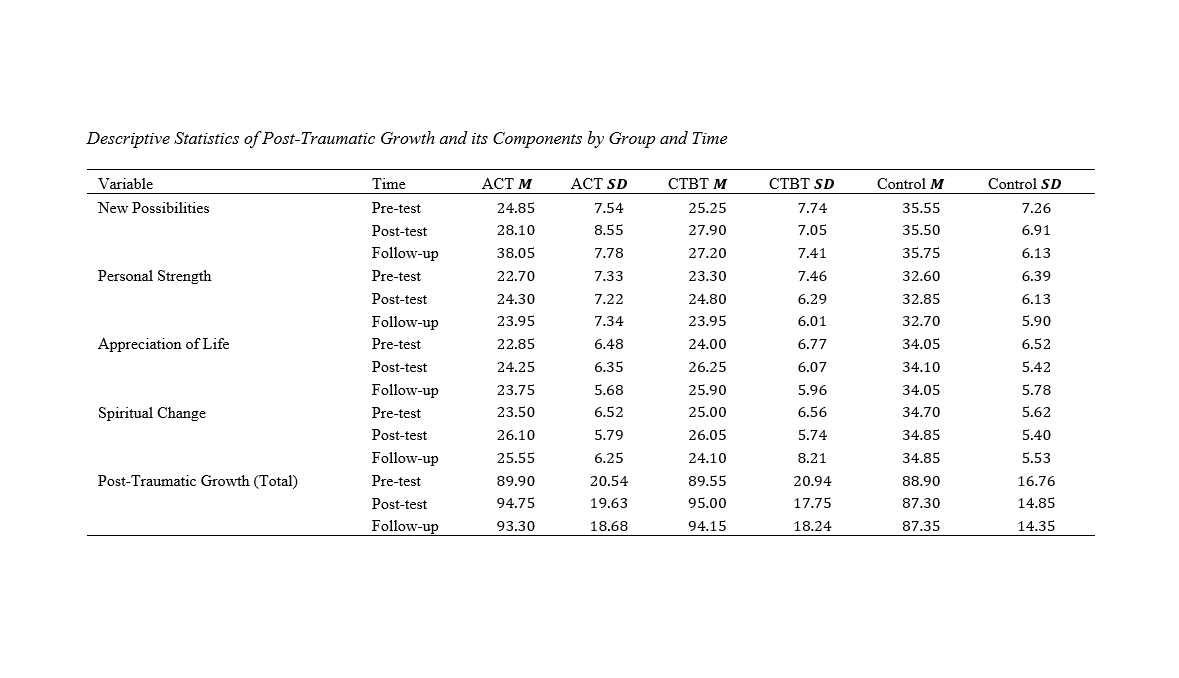
Findings: The results demonstrated a significant main effect for Time ( , ) regarding total post-traumatic growth. However, the main effect for Group ( ) and the Time Group interaction effect ( ) were not statistically significant for the total score. Bonferroni post-hoc analyses indicated no significant differences between the ACT and CTBT groups concerning total PTG at the post-test ( ) or the follow-up ( ) stages, though both were significantly higher than the control group. The only significant difference between the two active interventions emerged in the Spiritual Change sub-component at the follow-up stage, where the ACT group ( ) scored significantly higher than the CTBT group ( , ).
Conclusion: Both Acceptance and Commitment Therapy and Choice Theory-Based Therapy are highly and equally effective interventions for promoting overall post-traumatic growth in divorced women dealing with divorce grief. While both can be confidently utilized in clinical settings, ACT may offer a specific advantage in facilitating sustained spiritual change over time.
Downloads
References
Abron, E., Azizi, L. S., & Khajavand Khoshli, A. (2024). Comparative Study of the Effectiveness of Reality Therapy and Acceptance and Commitment Therapy on the Loneliness of Adolescents. Journal of Psychological Sciences, 23(142), 135-150. https://doi.org/10.61186/jps.23.142.135
Ansari, Z., Atashafrouz, A., & Behroozi, N. (2025). Comparing the Effectiveness of Resilience Training and Acceptance and Commitment Group Training on Quality of Life in Students from Divorced Families, Controlling for Age at Divorce and Time Since Divorce. Applied Family Therapy Journal, 6(4), 1-11. https://journals.kmanpub.com/index.php/aftj/article/view/4084?articlesBySameAuthorPage=33
Bani Hashemi, S., Hatami, M., Hasani, J., & sahebi, a. (2020). Comparing Effectiveness of the Cognitive-behavioral Therapy, Reality Therapy, and Acceptance and Commitment Therapy on Quality of Life, General Health, and Coping Strategies of Chronic Patient’s Caregivers. Journal of Clinical Psychology, 12(1), 63-76. https://doi.org/10.22075/jcp.2020.18992.1757
Behzadi, S., Tajeri, B., Soodagar, S., & Shariati, Z. (2021). Comparing the Effectiveness of Acceptance and Commitment Therapy and Reality Therapy on Life Satisfaction and Self-Care Behaviors in Elderly with Type 1 Diabetes. Applied Family Therapy Journal, 4(8), 483-501. https://doi.org/10.61838/kman.aftj.2.4.24
Borhani, F. S., Chin-Aveh, M., & Fereydouni, S. (2010). The effectiveness of combining commitment and acceptance-based group counseling with reality therapy on cognitive emotion regulation strategies and self-efficacy in infertile women. Iranian Journal of Nursing Research, 15(6), 75-85. https://ijnr.ir/article-1-2541-fa.html
Ezzatpanah, F., & Latifi, Z. (2019). The effectiveness of acceptance, commitment, and compassion-based training on pain catastrophizing, distress tolerance, and post-traumatic growth in patients with fibromyalgia syndrome. Health Psychology(32), 127-142. https://civilica.com/doc/1906146/
Hadian, S., Havasi soomar, N., Hosseinzadeh Taghvaei, M., Ebrahimi, M. I., & Ranjbaripour, T. (2023). Comparing the effectiveness of acceptance and commitment therapy and reality therapy on the responsibility and self-efficacy of divorced women [Research]. Advances in Cognitive Sciences, 25(3), 47-63. https://doi.org/10.30514/icss.25.3.47
Haghighat-Bayan, N., Nasiri, S., Malkian, M., Mousavi, S. M., & Jafari, S. (2022). Comparison of the Effectiveness of Emotion-Focused Therapy and Acceptance and Commitment Therapy on PTSD Symptoms and Post-Traumatic Growth in Individuals with PTSD in Tehran. Mashhad University of Medical Sciences Journal, 65(6). https://doi.org/10.22038/mjms.2023.23422
Haji Karam, A., Ghammari, M., & Amiri Majd, M. (2019). Comparing the effectiveness of group therapy based on acceptance and commitment therapy and reality therapy on work-family conflict and psychological well-being of employed married women with lasting effects. Scientific Journal of Kurdistan University of Medical Sciences, 24, 20-33. https://doi.org/10.29252/sjku.24.3.20
Jaafary, A., aghdam, G. F., & pouyamanesh, j. (2022). Comparison of the effectiveness of approaches based on acceptance and commitment therapy (ACT) and reality therapy on irrational thoughts of female supervisors under the auspices of the Relief Committee. Women and Family Studies, 55(15), 135-152. https://doi.org/10.30495/jwsf.2021.1933872.1586
Kazemipour, A., Mirderikvand, F., & Amraei, K. (2021). Effectiveness of Acceptance and Commitment Therapy on the Acceptance and Post-Traumatic Growth in Colorectal Cancer Patients Comorbid with Stress. Research-in-Medicine, 45(3), 38-43. http://pejouhesh.sbmu.ac.ir/article-1-2518-en.html
Nikoukar, Y., Jafari, A., Fathi-Aghdam, G., & Pouyamanesh, J. (2022). Comparison of the Effectiveness of Acceptance and Commitment Therapy (ACT) and Reality Therapy on Irrational Beliefs of Female Heads of Households Under the Welfare Organization. Women and Family Studies Quarterly, 15(55). https://www.sid.ir/paper/406120/fa
Ragheni, U., & Soltanzadeh, F. (2023). The Effectiveness of Acceptance and Commitment Therapy on Dysfunctional Attitudes of Discordant Couples The Effectiveness of Group Reality Therapy on Self-Efficacy Beliefs, Happiness, and Reducing Marital Conflicts in Married Women. Eighteenth International Conference on Psychology, Counseling, and Educational Sciences,
Sedghi, M., Ghaffari, O., Kazemi, R., & Narimani, M. (2019). Comparison of the effectiveness of couple therapy methods in the theory of Choice, acceptance and commitment (ACT), and integrative couple therapy in marital commitment of couples. Journal of Psychological Science, 18(81), 1069-1080. https://psychologicalscience.ir/article-1-336-en.html
Sepas, L., Shaker Dolaq, A., & Khademi, A. (2022). Comparing the effectiveness of Acceptance and Commitment Therapy and Reality Therapy on reducing anxiety sensitivity in women with Multiple Sclerosis (MS). Counseling and Psychotherapy Culture, 13(51), 85-113. https://qccpc.atu.ac.ir/article_14119.html?lang=en
Shahsavari, F., ansary, m., & elmimanesh, N. (2025). The Effectiveness of Reality Therapy on the Life Adjustment after Divorce and Meaning of Life in Divorced Heads of Household Women in Isfahan City. Knowledge & Research in Applied Psychology, 98(25), 175-190. https://doi.org/10.30486/jsrp.2023.1978995.3673
Zahed, H., Namazi, M., & Arab, N. (2025). Comparing the Effectiveness of Reality Therapy and Emotion-Focused Therapy on Irrational Beliefs and Marital Perfectionism in Women Experiencing Emotional Divorce. Journal of New Psychological Research, 20(77), 195-207. https://journals.tabrizu.ac.ir/article_19419.html?lang=en
Zakariazadeh Khatir, Z. K., Kazem Fakhri, M., & Haydari, S. (2022). The effectiveness of reality therapy on covert communication aggression and marital tension among women seeking divorce. Journal of Adolescent and Youth Psychological Studies (JAYPS), 3(1), 184-193. https://doi.org/10.61838/kman.jayps.3.1.15
Zamani Foroushani, Z., & Dokaneifard, F. (2017). Comparing the effectiveness of acceptance and commitment therapy and reality therapy on mental health and psychological well-being of women visiting Ashtiani neighborhood center. Third Conference on Knowledge and Technology of Educational Sciences, Social Studies and Psychology of Iran,
Zandi, A., Dinpanah-Khoshdarehgi, H., Ebrahim-Madahi, M., & Jamehri, F. (2023). Comparison of the effect of acceptance and commitment therapy and reality therapy on the self-care of diabetes type II patients. J Educ Health Promot, 12, 364. https://doi.org/10.4103/jehp.jehp_1174_22
Downloads
Additional Files
Publication Timeline
- Submitted
- Revised
- Accepted