Machine-Learning Identification of Family Adaptation Patterns During Economic Stress Based on Coping Strategies and Couple Communication
DOI:
https://doi.org/10.61838/kman.aftj.5213Keywords:
Family Adaptation, Economic Stress, Coping Strategies, Couple CommunicationAbstract
Objective: This study aimed to identify distinct family adaptation patterns during economic stress by applying unsupervised machine-learning to the interplay of coping strategies and couple communication behaviors.
Methods and Materials: A quantitative, cross-sectional design was employed with married couples from Malaysia experiencing varying degrees of economic stress. Data were collected via self-report instruments measuring perceived economic pressure, coping mechanisms (problem-focused, emotion-focused, and avoidant), and couple communication patterns (constructive and demand-withdraw). An unsupervised K-Means clustering algorithm was applied to the multidimensional data to segment the couples into naturally occurring adaptation profiles, followed by post-hoc statistical analyses to evaluate the characteristics of each profile and their associations with objective socio-economic factors.
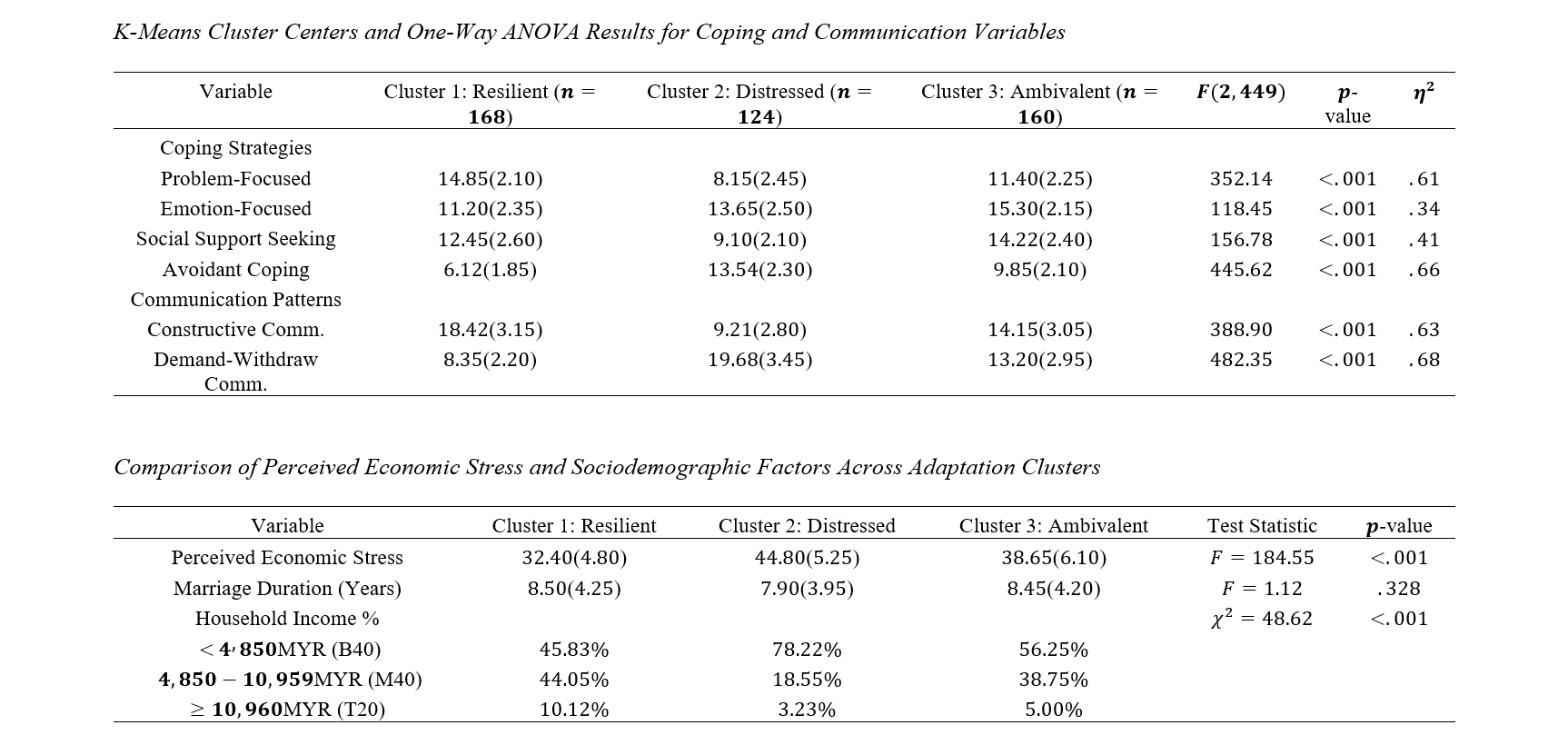
Findings: The K-Means clustering analysis ( ) successfully delineated three distinct family adaptation patterns. Cluster , the “Resilient-Constructive Adapters” ( , ), exhibited high problem-focused coping and constructive communication, reporting the lowest perceived economic stress ( , ). Cluster , the “Distressed-Avoidant Adapters” ( , ), was characterized by heavy reliance on avoidant coping and demand-withdraw communication, experiencing the highest levels of economic stress ( , ) and showing a disproportionate representation from the lowest income bracket ( ). Cluster , the “Ambivalent-Emotion-Focused Adapters” ( , ), displayed moderate communication quality with a high reliance on emotion-focused coping and social support seeking, reporting moderate economic stress ( , ). A statistically significant association was found between cluster membership and objective household income ( , ).
Conclusion: Unsupervised machine-learning successfully revealed that families navigate financial hardship through interconnected behavioral typologies, highlighting the necessity for tailored interventions that address both objective financial realities and dyadic relationship dynamics to foster resilience.
Downloads
References
Ahmadi, E., Ghasempour, M., & Shalchi, B. (2024). The Relationship between Family Functioning, Quality of Interpersonal Relationships, and Family Socio-economic Status with Adolescent Aggression. Quarterly Journal Of Family and Research, 21(3), 43-60. http://qjfr.ir/article-1-2556-en.html
Arami, H., Shafie Abadi, A., & Zahrakar, K. (2023). Qualitative Study to Identify Preventive Components of Family Collapse. Journal of Applied Family Therapy, 4(1), 312-339. https://doi.org/10.22034/aftj.2023.340575.1559
Asadi, K., Yousefi, Z., & Parsakia, K. (2024). The Role of Family in Managing Financial Stress and Economic Hardship. Journal of Psychosociological Research in Family and Culture, 2(3), 11-19. https://doi.org/10.61838/kman.jprfc.2.3.3
Fakhari, M., Rashidpour, A., & Korang Beheshti, S. (2023). Designing an Effective Economic Family Model with a Cultural Approach. Iranian-Islamic Family Studies Quarterly, 3(3), 17-32.
Fanta, A., Kim, S. E., Huang, C. J., Tsai, W., & Huang, C. Y. (2025). Economic Stress and Child Outcomes: The Family Stress Model Among Asian American Families During COVID-19. Frontiers in psychology, 16. https://doi.org/10.3389/fpsyg.2025.1591730
Finch, J. E., Kuo, P. X., & Akhavein, K. (2025). Economic Hardship and Children’s Cognitive Outcomes During COVID-19: The Family Stress Model and the Compensatory Role of Family Cohesion. Journal of Family Psychology. https://doi.org/10.1037/fam0001348
Gunawan, I. l. F. N. A., & Krisnatuti, D. (2022). The Relationship Between Economic Pressure, Husband-Wife Interaction, and Husband’s Marital Satisfaction. Journal of Child Family and Consumer Studies, 1(3), 175-184. https://doi.org/10.29244/jcfcs.1.3.175-184
Hosseini, S. A., Goltash, A., Ranjbar, M., & Mohammadjani, S. (2023). Designing and Validating the Family Economics Curriculum for Upper Secondary Education in Iran. Islamic Lifestyle Journal with a Focus on Health, 7(1). https://www.sid.ir/fileserver/jf/3008114020118.pdf
Juhaidi, A., Fitria, A., Hidayati, N., & Fadillah, R. (2024). First-Generation Scholar in Indonesian Indigenous Family Tribe: Economic, Social, and Cultural Capital. International Journal of Evaluation and Research in Education (Ijere), 13(3), 1545. https://doi.org/10.11591/ijere.v13i3.27448
Khori, A., Nurhayati, W., Arinindyah, O., Zawirrahmi, Z., & Shofiyullah, S. (2025). Implementing a Family Education Curriculum to Enhance Parental Roles in Character-Based Parenting: A Case Study at SMP Bisnis Aya Sophia Islamic School. Indonesian Journal of Management and Economic Research, 2(01), 113-120. https://doi.org/10.70508/mhcqe631
Lam, C. B., Lam, A., Li, X., & Chung, K. K. H. (2025). Mindful Parenting Mediates the Association of Family Economic Pressure With Child Adjustment: A Longitudinal Study. Journal of Family Psychology, 39(4), 515-525. https://doi.org/10.1037/fam0001337
Lee, J., Yoo, J., Chin, M., Son, S., Sung, M., & Chang, Y. E. (2022). Pathways From Economic Hardship to Couple Conflict by Socioeconomic Status During COVID‐19 in Korea. Family Relations, 72(1), 60-76. https://doi.org/10.1111/fare.12771
Lee, J. Y., Lee, S. J., Oh, S., Xu, A. J., Radney, A., & Rodriguez, C. M. (2024). Family Stress Processes Underlying COVID‐19–Related Economic Insecurity for Mothers and Fathers and Children's Internalizing Behaviour Problems. Child & Family Social Work, 30(3), 510-523. https://doi.org/10.1111/cfs.13188
Mohammad Ali, E., Nireh, Aghaei Bejestani, M., & Emam, S. M. (2022). Women's Employment in Family Economics from the Perspective of Jurisprudence and Subjective Law. Islamic Economic Jurisprudence Quarterly, 4(2), 41-60.
Nigam, R. (2023). Economic and Social Analysis of Family Institutions in the West. Journal of Family Law.
Oftedal, A., Larsen, L., & Helland, M. S. (2025). Economic Hardship During the Covid‐19 Pandemic and Trajectories of Parent–Child Relationships: A Prospective Longitudinal Study Among Norwegian Families. Family Process, 64(2). https://doi.org/10.1111/famp.70031
Qiu, Y. T., & Ye, P. (2023). The Influence of Family Socio-Economic Status on Learning Engagement of College Students Majoring in Preschool Education: The Mediating Role of Parental Autonomy Support and the Moderating Effect of Psychological Capital. Frontiers in psychology, 13. https://doi.org/10.3389/fpsyg.2022.1081608
Shi, Z. (2024). Research on the Relationship Between Family Economic Capital and Students Psychological Development. Communications in Humanities Research, 64(1), 1-5. https://doi.org/10.54254/2753-7064/2024.18274
Svyntozelska, O. (2023). Socio-Economic and Demographic Factors Influencing Interpersonal Communication Between Patients and Family Physicians: A Protocol for a Systematic Review. https://doi.org/10.1101/2023.09.18.23295671
Wilkinson, L., Shifrer, D., & Pearson, J. (2024). Family Socioeconomic Status in Adolescence and Gender Identification in Emerging Adulthood. Sociological Perspectives, 67(4-6), 314-337. https://doi.org/10.1177/07311214241283128
Wu, Z., Chen, Y., & Wang, P. (2023). Family Economic Status, Resilience, and Subjective Well-Being of Parents Whose Children Have Autism Spectrum Disorder. Social Behavior and Personality an International Journal, 51(3), 40-48. https://doi.org/10.2224/sbp.12115
Xiang, J., Wu, J., Lian, C., & Lin, X. (2025). The Effects of Home Quarantine Duration, Parental Emotional Intelligence, and Family Socioeconomic Status on Children’s Anxiety During the Pandemic: A Survey of 29,550 Parents. Psychology research and behavior management, Volume 18, 953-964. https://doi.org/10.2147/prbm.s522988
Yang, J., Li, W., Dong, W., Gao, L., & Wang, X. (2023). The Moderating Roles of Peer Pressure and Family Economic Stress in the Longitudinal Links Between Adolescent Trait Anger and Cyberbullying Perpetration. School Psychology, 38(2), 79-87. https://doi.org/10.1037/spq0000514
Yu, M. (2024). The Relation Between Family Socioeconomic Status and Academic Performance in Chinese Adolescents. Tssehr, 8, 22-33. https://doi.org/10.62051/jh2c9886
Yuan, H., Yan, Z., Yue, Y., Zhao, Y., & Lei, J. (2025). The Relationship Between Family Socio‐Economic Status and Preschool Children Parents' Parenting Sense of Competence: The Chain Mediating Role of Social Support and Psychological Capital. Child & Family Social Work. https://doi.org/10.1111/cfs.13263
Downloads
Additional Files
Publication Timeline
- Submitted
- Revised
- Accepted