Using Deep Learning to Classify Family Functioning Profiles Based on Parental Attachment, Emotion Socialization, and Child Behavioral Outcomes
DOI:
https://doi.org/10.61838/kman.aftj.5215Keywords:
Family Functioning, Parental Attachment, Emotion Socialization, Child Behavioral OutcomesAbstract
Objective: The objective of this study was to identify distinct family functioning typologies based on parental attachment, emotion socialization practices, and child behavioral outcomes, and to subsequently develop a deep learning model for the accurate automated classification of these profiles.
Methods and Materials: This study utilized a cross-sectional design involving two-parent families from Greece. Data were collected using secure online self-report questionnaires, including the Experiences in Close Relationships-Revised for parental attachment, the Coping with Children’s Negative Emotions Scale for parental emotion socialization, and the Strengths and Difficulties Questionnaire for child behavioral outcomes. Data analysis proceeded in two phases: first, Latent Profile Analysis (LPA) was utilized to identify unobserved family profiles. Second, a Multi-Layer Perceptron (MLP) deep learning model was developed to classify families into these established profiles. The dataset was partitioned into training ( ), validation ( ), and testing ( ) segments to evaluate the model’s predictive performance.
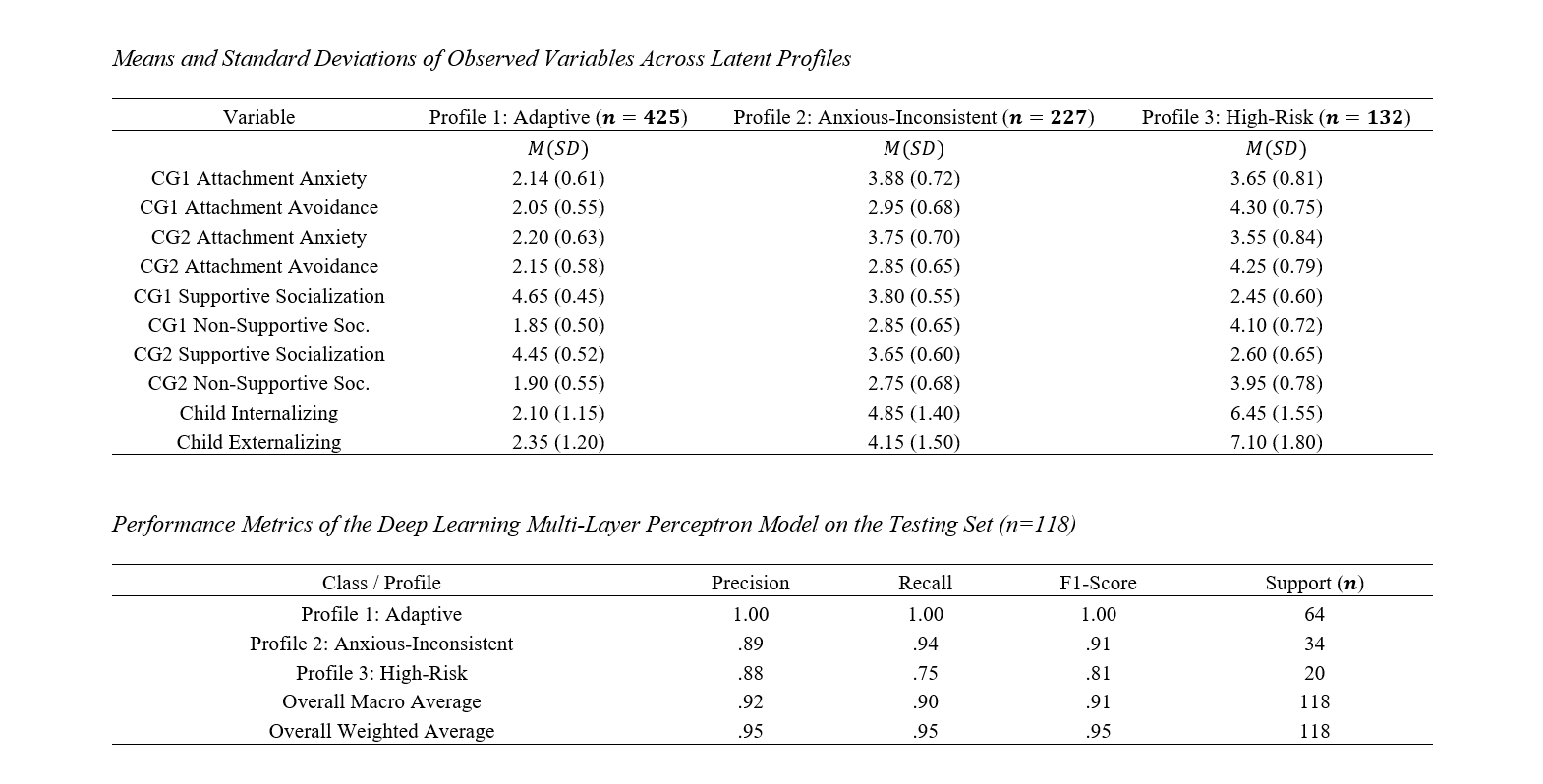
Findings: Latent Profile Analysis successfully identified three distinct family functioning profiles: Adaptive Family Functioning ( , ), Anxious-Inconsistent Functioning ( , ), and High-Risk/Avoidant-Punitive Functioning ( , ). The trained Multi-Layer Perceptron deep learning model demonstrated exceptional classification capabilities, achieving an overall accuracy of on the unseen test set. The model yielded high F1-scores for each respective class: for the Adaptive profile, for the Anxious-Inconsistent profile, and for the High-Risk profile, with the few misclassifications occurring primarily between the Anxious-Inconsistent and High-Risk groups.
Conclusion: The robust identification of multidimensional family profiles and their highly accurate classification via an artificial neural network provides a powerful, innovative methodological framework to enhance targeted clinical assessments and tailor psychological interventions.
Downloads
References
Alexander, K. (2025). Managing the Challenges of Adolescence Through Improved Family Functioning. The Brown University Child and Adolescent Behavior Letter, 41(6), 1-4. https://doi.org/10.1002/cbl.30871
Bennett, C., Regan, D., Dunsmore, J. C., King, G., & Westrupp, E. M. (2023). Social and Emotional Determinants of Parental Reflective Functioning in a Multinational Sample. Journal of Family Psychology, 37(6), 818-829. https://doi.org/10.1037/fam0001132
Chaki, H. B., & Faran, Y. (2025). The Effect of Family Characteristics on the Functioning of a Child with an Autistic Spectrum Disorder in Bedouin Society in Israel. Journal of Autism and Developmental Disorders, 55(3), 1078-1087. https://doi.org/10.1007/s10803-024-06255-z
Dexter, C. A., & Wong, K. (2024). Circle of security-parenting randomized waitlist control study: Change in reflective functioning explains positive caregiver behavior. Journal of Child and Family Studies, 33(2), 504-514. https://doi.org/10.1007/s10826-023-02710-0
Eyvazi, M. (2023). The Role and Impact of Family Psychological Functioning in Improving the Quality and Progress of English Language Learning Skills of Children with Disabilities. KMAN Counseling & Psychology Nexus, 1(2), 141-148. https://journals.kmanpub.com/index.php/psychnexus/article/view/3633
Gonzalez-Detrés, C. M., Murry, V. M., & Gonzales, N. A. (2025). Examining the Effects of Family and Acculturative Stress on Mexican American Parents’ Psychological Functioning as Predictors of Children’s Anxiety and Depression: The Mediating Role of Family Cohesion. Behavioral Sciences, 15(8), 1098. https://doi.org/10.3390/bs15081098
Harris, K. M., Feeken, M. C., Huntt, J. S., Fry, A. B., Seibel, L., Wolff, J. C., & Esposito‐Smythers, C. (2024). Parental Anxiety Symptoms, Parenting Confidence, and Family Functioning Following a Youth’s Hospitalization for Suicide Risk. Journal of Family Psychology, 38(8), 1170-1178. https://doi.org/10.1037/fam0001265
Hashemi Sanjani, A., Saravani, M., & Zinali Pour, A. (2024). Predicting family functioning and parenting styles based on the level of parents' use of mass media and virtual communication networks. Cultural and Educational Journal of Women and Family, 18(63), 287-304. https://ensani.ir/fa/article/546078/
Hoffman, S. J., Vukovich, M. M., Fulkerson, J. A., Gewirtz, A. H., Robertson, C., Fredkove, W. M., & Gaugler, J. E. (2023). The Impact of Parent Torture and Family Functioning on Youth Adjustment in War-Affected Families: A Path Analysis Describing Intergenerational Trauma and the Family System. Journal of Family Nursing, 29(3), 288-300. https://doi.org/10.1177/10748407231164747
Karazheh, S., Abdi, M., & Heidari, H. (2023). Family functioning and the role of maternal parenting styles in predicting behavioral problems [In Persian]. Andisheh va Raftar (Thought and Behavior), 1(93), 49-99.
Martins, P. C., & Oliveira, V. H. P. (2024). Child Well-Being, Family Functioning, and Contextual Strain: A Study of Multi-Assisted Low-Income Families. Children, 11(12), 1533. https://doi.org/10.3390/children11121533
Morillo‐Sarto, H., Torres‐Vallejos, J., Supervía, P. U., Barrada, J. R., & Juarros‐Basterretxea, J. (2025). The Impact of Social Media Disorder, Family Functioning, and Community Social Disorder on Adolescents’ Psychological Distress: The Mediating Role of Intolerance to Uncertainty. Children, 12(7), 861. https://doi.org/10.3390/children12070861
Norozi, N., & Babaee, E. (2023). The Role of Family Functioning and Loneliness in Predicting Internet Among High School Girls with Working Parents. Social Cognition, 12(24), 69-76. https://sc.journals.pnu.ac.ir/article_11060.html?lang=en
Priego-Ojeda, M., & Rusu, P. P. (2023). Emotion regulation, parental stress and family functioning: Families of children with disabilities vs normative families. Research in Developmental Disabilities, 139, 104548. https://doi.org/10.1016/j.ridd.2023.104548
Pu, D. F., & Rodriguez, C. M. (2023). Child and Parent Factors Predictive of Mothers’ and Fathers’ Perceived Family Functioning. Journal of Family Psychology, 37(1), 121-131. https://doi.org/10.1037/fam0000971
Qiao, T., Sun, Y., Ye, P., Yan, J., Wang, X., & Song, Z. (2024). The Association Between Family Functioning and Problem Behaviors Among Chinese Preschool Left-Behind Children: The Chain Mediating Effect of Emotion Regulation and Psychological Resilience. Frontiers in psychology, 15. https://doi.org/10.3389/fpsyg.2024.1343908
Radosavljevic, D. (2025). Engaging Caregivers In The Service Of Their Child?s Mental Health: An Examination Of Emotion Focused Family Therapy In Relation To Parental Reflective Functioning. https://yorkspace.library.yorku.ca/items/49377dc9-8e11-47d5-aff1-ec79bbfa403b
Rojas, L. M., Brincks, A., Brown, E. C., Bahamon, M., Estrada, Y., Lee, T. K., & Pantin, H. (2023). Family Functioning in Hispanic Parents of Adolescents: Who Benefits Most from a Family-Based HIV and Substance Use Preventive Intervention? Prevention Science, 24(2), 249-258. https://doi.org/10.1007/s11121-022-01489-8
Sarini, S. (2024). The Relationship Between Parental Mediation, Family Functioning, and Parental Digital Literacy With Children's Gadget Use. Jurnal Ilmiah Ilmu Keperawatan Indonesia, 14(02), 63-72. https://doi.org/10.33221/jiiki.v14i02.3484
Urbańska-Grosz, J. (2024). Family Functioning, Maternal Depression, and Adolescent Cognitive Flexibility and Its Associations With Adolescent Depression: A Cross-Sectional Study. Children, 11(1), 131. https://doi.org/10.3390/children11010131
Westrupp, E. M., Bennett, C., Berkowitz, T., Youssef, G. J., Toumbourou, J. W., Tucker, R., & Sciberras, E. (2023). Child, parent, and family mental health and functioning in Australia during COVID-19: comparison to pre-pandemic data. European Child & Adolescent Psychiatry, 32(2), 317-330. https://doi.org/10.1007/s00787-021-01861-z
Ye, Z. Y., Han, Z. Y., & Zhong, B. L. (2025). Family functioning and anxiety in children: a narrative review. Translational Pediatrics, 14(9), 2311. https://doi.org/10.21037/tp-2025-324
Yule, K., & Grych, J. H. (2023). Reflective Functioning and Emotion Socialization Behaviors in Caregivers of Preschoolers. Family Relations, 73(2), 603-622. https://doi.org/10.1111/fare.12887
Zamanpour, Z., Pakdaman, S., Ghanbari, S., & Nejat, P. (2023). The Moderating Role of Mother's Reflective Functioning in the Relationship Between Child's Temperament and Quality of Mother-Child Relationship. Journal of Family Research, 19(3), 519-531. https://doi.org/10.48308/jfr.19.3.519
Zhou, T., Xiong, W., Meng, Z., Yu, N. X., Zhang, J., & Luo, Y. (2024). Family Resources and Parental Problem‐Solving Skills Mediate Family Functioning and Family Adaptation in Families of Children With Cancer. Journal of clinical nursing. https://doi.org/10.1111/jocn.17528
Zhu, D., & Dunsmore, J. C. (2022). Family Functioning and Emotion Socialization In Chinese Two‐parent Households: A Person‐centered Approach. Social Development, 32(2), 463-480. https://doi.org/10.1111/sode.12605
Downloads
Additional Files
Publication Timeline
- Submitted
- Revised
- Accepted