Unsupervised Clustering of Intimate Partner Violence Typologies: Analyzing Communication Deviance, Attachment Anxiety, and Trait Impulsivity via Machine Learning
DOI:
https://doi.org/10.61838/kman.aftj.5228Keywords:
Intimate Partner Violence, Typologies, Communication Deviance, Attachment Anxiety, Trait ImpulsivityAbstract
Objective: This study aimed to identify distinct typologies of intimate partner violence (IPV) risk by analyzing the interplay of communication deviance, attachment anxiety, and trait impulsivity using unsupervised machine learning within a community sample.
Methods and Materials: A cross-sectional quantitative design was utilized with a sample of individuals from heterosexual couples in Poland. Data were collected via online self-report measures, including the Revised Conflict Tactics Scales (CTS2), the Communication Deviance Scale, the Experiences in Close Relationships-Revised (ECR-R) for attachment anxiety, and the Barratt Impulsiveness Scale (BIS-11). A k-means clustering algorithm was applied to the standardized psychological variables to derive typologies, which were subsequently profiled and validated against IPV severity using one-way ANOVAs.
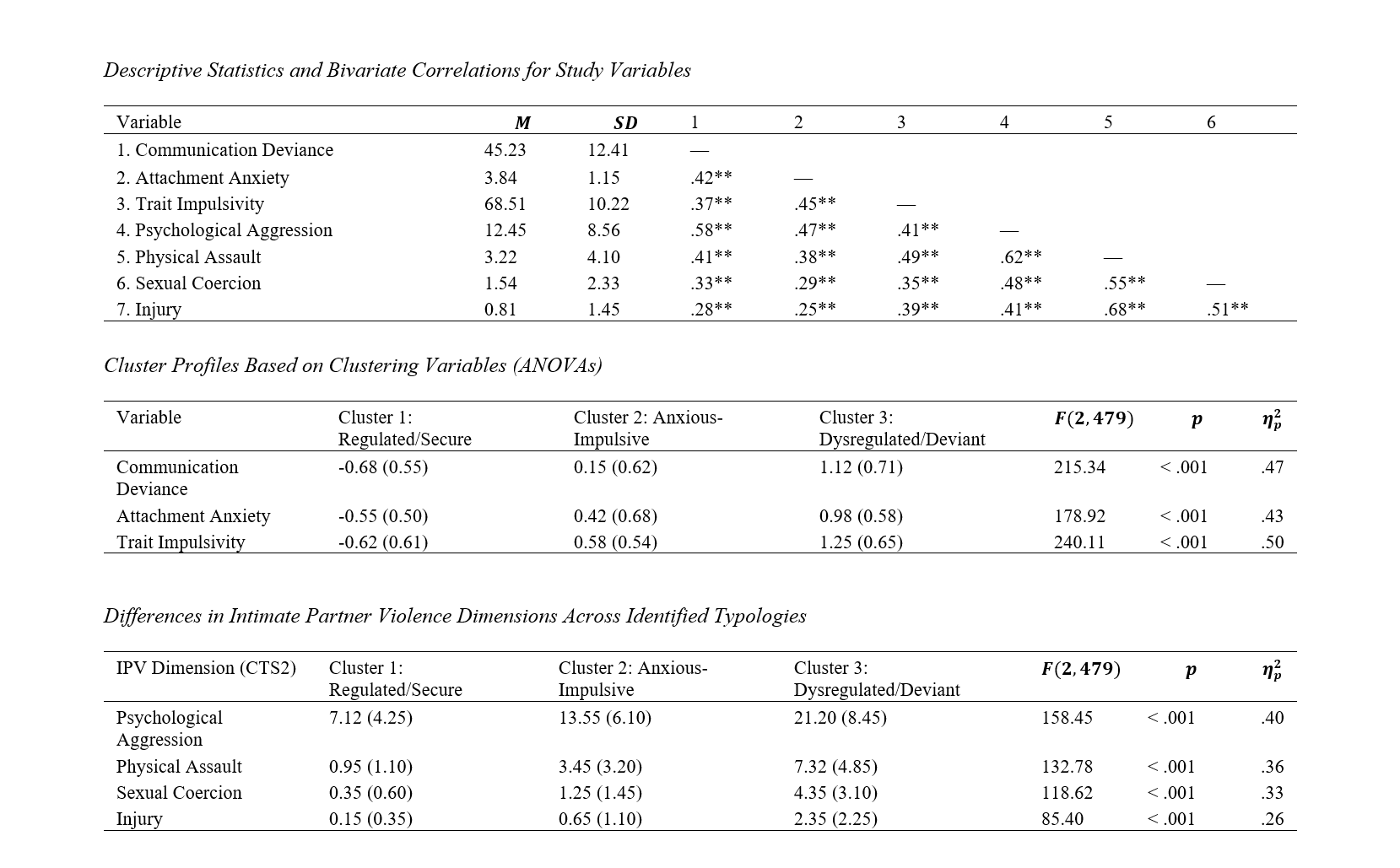
Findings: The k-means algorithm yielded a robust three-cluster solution. Cluster 1, the “Regulated/Secure” group ( , ), exhibited low scores across all three risk factors and reported minimal IPV. Cluster 2, the “Anxious-Impulsive” group ( , ), displayed elevated attachment anxiety and trait impulsivity alongside moderate communication deviance, corresponding to significantly higher rates of psychological and physical aggression. Cluster 3, the “Dysregulated/Deviant” group ( , ), demonstrated the highest scores across all three psychological constructs and reported the most severe, multifaceted IPV, including significantly elevated levels of sexual coercion and physical injury.
Conclusion: The identification of these distinct psychological risk profiles highlights the fundamental heterogeneity of IPV perpetration and underscores the critical necessity for tailored, person-centered screening and intervention strategies.
Downloads
References
Ahmed, A., Saeed, M., Hussein, H. A., & Nahas, H. G. E. (2024). Relation Between Intimate Partner Violence During Pregnancy and Postpartum Mother Psychological Wellbeing. South Eastern European Journal of Public Health, 291-296. https://doi.org/10.70135/seejph.vi.1672
Alqurashi, T. S., Ali, P. A., & Hinchliff, S. (2025). Notion of Understanding in The Marital Relationship: A Grounded Theory of Intimate Partner Violence from The Perspective of Saudi Men. Journal of family violence. https://doi.org/10.1007/s10896-025-00859-4
Amoak, D., Antabe, R., & Sano, Y. (2025). Toward ending violence against women: the association of intimate partner violence with food security status among ever-married women in Cameroon. Journal of interpersonal violence, 40(3-4), 955-973. https://doi.org/10.1177/08862605241255731
Ani, J. I. (2025). Predictors of Intimate Partner Violence and Associated Marital Disruption Among Ever-Married Women in Sub-Saharan Africa: A Multi-Country Analysis for Policy and Intervention Priorities. Frontiers in Sociology, 10. https://doi.org/10.3389/fsoc.2025.1658603
Atta, G. P., Newton, P., & Shah, T. (2025). Insights Into Intimate Partner Violence: Exploring Predictive Factors in Ghana Multiple Indicator Cluster Surveys 2018. Societies, 15(4), 100. https://doi.org/10.3390/soc15040100
Baumont, A. C. d., Oliveira, G. S., Figueiredo, J. B. d., Santos, J. F. d., Genro, B. P., Habigzang, L. F., & Manfro, G. G. (2024). Intimate Partner Violence and Women's Mental Health During the COVID-19 Pandemic in Brazil. Trends in Psychiatry and Psychotherapy. https://doi.org/10.47626/2237-6089-2022-0594
Brunton, R., & Dryer, R. (2024). Intimate Partner Violence Risk Factors: A Vulnerability-Adaptation Stress Model Approach. Journal of interpersonal violence, 39(15-16), 3738-3763. https://doi.org/10.1177/08862605241234352
Cénat, J. M., Amédée, L. M., Onesi, O., Darius, W. P., Barara, R., Villarreal, D. G., Seyed Mohammad Mahdi Moshirian, F., Labelle, P., & Hébert, M. (2024). Prevalence and Correlates of Intimate Partner Violence Among Women and Men in Mexico: A Systematic Review and Meta-Analysis. Trauma Violence & Abuse, 26(1), 20-40. https://doi.org/10.1177/15248380241271345
Cunha, O., Cruz, A. R., Rodrigues, A. d. C., Gonçalves, R. A., & Peixoto, M. M. (2024). Does Psychopathy Mediate the Relationship Between Exposure to Intimate Partner Violence in Childhood and the Perpetration of Intimate Partner Violence in Adulthood? Criminology & Criminal Justice. https://doi.org/10.1177/17488958241270798
Dubé, V., Tremblay-Perreault, A., Allard-Cobetto, P., & Hébert, M. (2024). Alexithymia as a Mediator between Intimate Partner Violence and Post-Traumatic Stress Symptoms in Mothers of Children Disclosing Sexual Abuse. Journal of family violence, 39(3), 359-367. https://doi.org/10.1007/s10896-023-00512-y
Fan, X. M., & Kim, H. W. (2024). The Status of Intimate Partner Violence Against Pregnant Women in Contemporary China: A Scoping Review. Womens Health Nurs, 30(1), 41-55. https://doi.org/10.4069/whn.2024.03.16
Galdámez-Vázquez, S., & Hernández-Gordillo, J. L. (2024). Intimate Partner Violence Among LGBT+ University Students. Journal Health Education and Welfare, 24-35. https://doi.org/10.35429/jhew.2024.14.8.24.35
Golden, K., Fitchett, G., Shen, S., Godlin, A., & Gobin, R. (2024). In coping with intimate partner violence, women's beliefs about forgiveness matter. Journal of interpersonal violence, 40(7-8), 1505-1529. https://doi.org/10.1177/08862605241260616
Gottfredson, M. R., & Nielsen, M. S. (2024). Intimate Partner Violence, Femicide, and General Theories: Issues for Research and Policy From the View of Modern Control Theory. Journal of Contemporary Criminal Justice, 40(2), 247-271. https://doi.org/10.1177/10439862241245838
Grocott, L. R., Brick, L. A., Stuart, G. L., & Shorey, R. C. (2024). Same-Day and Next-Day Associations Between Relational Factors and Intimate Partner Violence in Young Adult Couples. Psychology of violence, 14(2), 107-116. https://doi.org/10.1037/vio0000496
Guermazi, F., Tabib, F., Chérif, F., Masmoudi, R., Mnif, D., Féki, I., Baâti, I., & Masmoudi, J. (2024). Intimate Partner Violence in Tunisia: Emotional Abuse and Dependency, Alexithymia, and Self-Esteem in Female Victims. Social Sciences, 13(10), 503. https://doi.org/10.3390/socsci13100503
Hegarty, K., McKibbin, G., Hameed, M., Koziol-McLain, J., Feder, G., Tarzia, L., & Hooker, L. (2023). The health impacts of intimate partner violence against women: A life course perspective. The Lancet Public Health, 8(4), e299–e310. https://doi.org/10.1016/S2468-2667(23)00018-3
Jud, A., Grafe, B., Meshkova, K., Kavemann, B., Meysen, T., Hoffmann, U., Ziegenhain, U., & Fegert, J. (2023). Prevalence and predictors of affirmations of intimate partner violence in Germany: a first nationwide study on victimization in women and men. Journal of interpersonal violence, 38(1-2), 1473-1493. https://doi.org/10.1177/08862605221092066
Kadengye, D. T., Izudi, J., Kemigisha, E., & Kiwuwa-Muyingo, S. (2023). Effect of Justification of Wife-Beating on Experiences of Intimate Partner Violence Among Men and Women in Uganda: A Propensity-Score Matched Analysis of the 2016 Demographic Health Survey Data. PLoS One, 18(4), e0276025. https://doi.org/10.1371/journal.pone.0276025
Kok, B., & Kucukgoncu, S. (2024). Effects of Sexual Myths and Intimate Partner Violence on Women's Sexual Self-Schemas. Archives of Sexual Behavior, 53(1), 375-382. https://doi.org/10.1007/s10508-023-02729-w
Lalande, C., Gauthier, S., Damant, D., Lessard, G., & Dubé, M. (2023). Professional Representations of Collaboration in the Response to Intimate Partner Violence. Journal of family violence. https://doi.org/10.1007/s10896-023-00504-y
Landfield, M., Ali, N., Azarafza, S., Baer, S., Belur, A., Griffin, N., Kosak, D., Lerch, J., Patatanian, R., Quintero, E., Scott, S., Balice, G., & Leibert, M. (2023). Examining the Rise of Intimate Partner Violence During COVID-19: A Call to Action for Psychologists as Social Advocates. Psychology and Cognitive Sciences - Open Journal, 9(1), 8-16. https://doi.org/10.17140/pcsoj-9-169
Leat, S. R., Ravi, K. E., Rai, A., Obenauf, C., & Bryant, S. M. (2023). Do I Belong Here? Experiences of Transgender Survivors of Intimate Partner Violence in Domestic Violence Shelters. Families in Society the Journal of Contemporary Social Services, 106(1), 245-255. https://doi.org/10.1177/10443894231196929
Lee, J. Y., Yoon, S., Park, K., Radney, A., Shipe, S. L., & Pace, G. T. (2023). Father–Mother Co-Involvement in Child Maltreatment: Associations of Prior Perpetration, Parental Substance Use, Parental Medical Conditions, Inadequate Housing, and Intimate Partner Violence With Different Maltreatment Types. Children, 10(4), 707. https://doi.org/10.3390/children10040707
Lisi, A., Lanna, M., & Maldonado, R. (2023). The longitudinal association between intimate partner violence and incidence of anxiety disorders in women: A population-based study. Journal of affective disorders, 320, 221–228. https://doi.org/10.1016/j.jad.2022.09.104
Maharlouei, N., Roozmeh, S., Roozegar, M.-h. Z., Shahraki, H. R., Bazrafshan, K., Moradi-alamdarloo, S., Vardanjani, H. M., & Lankarani, K. B. (2023). Intimate Partner Violence During Pregnancy in COVID-19 Pandemic: A Cross-Sectional Study From South-West of Iran. BMC public health. https://doi.org/10.1186/s12889-023-15258-x
Malesa, K. J. (2023). Hegemonic Masculinity as a Contributing Factor Toward Intimate Partner Violence in Contemporary South Africa. Commonwealth Youth and Development, 20(2). https://doi.org/10.25159/2663-6549/11880
McKay, T. (2023). No Escape: Mass Incarceration and the Social Ecology of Intimate Partner Violence Against Women. Violence Against Women, 30(10), 2461-2481. https://doi.org/10.1177/10778012231158110
Mootz, J. J., dos Santos, P. F., dos Santos, K., Stith, S., Wainberg, M. L., & Oliffe, J. (2024). Engaging Mozambican men in a couple-based therapy to reduce intimate partner violence and improve mental health: Community stakeholders' perspectives. SSM-Mental Health, 5. https://doi.org/10.1016/j.ssmmh.2024.100297
Mosha, I. H., Akyoo, W. O., & Ezekiel, M. J. (2023). Perpetrators’ Characteristics and Intimate Partner Violence in Informal Settlements at Iringa Municipality Tanzania. Journal of Asian and African Studies, 60(4), 2308-2323. https://doi.org/10.1177/00219096231215699
Neilson, E. C., Gulati, N. K., Stappenbeck, C. A., George, W. H., & Davis, K. C. (2023). Emotion Regulation and Intimate Partner Violence Perpetration in Undergraduate Samples: A Review of the Literature. Trauma, Violence, & Abuse, 24(2), 576-596. https://doi.org/10.1177/15248380211036063
Nikrouy, F., Mohammadi, K. H. S., & Samavi, S. A. (2024). Structural Relationship Model of Basic Psychological Needs With Intimate Partner Violence: The Mediating Role of Gender Discrimination and Self-Esteem. Journal of interpersonal violence, 40(5-6), 1387-1411. https://doi.org/10.1177/08862605241259415
Nudin, N. S. M., & Mohamed, N. F. (2023). Exploring the Long-Term Psychological Impact of Childhood Abuse on Intimate Partner Violence Victims in Malaysia. International Journal of Academic Research in Business and Social Sciences, 13(5). https://doi.org/10.6007/ijarbss/v13-i5/17156
Nur, N. (2023). Suicidal Thoughts and Attempts Among Married Women Who Experience Intimate Partner Violence in Türkiye. Eastern Mediterranean Health Journal, 29(9). https://doi.org/10.26719/emhj.23.097
Ortega Ceballos, P. A., Rivera Rivera, L., Reynales Shigematsu, L. M., Austria Corrales, F., Toledano-Toledano, F., & Pérez Amezcua, B. (2023). Psychological distress, intimate partner violence and substance use in a representative sample from Mexico: A structural equation model. Frontiers in Public Health, 11(1), 1-11. https://doi.org/10.3389/fpubh.2023.1101487
Park, Y., Volling, B. L., Maguire‐Jack, K., & Park, Y. (2025). The Role of Depression in the Relationship Between Psychological Intimate Partner Violence and Mothers’ and Fathers’ Spanking: An Actor–partner Interdependence Mediation Model. Psychology of Men & Masculinity, 26(2), 241-253. https://doi.org/10.1037/men0000508
Pengpid, S., & Peltzer, K. (2024). Associations of history of intimate partner violence with mental ill-health and lifestyle factors in middle-aged and older men and women in South Africa. Archives of Gerontology and Geriatrics, 118, 105286. https://doi.org/10.1016/j.archger.2023.105286
Reed, K. M. P., Kline, N. K., & Prichett, B. (2025). The Role of COVID-Related Socioeconomic Stress and Emotion Regulation in Intimate Partner Violence Survivors' Posttraumatic Symptomology. Partner Abuse, PA-2024-0005.R2021. https://www.researchgate.net/publication/387666780_The_Role_of_COVID-Related_Socioeconomic_Stress_and_Emotion_Regulation_in_Intimate_Partner_Violence_Survivors%27_Posttraumatic_Symptomology
Roy, R., Vranda, M. N., Jagannathan, A., Vasanthra, C. R., & Ranjith, P. J. (2023). Conjoint Couple Therapy With a Woman Survivor of Intimate Partner Violence: Strengths and Challenges. Indian Journal of Psychological Medicine, 45(6), 629-633. https://doi.org/10.1177/02537176231154820
Sarno, E. L., Newcomb, M. E., & Whitton, S. W. (2023). Minority Stress and Intimate Partner Violence Among Sexual and Gender Minorities Assigned Female at Birth. Psychology of violence, 13(3), 239-247. https://doi.org/10.1037/vio0000466
Scott, S. B., Pulice-Farrow, L., Quyen, A., Brunett, K. M., & Balsam, K. F. (2023). Intimate Partner Violence in Transgender and Nonbinary Relationships: Actor-Partner Associations With Relationship Satisfaction, Dyadic Coping, and Partner Support. LGBT Health, 10(S1), S20-S27. https://doi.org/10.1089/lgbt.2023.0112
Seeletse, S. M. (2024). Why Stay Despite Intimate Partner Violence? Lived Experiences of Victims in Positions of Strength. Humanitas Indonesian Psychological Journal, 40-52. https://doi.org/10.26555/humanitas.v21i1.472
Seifu, B. L., Asebe, H. A., Legesse, B. T., Mulaw, G. F., Tebeje, T. M., & Mare, K. U. (2024). Prognostic Factors of First Intimate Partner Violence Among Ever-Married Women in Sub-Saharan Africa: Gompertz Gamma Shared Frailty Modeling. PLoS One, 19(5), e0303187. https://doi.org/10.1371/journal.pone.0303187
Shahbazi, H., Sadeghi, M. A., & Panaghi, L. (2023). Dehumanization in female victims of intimate partner violence. Journal of injury and violence research, 15(1), 83. https://www.ncbi.nlm.nih.gov/pmc/articles/PMC10369329/
Simpson, L., Kumar, S. A., Brockdorf, A. N., Brock, R. L., Messman, T. L., Gratz, K. L., & DiLillo, D. J. (2024). The Cumulative Impact of Recurrent Experiences of Intimate Partner Violence on Emotion Dysregulation: A Longitudinal Investigation. Journal of interpersonal violence, 40(11-12), 2760-2783. https://doi.org/10.1177/08862605241278996
Sójta, K., Margulska, A., Jóźwiak-Majchrzak, W., Grażka, A., Grzelczak, K., & Strzelecki, D. (2023). Cognitive–Affective Risk Factors of Female Intimate Partner Violence Victimization: The Role of Early Maladaptive Schemas and Strategic Emotional Intelligence. Brain Sciences, 13(7), 1118. https://doi.org/10.3390/brainsci13071118
Taccini, F., & Mannarini, S. (2025). Exploring the Phenomenon of Victim Blaming Toward Women With an Intimate Partner Violence Experience and the Role of Empathy. Journal of interpersonal violence. https://doi.org/10.1177/08862605241307224
Taccini, F., Rossi, A., & Mannarini, S. (2024). Unveiling the Role of Emotion Regulation in the Relationship Between Intimate Partner Violence Increases and Post-Traumatic Stress Disorder: A Mediation Analysis. Behavioral Sciences, 14(9), 799. https://doi.org/10.3390/bs14090799
Taşkale, N., Babcock, J. C., & Gottman, J. M. (2024). A Dyadic Analysis of the Relationships Between Antisocial and Borderline Personality and Intimate Partner Violence Perpetration. Journal of interpersonal violence, 40(7-8), 1959-1974. https://doi.org/10.1177/08862605241271378
Urquhart, G., MacLennan, S., & Guntupalli, A. M. (2023). Is There an Association Between Intimate Partner Violence and the Prevalence of Cervical Cancer Screening in Jordan? PLoS One, 18(8), e0290678. https://doi.org/10.1371/journal.pone.0290678
Viejo, C. M., Ruiz, M. Á. M., & Burgueño, F. (2023). Intimate Partner Violence in Vulnerable Contexts: A Case Study. Societies, 13(3), 53. https://doi.org/10.3390/soc13030053
White, S., Sin, J., Sweeney, A., Salisbury, T. T., Wahlich, C., Guevara, C. M. M., Gillard, S., Brett, E., Allwright, L., Iqbal, N., Khan, A., Perôt, C., Marks, J., & Mantovani, N. (2023). Global Prevalence and Mental Health Outcomes of Intimate Partner Violence Among Women: A Systematic Review and Meta-Analysis. Trauma Violence & Abuse, 25(1), 494-511. https://doi.org/10.1177/15248380231155529
Whitton, S. W., Welge, J. A., & Newcomb, M. E. (2023). Evaluation of Traditional Risk Factors for Intimate Partner Violence Among Sexual and Gender Minority Youth. Psychology of violence, 13(6), 456-467. https://doi.org/10.1037/vio0000486
Win, A. M. M. (2025). Exploring Influencing Factors on Help-Seeking Behaviors for Intimate Partner Violence: Insights From Ethnic Women Survivors in Myanmar. International journal of environmental research and public health, 22(6), 899. https://doi.org/10.3390/ijerph22060899
Woofter, R., Mboya, J., Golub, G., & Sudhinaraset, M. (2024). Intimate Partner Violence and Postpartum Healthcare Access in Kenya: A Cross-Sectional Study. BMC Pregnancy and Childbirth, 24(1). https://doi.org/10.1186/s12884-024-06342-0
Yirgu, R., Wondimagegnehu, A., Qian, J., Milkovich, R., Zimmerman, L., Decker, M. R., Glass, N., Seid, F., Zekarias, L., & Wood, S. N. (2023). Needs and Unmet Needs for Support Services for Recently Pregnant Intimate Partner Violence Survivors in Ethiopia During the COVID-19 Pandemic. BMC public health, 23(1). https://doi.org/10.1186/s12889-023-15634-7
Downloads
Additional Files
Publication Timeline
- Submitted
- Revised
- Accepted