Algorithmic Modeling of Caregiver Systemic Burden in Chronic Illness by Intersecting Partner Neuroticism and Dyadic Coping Mechanisms
DOI:
https://doi.org/10.61838/kman.aftj.5269Keywords:
Caregiver systemic burden, chronic illness, dyadic coping, neuroticismAbstract
Objective: To develop an algorithmic model predicting caregiver systemic burden by evaluating the complex, non-linear intersections between a care-recipient’s neuroticism and the couple’s dyadic coping mechanisms.
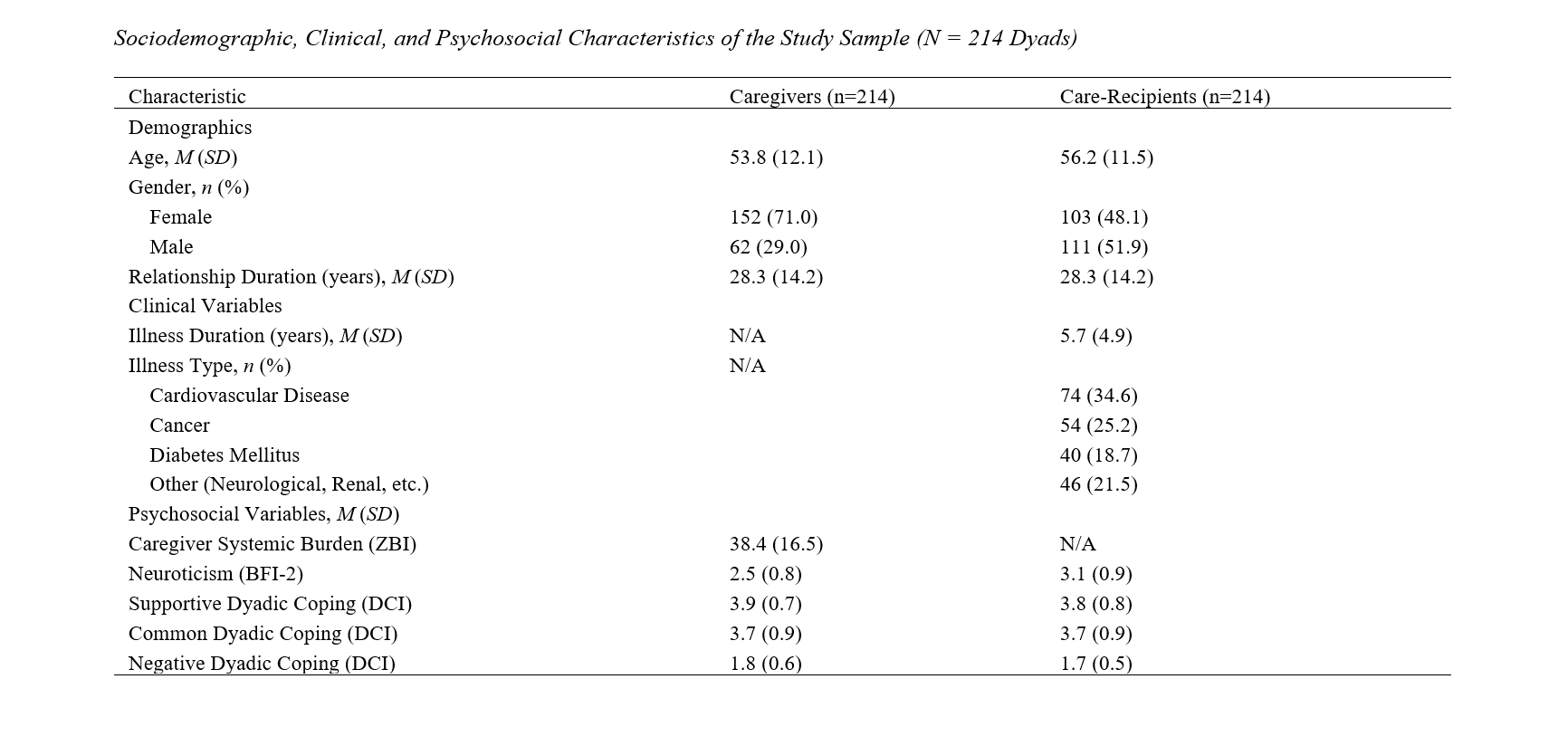
Methods and Materials: A cross-sectional, dyadic study design was utilized, comprising 214 caregiver/care-recipient dyads managing chronic illness in Yerevan, Armenia. Psychometric data were collected using the Zarit Burden Interview (ZBI) for caregiver burden, the Big Five Inventory-2 (BFI-2) for care-recipient neuroticism, and the Dyadic Coping Inventory (DCI) for dyadic coping. Predictive modeling was conducted using a Gradient Boosting Machine (GBM) algorithm with the dataset partitioned into training ( ) and testing ( ) subsets, while SHapley Additive exPlanations (SHAP) were employed to extract feature importance and interaction effects.
Findings: The GBM model exhibited strong predictive performance, accounting for of the variance in caregiver systemic burden on the test set ( ), with a Root Mean Square Error ( ) of . SHAP analyses identified care-recipient neuroticism as the most potent predictor of burden (Mean ), followed by caregiver engagement in negative dyadic coping (Mean ) and illness duration (Mean ). Interaction analyses revealed that the detrimental impact of partner neuroticism was exponentially amplified by negative dyadic coping and significantly buffered by active supportive dyadic coping.
Conclusion: Algorithmic modeling effectively demonstrates that caregiver systemic burden is a deeply interdependent phenomenon, highlighting that the psychological toll of a partner’s neuroticism is highly conditional upon the couple’s underlying dyadic coping architecture.
Downloads
References
Alinajimi, F., Deldar, Z., Dehghani, M., & Khatibi, A. (2023). Emotion Regulation Mediates the Relationship Between Family Caregivers’ Pain-Related Beliefs and Patients’ Coping Strategies. Frontiers in Behavioral Neuroscience, 17. https://doi.org/10.3389/fnbeh.2023.983350
Calhoun, P. S., Beckham, J. C., & Bosworth, H. B. (2014). Caregiver burden and psychological distress in partners of veterans with chronic posttraumatic stress disorder. Journal of Traumatic Stress, 15, 205-212. https://doi.org/10.1023/A:1015251210928
Casaleiro, T., Martins, H., & Caldeira, S. (2024). Promoting Spiritual Coping of Family Caregivers of an Adult Relative with Severe Mental Illness: Development and Test of a Nursing Intervention. Healthcare, 12(13), 1247. https://doi.org/10.3390/healthcare12131247
Chica‐Pérez, A., Correa‐Casado, M., Fernández‐Sola, C., Granero‐Molina, J., Cortés-Rodríguez, A. E., & Hernández‐Padilla, J. M. (2025). The Family Caregiver Role From the Perspective of Older Women Experiencing Poverty in a High‐Income Country: A Qualitative Study. Journal of Advanced Nursing. https://doi.org/10.1111/jan.17043
Francis, S. R., Hall, E. O., & Delmar, C. (2021). Spouse Caregivers’ Experiences of Suffering in Relation to Care for a Partner With Brain Tumor. Cancer Nursing, 45(2), E320-E328. https://doi.org/10.1097/ncc.0000000000000935
Genter, P., Høeg, B. L., Hamre, C. J., Andersen, E. W., Dalton, S. O., Ribers, B., & Bidstrup, P. E. (2021). Protocol for ‘Resilient Caregivers’: A Randomised Trial of a Resilience-Based Intervention for Psychologically Distressed Partner Caregivers of Patients With Cancer. BMJ open, 11(11), e048327. https://doi.org/10.1136/bmjopen-2020-048327
Guthrie, C. S., Boparai, S., Friedman, D. L., Compas, B. E., & Katz, L. F. (2025). Caregiver Emotion Socialization and Child Adjustment in Context of Pediatric Cancer. Journal of Family Psychology, 39(4), 491-502. https://doi.org/10.1037/fam0001323
Harris, S. M., Adams, M., Zubatsky, M., & White, M. B. (2011). A Caregiver Perspective of How Alzheimer's Disease and Related Disorders Affect Couple Intimacy. Aging & mental health, 15(8), 950-960. https://doi.org/10.1080/13607863.2011.583629
Karuna, Y. M., Dutt, A., Shenoy, R., Lee, Y., Thimmaiah, C., Bhat, S. S., Nayak, A., & Rao, A. (2024). A Scoping Review on Parental/Caregiver Challenges in Maintaining Oral Hygiene Among Children With Autism Spectrum Disorder. International Journal of Paediatric Dentistry. https://doi.org/10.1111/ipd.13268
Marsack‐Topolewski, C. N., Wang, F., & Samuel, P. S. (2025). Characteristics of Adult Children With Autism and Caregiver Burden. Family Relations, 74(2), 931-950. https://doi.org/10.1111/fare.13141
Marzban, A., Fereidooni‐Moghadam, M., & Ghezelbash, S. (2024). Coping Strategies Among Family Caregivers of Patients With Chronic Mental Disorders: A Cross-Sectional Study. Jundishapur Journal of Chronic Disease Care, 13(2). https://doi.org/10.5812/jjcdc-120635
Milbury, K., Badr, H., Fossella, F., Pisters, K. M., & Carmack, C. L. (2013). Longitudinal associations between caregiver burden and patient and spouse distress in couples coping with lung cancer. Supportive Care in Cancer, 21(9), 2371-2379. https://doi.org/10.1007/s00520-013-1795-6
Ostwald, S. K., Godwin, K. M., & Cron, S. G. (2009). Predictors of Life Satisfaction in Stroke Survivors and Spousal Caregivers After Inpatient Rehabilitation. Rehabilitation Nursing Journal, 34(4). https://journals.lww.com/rehabnursingjournal/fulltext/2009/07000/predictors_of_life_satisfaction_in_stroke.5.aspx
Otobe, Y., Kimura, Y., Terao, Y., Suzuki, M., Tanaka, S., Kojima, I., Koyama, S., Kusumi, H., & Yamada, M. (2023). Associations between caregiver burden and care receivers' sharing ratio of household tasks among spousal caregivers. Geriatrics & Gerontology International, 23(8), 616-621. https://doi.org/10.1111/ggi.14636
Radosavljevic, D. (2025). Engaging Caregivers In The Service Of Their Child?s Mental Health: An Examination Of Emotion Focused Family Therapy In Relation To Parental Reflective Functioning. https://yorkspace.library.yorku.ca/items/49377dc9-8e11-47d5-aff1-ec79bbfa403b
Rodrigues, D. F., Carvalho, L., & Pinto, C. (2025). Lower-Limb Amputees and Family Caregivers: Challenges, Needs, and Strategies for Empowerment—A Qualitative Study. Nursing Reports, 15(5), 166. https://doi.org/10.3390/nursrep15050166
Saban, K. L., Griffin, J. M., Urban, A., Janusek, M. A., Pape, T., & Collins, E. G. (2016). Perceived Health, Caregiver Burden, and Quality of Life in Women Partners Providing Care to Veterans With Traumatic Brain Injury. The Journal of Rehabilitation Research and Development. https://doi.org/10.1682/jrrd.2015.07.0143
Sharbafchi, M. R., Mousavi, S. M., Sheikhani, G., Keyvanara, M., & Ani, S. (2025). Caring Challenges of Family Caregivers of Cancer Patients in the COVID-19 Pandemic: A Qualitative Study. Iranian Journal of Nursing and Midwifery Research, 30(2), 175-181. https://doi.org/10.4103/ijnmr.ijnmr_125_23
Sikandar, A., Anwar, A., Afzal, A., & Nayab, M. (2024). Psycho-Social Challenges and Coping Strategies of Caregivers of Thalassemia Patients in District Gujrat. Journal of Asian Development Studies, 13(1), 945-958. https://doi.org/10.62345/jads.2024.13.1.78
Singer, H., Clarke, E., Schiltz, H. K., & Lord, C. (2023). Caregivers and Coping: Well-Being and Coping Styles Among Caregivers of Young Adults With Developmental Disabilities. https://doi.org/10.1101/2023.02.24.23286429
Singh, M., Austin, A., Lindenbach, D., Steen, H. V., Habina, C., Marcoux‐Louie, G., Loeb, K. L., Engel, S. G., Grange, D. L., & Dimitropoulos, G. (2025). Ecological Momentary Assessment for Adolescents With Anorexia Nervosa and Their Parents/Caregivers In Family‐Based Treatment. International Journal of Eating Disorders, 58(3), 608-623. https://doi.org/10.1002/eat.24368
Tengku Mohd Saifuddin Tengku, K., Ariaratnam, S., Nikmat, A. W., Abdullah, N. N., & Khing, T. L. (2022). Coping Strategies and Their Associated Factors Among Caregivers of Patients With Schizophrenia in Kuantan, Malaysia. Frontiers in Psychiatry, 13. https://doi.org/10.3389/fpsyt.2022.1004034
Tey, M. Q., & Lee, G. L. (2022). Understanding Bereavement Experiences and Coping Among Bereaved Family Caregivers in Singapore: Positive Meaning Reconstruction in the Dual Process Model. OMEGA - Journal of Death and Dying, 91(1), 263-280. https://doi.org/10.1177/00302228221133584
Veronese, G., Mahamid, F., Diab, M., Hassouna, B., & Bdier, D. (2025). Beyond Survival: A Qualitative Study on the Intersection of Caregiving, Coping, and Mental Health in Gaza’s Ongoing Mass Massacre. Journal of interpersonal violence. https://doi.org/10.1177/08862605251336360
Watt, T. G. (2023). Acceptance and Commitment Therapy (ACT) for People With Advanced Progressive Illness, Their Caregivers and Staff Involved in Their Care: A Scoping Review. Palliative Medicine, 37(8), 1100-1128. https://doi.org/10.1177/02692163231183101
Yang, Q. Q., Chen, Y. D., Schwade, M., & Zhang, Q. (2025). Exploring the dynamics of compassion fatigue, compassion satisfaction, and burnout in family caregivers of disabled elderly: A moderated mediation analysis of social support. Geriatric Nursing, 65, 103537. https://doi.org/10.1016/j.gerinurse.2025.103537
Zhang, N., Liu, Y., Yu, X., Tian, Z., Liu, Y., Li, Y., Liu, X., Zhu, H., & Wang, L. (2024). Positive Coping Style and Family Resilience of Caregivers of COPD Patients: The Chain Mediating Roles of Caregiver Burden and Resilience. Journal of clinical nursing, 34(2), 554-564. https://doi.org/10.1111/jocn.17587
Zhang, Y. H., Wang, L., Cao, R., Chen, L., Yuan, H., Li, R., Jiang, X. S., Cheng, Y., Zou, H., Yang, B. X., & Liu, Q. (2025). Family Resilience in Adolescent and Young Adult Patients With Hematological Malignancies: A Qualitative Study of Patients and Family Caregivers. Psycho-Oncology, 34(7). https://doi.org/10.1002/pon.70224
Downloads
Additional Files
Publication Timeline
- Submitted
- Revised
- Accepted