
The Metaverse and the Reconsideration of Pure Reason: Identity and Ethical Crises in Relation to Women and Family from a Psychological Perspective
Keywords:
Metaverse, Identity Crisis, Ethical Relativism, Digital Identity, Gender Roles, Family Dynamics, Psychological ImpactAbstract
Objective: The aim of this study was to investigate the identity and ethical crises emerging from engagement with the metaverse in relation to women and family from a psychological perspective.
Methods and Materials: This study employed a qualitative research design grounded in an interpretive paradigm to explore lived experiences of individuals engaged in the metaverse. The participants consisted of 24 individuals (12 women and 12 men) from Tehran, selected through purposive sampling with maximum variation in age, education, and marital status, and data collection continued until theoretical saturation was achieved. Data were gathered through semi-structured, in-depth interviews focusing on identity construction, moral reasoning, gender roles, and family dynamics within virtual environments. Each interview lasted between 60 and 90 minutes and was transcribed verbatim. The data were analyzed using thematic analysis, involving open coding, axial categorization, and selective theme development. To ensure trustworthiness, strategies such as member checking, peer debriefing, and maintaining an audit trail were employed.
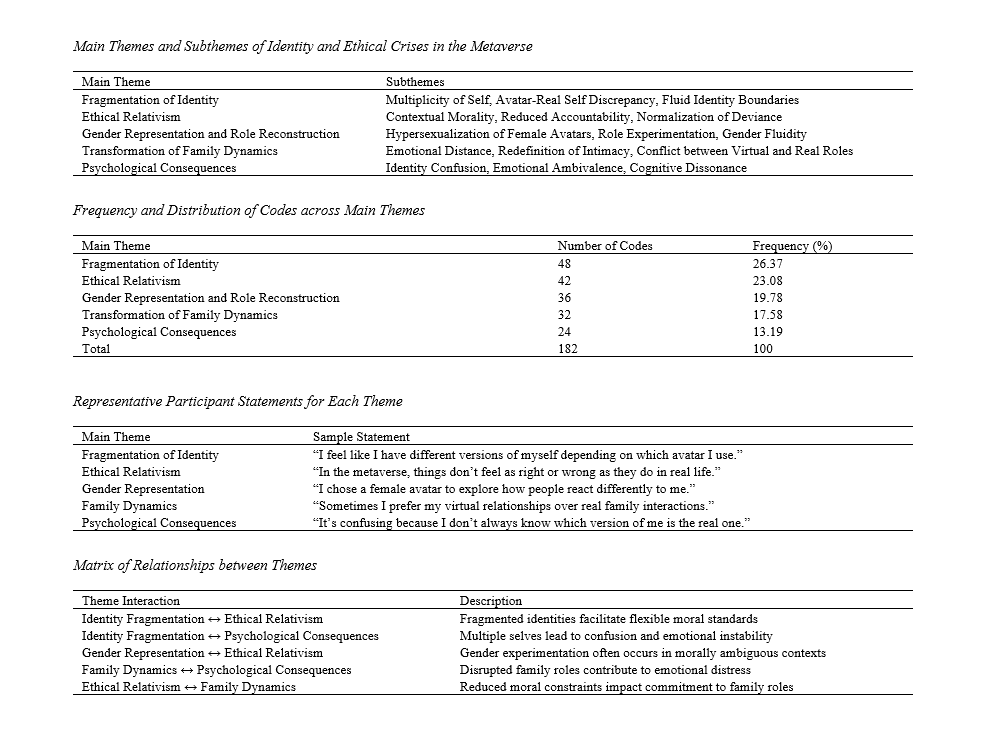
Findings: The findings revealed five core themes including identity fragmentation, ethical relativism, gender role reconstruction, transformation of family dynamics, and psychological consequences. The results indicated that engagement with the metaverse significantly contributes to the multiplicity and fluidity of identity, leading to discrepancies between virtual and real selves. Ethical reasoning was found to shift toward context-dependent relativism, characterized by reduced accountability and flexible moral boundaries. Gender representation in the metaverse facilitated both identity exploration and the reinforcement of stereotypical norms. Furthermore, virtual immersion was associated with altered family interactions, including emotional distancing and redefined relational priorities.
Conclusion: The metaverse represents a transformative digital context that simultaneously expands opportunities for identity exploration and intensifies psychological and ethical challenges, necessitating a critical reconsideration of self, morality, and family relationships within technologically mediated environments.
Downloads
References
Farah, M. F., Ramadan, Z., & Nassereddine, Y. (2024). When Digital Spaces Matter: The Influence of Uniqueness and Place Attachment on Self‐identity Expression With Brands Using Generative AI on the Metaverse. Psychology and Marketing, 41(12), 2965-2976. https://doi.org/10.1002/mar.22097
Gardner, S. (1999). Kant and the Critique of Pure Reason. Routledge.
Hadi, R., Melumad, S., & Park, E. S. (2023). The Metaverse: A New Digital Frontier for Consumer Behavior. Journal of Consumer Psychology. https://doi.org/10.1002/jcpy.1356
Hajian, a., Daneshgar, S., Sadeghi R, K., Ojha, D., & Katiyar, G. (2024). From Theory to Practice: Empirical Perspectives on the Metaverse's Potential. Technological Forecasting and Social Change, 201, 123224. https://doi.org/10.1016/j.techfore.2024.123224
Hordijk, R. (2024). Spectral Inheritance : Unlearning the Maturity-Trope. https://doi.org/10.3384/9789180754781
Kant, I. (2022). Critique of Pure Reason. Qoqnos Publishing.
Latif Zadeh, M., & Gubouli Darfashan, M. M. (2023). Introducing digital identity in the metaverse: Identifying related legal challenges and solutions. Private Law Studies Quarterly, 53(2), 349-372.
Malik, S. (2024). Exploring Current Technologies, Applications, and Challenges in the Metaverse: A Comprehensive Survey. Journal of Graphic Era University, 105-124. https://doi.org/10.13052/jgeu0975-1416.1217
Missonnier, S. (2023). The Genesis of Perinatal Clinical Psychology and Its Contemporary Issues. Frontiers in Psychiatry, 14. https://doi.org/10.3389/fpsyt.2023.1090365
Mitrushchenkova, A. N. (2023). Personal Identity in the Metaverse: Challenges and Risks. Kutafin Law Review, 9(4), 793-817. https://doi.org/10.17803/2313-5395.2022.4.22.793-817
Richter, S., Mohammadhossein, N., Richter, A., & Trier, M. (2025). Augmented Reality and the Metaverse - Speculating About the Future. Ajis, 29. https://doi.org/10.3127/ajis.v29.5429
Riggio, A. (2016). The violence of pure reason: Neoreaction. Social Epistemology Review and Reply Collective, 5(9), 1-15. https://social-epistemology.com/wp-content/uploads/2016/09/riggio_review.pdf
Shapiro, A. N. (2024). Decoding Digital Culture With Science Fiction. https://doi.org/10.1515/9783839472422
Singh, R. (2024). Metaverse. 81-102. https://doi.org/10.4018/979-8-3693-4038-7.ch006
Strawson, P. F. (1966). The Bounds of Sense: An Essay on Kant's Critique of Pure Reason. Routledge.
Thomas, J., Kuhail, M. A., & Al-Beyahi, F. (2024). The Metaverse, Religious Practice and Wellbeing: A Narrative Review. Cyberpsychology Behavior and Social Networking, 27(1), 57-63. https://doi.org/10.1089/cyber.2023.0003
Wang, S., & Wang, W. (2023). A Review of the Application of Digital Identity in the Metaverse. Security and Safety, 2, 2023009. https://doi.org/10.1051/sands/2023009
Wertz, F. J. (2026). A History of Humanistic and Existential Psychology: The Possibility and Cultural Contexts of Renewal in Science. 3-46. https://doi.org/10.1037/0000431-001
Yin, B., Wang, Y., Fei, C.-Y., & Jiang, K. (2022). Metaverse as a Possible Tool for Reshaping Schema Modes in Treating Personality Disorders. Frontiers in psychology, 13. https://doi.org/10.3389/fpsyg.2022.1010971
Zhang, X., Chen, Y. C., Hu, L., & Wang, Y. (2022). The Metaverse in Education: Definition, Framework, Features, Potential Applications, Challenges, and Future Research Topics. Frontiers in psychology, 13. https://doi.org/10.3389/fpsyg.2022.1016300
Zou, J., & Hu, X. (2024). Risks of social interaction order in metaverse and legal responses. [Journal Name], 721-739.
Downloads
Additional Files
Publication Timeline
- Submitted
- Revised
- Accepted