Comparing the Effectiveness of Cognitive-Behavioral Couple Therapy and Emotionally Focused Couple Therapy on Romantic Relationship Perfectionism in Couples with Conflict
Keywords:
Romantic Relationship Perfectionism, Cognitive-Behavioral Couple Therapy, Emotionally Focused Couple TherapyAbstract
Objective: The present study aimed to compare the effectiveness of cognitive-behavioral couple therapy and emotionally focused couple therapy on romantic relationship perfectionism among couples experiencing marital conflict.
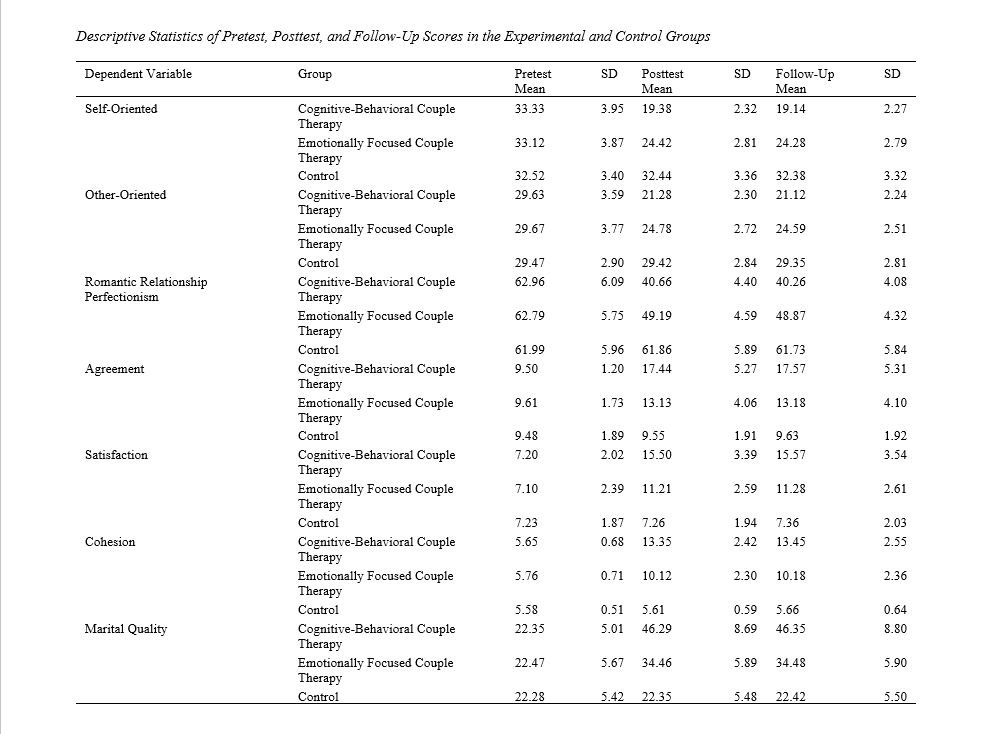
Methods and Materials: The present study employed a quasi-experimental pretest–posttest design with a control group and a three-month follow-up period. The statistical population consisted of all couples referring to counseling centers in Districts 21 and 22 of Tehran in 2025. Using purposive sampling and G*Power software, 45 couples meeting the inclusion criteria were selected and randomly assigned into two experimental groups and one control group, with 15 couples in each group. Data collection instruments included the Romantic Relationship Perfectionism Scale developed by Matte and Lafontaine (2012) and the Marital Conflict Questionnaire developed by Sanaei and Barati (1999). The first experimental group received cognitive-behavioral couple therapy based on Dattilio’s (2009) protocol in 10 sessions of 90 minutes, while the second experimental group received emotionally focused couple therapy based on Johnson’s (2012) model in 9 sessions of 90 minutes. The control group received no intervention. Data were analyzed using mixed repeated-measures analysis of variance in IBM SPSS Statistics version 18.
Findings: The results of mixed repeated-measures analysis of variance demonstrated significant effects of group, treatment stages, and the interaction between group and treatment stages on self-oriented and other-oriented romantic relationship perfectionism (p < .001). Both cognitive-behavioral couple therapy and emotionally focused couple therapy significantly reduced romantic relationship perfectionism compared to the control group. The Bonferroni post-hoc test indicated significant differences between pretest and posttest scores as well as between pretest and follow-up scores (p < .001), while no significant differences were observed between posttest and follow-up stages, indicating the stability of treatment effects. Furthermore, Tukey post-hoc comparisons revealed that cognitive-behavioral couple therapy was significantly more effective than emotionally focused couple therapy in reducing both self-oriented and other-oriented perfectionism (p < .05).
Conclusion: The findings suggest that both cognitive-behavioral couple therapy and emotionally focused couple therapy are effective interventions for reducing romantic relationship perfectionism among couples with marital conflict; however, cognitive-behavioral couple therapy demonstrated greater effectiveness. These results highlight the importance of targeting maladaptive cognitive patterns, unrealistic relational expectations, and emotional interactional processes in therapeutic interventions for distressed couples.
Downloads
References
Angelo, N. L., Brullo, G., Marsiglia, A., Tirelli, A., Piroddi, E., Viti, C., & Pozza, A. (2024). Romantic Relationship Obsessive-Compulsive Doubts, Perfectionism, and DSM-5 Personality Traits in LGB People: A Comparison with Heterosexual Individuals. Frontiers in psychology, 15, 1187179. https://doi.org/10.3389/fpsyg.2024.1187179
Benjamin, P., Bell, C., Gadgil, T., Mayhugh, S., & Durtschi, J. (2025). My Mama Don't Like You and She Likes Everyone: The Role of Family Approval in Partner Conflict and Satisfaction. Journal of marital and family therapy, 51(4), e70062. https://doi.org/10.1111/jmft.70062
Biran Talmor, S., Shahar, B., Sbarra, D. A., & Bar-Kalifa, E. (2025). The Development of a Brief Session-Level Process Measure for Emotion-Focused Couple Therapy. Family Process, 64(1), e70000. https://doi.org/10.1111/famp.70000
Bouchard, K. N., Bergeron, S., & Rosen, N. O. (2024). Feasibility of a Cognitive-Behavioral Couple Therapy Intervention for Sexual Interest/Arousal Disorder. The Journal of Sex Research, 1-11. https://doi.org/10.1093/jsxmed/qdae054.018
Carr, A. (2025). Couple Therapy and Systemic Interventions for Adult-Focused Problems: The Evidence Base. Journal of Family Therapy, 47(1), e12481. https://doi.org/10.1111/1467-6427.12481
Dailey, J., Timulak, L., Goldman, R. S., & Greenberg, L. S. (2024). Capturing the Change: A Case Study Investigation of Emotional and Interactional Transformation in Emotion-Focused Therapy for Couples. Person-Centered & Experiential Psychotherapies, 23(1), 1-19. https://doi.org/10.1080/14779757.2023.2204480
Ebrahimi, M. (2022). Effectiveness of Emotion-Focused Couple Therapy (EFT) on Improving Emotional Intimacy, Increasing Optimism, and Improving Communication Patterns in Couples Seeking Divorce. Second Conference on Social Sciences, Psychology, Educational Sciences and Humanities,
Ezeh, L. N., Ndukaihe, I. L., Etodike Chukwuemeka, E., & Anid, K. J. (2023). Locus of Control and Marital Satisfaction Among Nursing Professionals: Moderating Role of Emotional Expressiveness.
Firoozi, M., Golparvar, M., & Aghaei, A. (2022). Comparison of the Effectiveness of Emotion-Focused Couple Therapy, Cognitive-Behavioral Couple Therapy, and Gottman Systemic-Cognitive Couple Therapy on Affective Balance and Dysfunctional Expectations in Women with Symptoms of Sexual Dysfunction. Ravane Parastari, 10(1), 1-17.
Gong, Q., Kramer, K. Z., & Tu, K. M. (2023). Fathers' Marital Conflict and Children's Socioemotional Skills: A Moderated-Mediation Model of Conflict Resolution and Parenting. Journal of Family Psychology, 37(7), 1048. https://doi.org/10.1037/fam0001102
Grey, C. J. (2024). Are You Satisfied? A Look at How Adult Attachment Style and Perfectionism Influence Romantic Relationship Satisfaction Auburn University].
Hatami Manesh, N. (2023). Effectiveness of Cognitive-Behavioral Couple Therapy on Marital Relationship Quality in Couples with Marital Conflicts. Seventeenth International Conference on Psychology, Counseling and Educational Sciences,
Hsu, K. Y., Cenzer, I., Harrison, K. L., Ritchie, C. S., Waite, L., & Kotwal, A. (2023). In Sickness and in Health: Loneliness, Depression, and the Role of Marital Quality Among Spouses of Persons with Dementia. Journal of the American Geriatrics Society, 71(11), 3538-3545. https://doi.org/10.1111/jgs.18520
Jesuorobo, W. O., & Igbineweka, M. N. (2023). Coupling Sex and Emotional Expressiveness as Determinants of Marital Intimacy Among Married Couples. International Journal of Applied Guidance and Counseling, 4(1). https://doi.org/10.26486/ijagc.v4i1.3077
Keshtmand, Z., & Parandin, S. (2023). Effectiveness of Group Emotion-Focused Couple Therapy Training on Marital Adjustment and Quality of Life in Women with Marital Disputes in Islamabad-e Gharb. First International Conference on Psychology, Social Sciences, Educational Sciences and Philosophy, Babol.
Keyvani, M., Panah Ali, A., Livarjani, S., & Khademi, A. (2025). Comparison of the Effectiveness of Schema Therapy and Emotion-Focused Therapy on Early Maladaptive Schemas, Marital Quality of Life, and Cognitive Emotion Regulation in Betrayed Couples. Quarterly Journal of New Psychological Research, 20(79), 131-145.
Kula, O., Machluf, R., Shahar, B., Greenberg, L. S., & Bar-Kalifa, E. (2024). The Effect of Therapists' Enactment Interventions in Promoting Vulnerability Sharing in Emotion Focused Couple Therapy. Psychotherapy Research, 34(6), 748-759. https://doi.org/10.1080/10503307.2023.2245961
Kykyri, V. L., Nyman-Salonen, P., Tschacher, W., Tourunen, A., Penttonen, M., & Seikkula, J. (2025). Exploring the Role of Emotions and Conversation Content in Interpersonal Synchrony: A Case Study of a Couple Therapy Session. Psychotherapy Research, 35(2), 190-206. https://doi.org/10.1080/10503307.2024.2361432
Lebow, J., & Snyder, D. K. (2022). Couple Therapy in the 2020s: Current Status and Emerging Developments. Family Process, 61(4), 1359-1385. https://doi.org/10.1111/famp.12824
Li, Z., Zhao, Y., He, R., Luo, R., Luo, Y., Yang, Z., & Chen, F. (2024). An Integrated Model: Marital Effect on Adolescent Behavioral Problems Through Siblings. Frontiers in psychology, 14, 1282092. https://doi.org/10.3389/fpsyg.2023.1282092
Lin, L., Guo, H., Duan, L., He, L., Wu, C., Lin, Z., & Sun, J. (2022). Research on the Relationship Between Marital Commitment, Sacrifice Behavior and Marital Quality of Military Couples. Frontiers in psychology, 13, 964167. https://doi.org/10.3389/fpsyg.2022.964167
Mendoza, A., & Leeth, C. K. (2025). A Relational Approach to Emotionally Focused Therapy. The Family Journal, 10664807251318969. https://doi.org/10.1177/10664807251318969
Mohammadpanah, M., Tanha, Z., & Babaei Motlagh, F. (2023). Effect of Emotion-Focused Couple Therapy on Resilience, Emotional Intelligence, and Emotional Expressiveness in Couples Covered by Welfare Services in Khorramabad. Family and Health Quarterly, 13(2), 69-87.
Nadri, R., Sadeghi, M., & Ghazanfari, F. (2023). Effectiveness of Emotion-Based Cognitive-Behavioral Couple Therapy on Emotional Intimacy in Couples with Marital Conflict. Sixth National Conference on Modern Technologies in Education, Psychology and Counseling in Iran, Tehran.
Novak, J. R., Wilson, S. J., Ermer, A. E., & Harper, J. M. (2023). Aging Together: Dyadic Profiles of Older Couples' Marital Quality, Psychological Well-Being, and Physical Health. Journal of Social and Personal Relationships, 40(6), 1897-1919. https://doi.org/10.1177/02654075221135451
Postler, K. B., Helms, H. M., & Anastopoulos, A. D. (2022). Examining the Linkages Between Marital Quality and Anxiety: A Meta-Analytic Review. Family Process, 61(4), 1456-1472. https://doi.org/10.1111/famp.12798
Rancourt, K. M., Bergeron, S., Vaillancourt-Morel, M. P., Lee-Baggley, D., Delisle, I., & Rosen, N. O. (2022). Sexual Communication Mediates Cognitive-Behavioral Couple Therapy Outcomes: A Randomized Clinical Trial for Provoked Vestibulodynia. Journal of Family Psychology, 36(7), 1073. https://doi.org/10.1037/fam0000968
Saleh, U., & Usman, Y. A. (2022). The Relationship Between Married Couple's Emotional Expressivity and Marital Satisfaction During COVID-19 Pandemic in Makassar. Interdisciplinary Conference of Psychology, Health, and Social Science (ICPHS 2021),
Sami, F., Kiamarthi, A., & Abolghasemi, A. (2022). Comparison of the Effectiveness of Integrative Couple Therapy and Emotion-Focused Couple Therapy on Marital Relationship Quality in Couples with Symptoms of Post-Traumatic Stress Disorder. Cultural Studies of Police Quarterly, 9(3), 55-71.
Santerre-Baillargeon, M., Rosen, N. O., Vaillancourt-Morel, M. P., Corsini-Munt, S., Steben, M., Mayrand, M. H., & Bergeron, S. (2023). Mediators of Change in Cognitive-Behavioral Couple Therapy for Genito-Pelvic Pain: Results of a Randomized Clinical Trial. Health Psychology, 42(3), 161. https://doi.org/10.1037/hea0001274
Senol, A., Gurbuz, F., & Dost, M. T. (2023). Emotion-Focused Couple Therapy: A Review of Theory and Practice. Psikiyatride Guncel Yaklasimlar, 15(1), 146-160. https://doi.org/10.18863/pgy.1090793
Seydi Yousefi, M., Mohammadian, F., & Nademi, A. (2023). Comparison of the Effectiveness of Schema-Focused Couple Therapy and Emotion-Focused Couple Therapy on Spouse Acceptance in Couples with Marital Disagreement. Royesh-e Ravanshenasi, 12(4), 55-64.
Sherlow-Levin, A., Shahar, B., Goldman, R., & Bar-Kalifa, E. (2024). Applying the Rupture Resolution Rating System to Emotion-Focused Couple Therapy. Journal of marital and family therapy, 50(4), 801-820. https://doi.org/10.1111/jmft.12723
Spengler, P. M., Lee, N. A., Wiebe, S. A., & Wittenborn, A. K. (2024). A Comprehensive Meta-Analysis on the Efficacy of Emotionally Focused Couple Therapy. Couple and family psychology: Research and practice, 13(2), 81-99. https://doi.org/10.1037/cfp0000233
Thomas, P. A., Richards, E. A., & Forster, A. K. (2022). Is Marital Quality Related to Physical Activity Across the Life Course for Men and Women? Journal of Aging and Health, 34(6-8), 973-983. https://doi.org/10.1177/08982643221083083
Tiantian, L. I., & Bing, W. U. (2023). The Relationship Between Maternal Negative Emotional Expressiveness and Child Anxiety: A Moderated Mediation Model. Studies of Psychology and Behavior, 21(1), 72.
Timulak, L., Dailey, J., Lunn, J., & McKnight, J. (2025). Transdiagnostic Emotion-Focused Therapy for Couples with Co-Morbid Relational and Mood, Anxiety and Related Difficulties. Journal of Contemporary Psychotherapy, 55(1), 1-10. https://doi.org/10.1007/s10879-024-09645-7
Toroslu, B., & Cirakoglu, O. C. (2023). Do Perfectionism and Intolerance of Uncertainty Mediate the Relationship Between Early Maladaptive Schemas and Relationship and Partner Related Obsessive-Compulsive Symptoms? Current Psychology, 42(22), 19037-19053. https://doi.org/10.1007/s12144-022-03050-w
Vacca, M., Terrasi, M., Esposito, R. M., & Lombardo, C. (2022). To Be or Not to Be in a Couple: Perfectionism as a Predictor. Current Psychology, 41(5), 3165-3172. https://doi.org/10.1007/s12144-020-00846-6
Vand, N. A. (2022). Investigating the Use of Sexual Drugs in the Effect of Group Cognitive-Behavioral Couple Therapy on Marital Relationships. Eurasian Journal of Chemical, Medicinal and Petroleum Research, 1(4), 155-174.
Viens, N., Langlois, F., & Vaillancourt-Morel, M. P. (2025). Multidimensional Perfectionism and Sexual Difficulties Among Adult Couples: A Dyadic Cross-Sectional and Longitudinal Study. The Journal of Sex Research, 1-11. https://doi.org/10.1080/00224499.2025.2456117
Wang, P., Gan, X., Li, H., & Jin, X. (2023). Parental Marital Conflict and Internet Gaming Disorder Among Chinese Adolescents: The Multiple Mediating Roles of Deviant Peer Affiliation and Teacher-Student Relationship. PLoS One, 18(1), e0280302. https://doi.org/10.1371/journal.pone.0280302
Wang, Y. B., Chen, X. X., Li, S. T., & Yan, H. P. (2025). Effects of Family Cognitive Therapy on Aggressive Behavior, Family Functioning, and Marital Quality in Patients with Major Depression. World journal of psychiatry, 15(3), 101190. https://doi.org/10.5498/wjp.v15.i3.101190
Xiao, Z. (2023). Can a Relationship Optimism and Perfectionism Intervention Increase Romantic Relationship Well-Being?
Yan, Z., Yu, S., & Lin, W. (2024). Parents' Perceived Social Support and Children's Mental Health: The Chain Mediating Role of Parental Marital Quality and Parent-Child Relationships. Current Psychology, 43(5), 4198-4210. https://doi.org/10.1007/s12144-023-04625-x
Yuan, Q., Fan, Z., & Leng, J. (2022). The Effect of Emotional Reactivity on Marital Quality in Chinese Couples: The Mediating Role of Perceived Partner Responsiveness. Frontiers in psychology, 12, 787899. https://doi.org/10.3389/fpsyg.2021.787899
Zamani Far, M., Keshavarzi Arshadi, F., Hasani, F., & Emamipour, S. (2022). Comparison of the Effectiveness of Cognitive-Behavioral Couple Therapy and Systemic-Behavioral Couple Therapy on Intimacy and Self-Differentiation in Couples with Marital Conflict. Journal of Psychological Science, 21(117), 1779-1798.
Downloads
Additional Files
Publication Timeline
- Submitted
- Revised
- Accepted