Predicting Parenting Styles in Parents of Children with Intellectual Disabilities Based on Emotional Self-Regulation, Integrative Self-Knowledge, and Resilience
Keywords:
Integrative self-knowledge, parenting, children with intellectual disabilities, resilience, emotional self-regulationAbstract
Objective: The present study aimed to predict parenting styles among parents of children with intellectual disabilities based on emotional self-regulation, integrative self-knowledge, and resilience.
Methods and Materials: This study employed a descriptive correlational design. The statistical population consisted of parents of children with intellectual disabilities in Kermanshah in 2025. A multistage cluster sampling method was used to select participants from rehabilitation and occupational therapy centers, resulting in a final sample of 315 parents who met the inclusion criteria. Data were collected using standardized instruments, including the Difficulties in Emotion Regulation Scale, the Parenting Styles Questionnaire, the Connor–Davidson Resilience Scale, and the Integrative Self-Knowledge Questionnaire. Data analysis was conducted using Pearson correlation and multiple regression analyses in SPSS version 26.
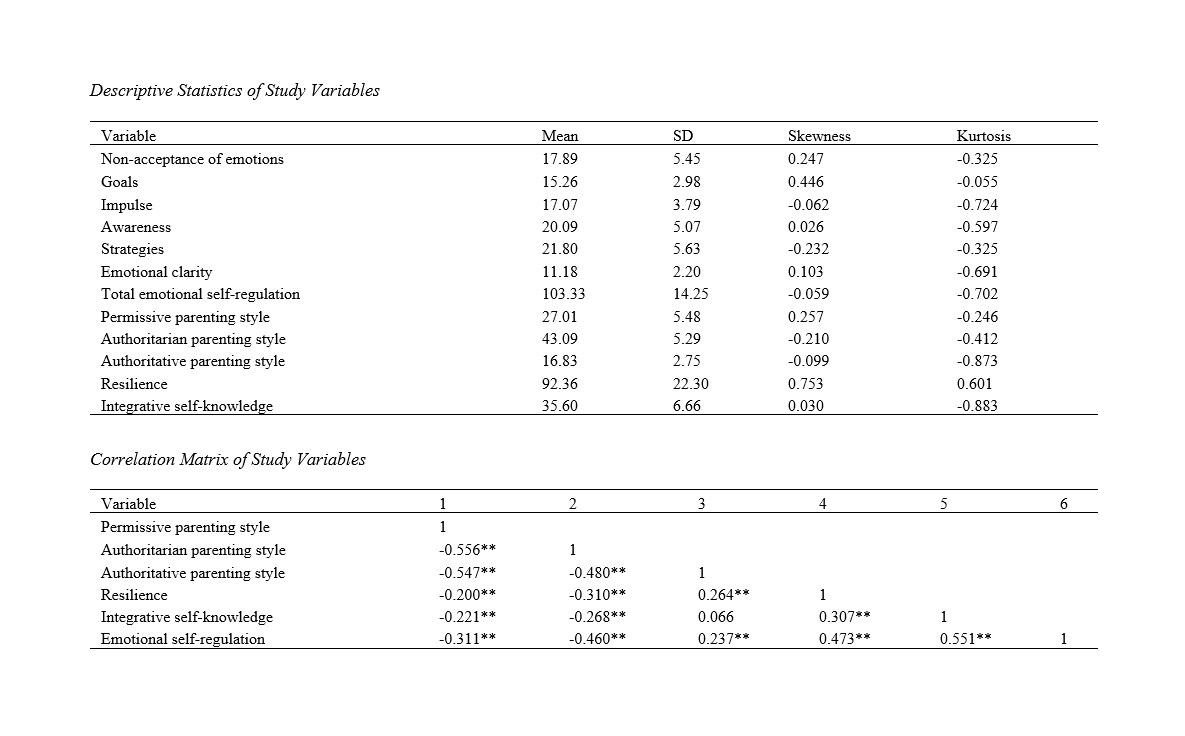
Findings: The results indicated that emotional self-regulation, integrative self-knowledge, and resilience significantly predicted parenting styles. Emotional self-regulation (β = -0.485, p < .001), integrative self-knowledge (β = -0.141, p < .05), and resilience (β = -0.131, p < .05) negatively predicted authoritarian parenting, with the model explaining 25.5% of the variance (R² = 0.255). For permissive parenting, emotional self-regulation (β = -0.229, p < .001) and integrative self-knowledge (β = -0.204, p < .001) were significant negative predictors, while resilience was not significant, and the model explained 15.4% of the variance (R² = 0.154). In predicting authoritative parenting, integrative self-knowledge (β = 0.194, p < .01) and resilience (β = 0.296, p < .001) were significant positive predictors, while emotional self-regulation was not significant (β = 0.092, p > .05), with the model explaining 10% of the variance (R² = 0.100). Correlation analyses also revealed significant relationships among the study variables.
Conclusion: The findings suggest that emotional self-regulation, integrative self-knowledge, and resilience play important roles in shaping parenting styles among parents of children with intellectual disabilities, with adaptive psychological resources promoting authoritative parenting and reducing maladaptive styles.
Downloads
References
Alarcon-Espinoza, M., Sanduvete-Chaves, S., Anguera, M. T., Samper Garcia, P., & Chacon-Moscoso, S. (2022). Emotional Self-Regulation in Everyday Life: A Systematic Review. Frontiers in psychology, 13, 884756. https://doi.org/10.3389/fpsyg.2022.884756
Baneshi, F., & Bagholi, H. (2019). Comparison of Parenting Styles, Emotion Regulation, and Happiness among Parents of Children with Autism and Children with Attention-Deficit/Hyperactivity Disorder Islamic Azad University, Marvdasht Branch].
Brodaty, H., & Donkin, M. (2022). Family Caregivers of People with Dementia. Dialogues in clinical neuroscience.
Cheng, A. W., & Lai, C. Y. (2023). Parental Stress in Families of Children with Special Educational Needs: A Systematic Review. Frontiers in Psychiatry, 14, 1198302. https://doi.org/10.3389/fpsyt.2023.1198302
Colton, K. C., Godleski, S. A., & Crane, C. A. (2023). Applying a Bifactor Model to the Functions of Relational Aggression: Associations with Hostile Attribution Biases and Difficulties with Emotion Regulation. Aggressive Behavior. https://doi.org/10.1002/ab.22053
Dukmak, S. J., Mousa, A., & Algharaibeh, M. (2023). Child Behavior Problems as Predictors of Stress in Parents of Children with Developmental and Intellectual Disabilities in Four Emirates of the United Arab Emirates. Journal of Mental Health Research in Intellectual Disabilities, 16(2), 114-141. https://doi.org/10.1080/19315864.2022.2098434
Ericson Lidman, E., & Antonsson, H. (2022). Registered Nurses' Experiences of Challenging Situations in Their Psychosocial Working Environment in Home Care of Patients with Functional and/or Intellectual Disability: A Qualitative Study. Nordic Journal of Nursing Research, 20(5), 700-725. https://doi.org/10.1177/20571585221096585
Etesamifard, H., & Alaviniya, N. (2025). A Comparison of Object Relations, Self-Compassion, and Coherent Self-Knowledge among Students with Different Levels of Love Trauma. Quarterly Journal of Psychological and Educational Studies, 11(1).
Francesconi, M., Flouri, E., & Harrison, A. (2022). Decision-Making Difficulties Mediate the Association between Poor Emotion Regulation and Eating Disorder Symptoms in Adolescence. Psychological medicine, 1-10. https://doi.org/10.1017/S003329172200037X
Habibi, N., Mikaeili, N., & Hatami Varzaneh, A. (2023). The Mediating Role of Emotional Self-Regulation in the Relationship between Perceived Social Support and Parenting Self-Efficacy among Parents of Children with Phenylketonuria. Empowering Exceptional Children, 14(1).
Iwanski, A., Lichtenstein, L., Paulus, J., Werner, C., Walper, S., Vierhaus, M., & Zimmermann, P. (2025). Parental Emotion Regulation and Children's Mental Health: Longitudinal Mediation by Parenting Stress and Sensitive Challenging Parenting. Personality and individual differences, 246, 113262. https://doi.org/10.1016/j.paid.2025.113262
Javanmojarad, A. (2024). The Mediating Role of Resilience in the Relationship between Self-Concept and Negative Affect among Students. Rooyesh-e-Ravanshenasi, 13(1), 11-18.
Khalil Arjomandi, F., Kashani Vahid, L., & Vakili, S. (2024). Developing a Structural Model of Psychological Well-Being among Mothers of Children with Intellectual Disability Based on Core Self-Evaluation with the Mediation of Inferiority Feeling. Journal of Psychological Science, 23(134), 131-146.
Langley, E., Totsika, V., & Hastings, R. P. (2020). Psychological Well-Being of Fathers with and without a Child with Intellectual Disability: A Population-Based Study. Journal of Intellectual Disability Research, 64(6), 399-413. https://doi.org/10.1111/jir.12692
Lara-Cabrera, M. L., Betancort, M., Muñoz-Rubilar, C. A., Rodríguez Novo, N., & De las Cuevas, C. (2021). The Mediating Role of Resilience in the Relationship between Perceived Stress and Mental Health. International journal of environmental research and public health, 18(18), 9762. https://doi.org/10.3390/ijerph18189762
MacKinnon, A. L., Silang, K., & Penner, K. (2022). Promoting Mental Health in Parents of Young Children Using eHealth Interventions: A Systematic Review and Meta-Analysis. Clinical Child and Family Psychology Review, 25(3), 413-434. https://doi.org/10.1007/s10567-022-00385-5
Mikolajczak, M., Gross, J. J., & Roskam, I. (2019). Parental Burnout: What Is It, and Why Does It Matter? Clinical Psychological Science, 7(6), 1319-1329. https://doi.org/10.1177/2167702619858430
Ping, Y., Wang, W., Li, Y., & Li, Y. (2022). Fathers' Parenting Stress, Parenting Styles and Children's Problem Behavior: The Mediating Role of Parental Burnout. Current Psychology, 1-13. https://doi.org/10.1007/s12144-022-03667-x
Piro-Gambetti, B., Greenlee, J., Hickey, E. J., Putney, J. M., Lorang, E., & Hartley, S. L. (2023). Parental Depression Symptoms and Internalizing Mental Health Problems in Autistic Children. Journal of Autism and Developmental Disorders, 53(6), 2373-2383. https://doi.org/10.1007/s10803-022-05518-x
Rohi, M., Manzari Tavakoli, A., & Tajrobe Kar, M. (2022). The Effectiveness of Cognitive-Behavioral Therapy on Coherent Self-Knowledge, Emotion Regulation, and Quality of Life in Hemodialysis Patients: A Quasi-Experimental Study. Rafsanjan University of Medical Sciences Journal, 21(10), 1055-1070. https://doi.org/10.52547/jrums.21.10.1055
Shabahang, R., Khosrojavid, M., & Ahmadi, A. (2018). The Role of Attitude and Resilience in Predicting Quality of Life among Parents of Exceptional Children. Child Mental Health Quarterly, 5(3), 11-21.
Shafiei, H., Aghajani, S., & Basharpoor, S. (2023). Examining the Relationship between Emotional Self-Regulation and Psychological Distress among Mothers of Children with Autism. Second National Conference on Psychotherapy, Ardabil,
Shams, S., & Kakabraei, K. (2022). A Comparison of Perceived Stress, Mental Comfort, and Resilience among Parents of Children with Autism, Intellectual Disabilities, and ADHD. A New Approach in Educational Sciences, 4(2), 134-144.
Shams, S., & Kakabraei, K. (2022). A Comparison of Perceived Stress, Mental Comfort, and Resilience among Parents of Children with Autism, Intellectual Disability, and Hyperactivity. A New Approach in Educational Sciences, 4(2), 134-144.
Shi, K., Feng, G., Huang, Q., Ye, M., & Cui, H. (2023). Mindfulness and Negative Emotions among Chinese College Students: Chain Mediation Effect of Rumination and Resilience. Frontiers in psychology, 14(2), 1-14. https://doi.org/10.3389/fpsyg.2023.1280663
Singer, G. H., Maul, C., Wang, M., & Ethridge, B. L. (2021). Resilience in Families of Children with Disabilities: Risk and Protective Factors. In Handbook of Special Education (pp. 654-667). Routledge.
Singh, A., & Verma, R. (2017). Unplanned Journey of Parenting a Child with Special Needs. PARIPEX Indian Journal of Research, 6(3), 581-583.
Teymouri, S., & Ataeifar, R. (2019). The Relationship between Maternal Stress and Child Behavioral and Emotional Disorders. Thought and Behavior, 4(16), 17-26.
Wang, W., Song, T., Chen, S., Li, Y., & Li, Y. (2023). Work-Family Enrichment and Parental Burnout: The Mediating Effects of Parenting Sense of Competence and Parenting Stress. Current Psychology, 1-11.
Yıldırım, M., & Solmaz, F. (2022). COVID-19 Burnout, COVID-19 Stress and Resilience: Initial Psychometric Properties of COVID-19 Burnout Scale. Death Studies, 46(3), 524-532. https://doi.org/10.1080/07481187.2020.1818885
Zhang, X., Gatzke-Kopp, L. M., & Cole, P. M. O. (2022). A Dynamic Systems Account of Parental Self-Regulation Processes in the Context of Challenging Child Behavior. Child development, 93(5), 501-514. https://doi.org/10.1111/cdev.13808
Zimmer-Gembeck, M. J., Rudolph, J., Kerin, J., & Bohadana-Brown, G. (2022). Parent Emotional Regulation: A Meta-Analytic Review of Its Association with Parenting and Child Adjustment. International Journal of Behavioral Development, 46(1), 63-82. https://doi.org/10.1177/01650254211051086
Downloads
Publication Timeline
- Submitted
- Revised
- Accepted