Modeling Coparenting Quality Based on Marital Satisfaction, Emotional Intelligence, Parenting Alliance, and Psychological Flexibility
DOI:
https://doi.org/10.61838/kman.aftj.5451Keywords:
Coparenting Quality, Marital Satisfaction, Emotional Intelligence, Parenting Alliance, Psychological FlexibilityAbstract
Objective: The present study aimed to develop and test a structural model of coparenting quality based on marital satisfaction, emotional intelligence, parenting alliance, and psychological flexibility among Canadian parents.
Methods and Materials: This study employed a cross-sectional correlational design using structural equation modeling (SEM). The study population consisted of married or cohabiting parents residing in Canada who had at least one child between the ages of 3 and 16 years. A total of 624 parents were recruited through community organizations, educational institutions, parenting networks, and online platforms using convenience sampling. Data were collected using the Coparenting Relationship Scale (CRS), Revised Dyadic Adjustment Scale (RDAS), Wong and Law Emotional Intelligence Scale (WLEIS), Parenting Alliance Measure (PAM), and Acceptance and Action Questionnaire-II (AAQ-II). Descriptive statistics, Pearson correlation analysis, confirmatory factor analysis, and structural equation modeling were conducted using SPSS 29 and AMOS 29. Model fit was evaluated using χ²/df, CFI, TLI, GFI, AGFI, RMSEA, and SRMR indices.
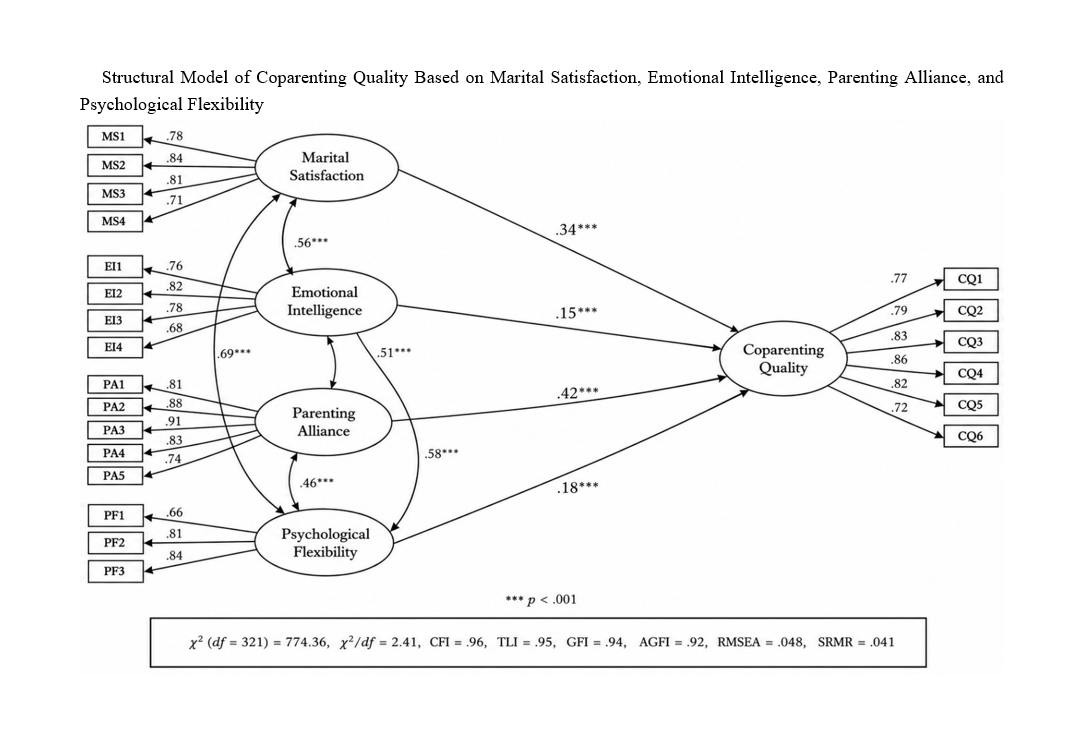
Findings: The results revealed significant positive correlations among all study variables. The proposed structural model demonstrated excellent fit to the data (χ²/df = 2.41, CFI = .96, TLI = .95, GFI = .94, AGFI = .92, RMSEA = .048, SRMR = .041). Structural path analysis indicated that parenting alliance was the strongest predictor of coparenting quality (β = .42, p < .001), followed by marital satisfaction (β = .34, p < .001), psychological flexibility (β = .18, p < .001), and emotional intelligence (β = .15, p < .001). Collectively, the predictor variables explained 68% of the variance in coparenting quality (R² = .68), demonstrating substantial explanatory power.
Conclusion: The findings indicate that coparenting quality is significantly influenced by both relational and psychological factors. Parenting alliance and marital satisfaction emerged as particularly influential determinants, while emotional intelligence and psychological flexibility contributed additional explanatory value.
Downloads
References
Allen, E. S., Renshaw, K. D., & Fredman, S. J. (2023). An Exploration of Potential Pressures to Engage in Parenting Accommodation of PTSD Symptoms for Military Couples. Family Process, 63(1), 315-330. https://doi.org/10.1111/famp.12858
Baumann, M., Villeneuve, É., Bélanger, C., Paradis, A., Herba, C. M., & Godbout, N. (2025). Dyadic Analysis of Cumulative Childhood Trauma and Relationship Satisfaction: The Role of Parental Alliance. Journal of marital and family therapy, 51(2). https://doi.org/10.1111/jmft.70002
Brites, R., Brandão, T., Hipólito, J., Jiménez-Ros, A. M., & Nunes, O. (2023). Emotion Regulation, Resilience, and Mental Health: A Mediation Study With University Students in the Pandemic Context. Psychology in the Schools, 61(1), 304-328. https://doi.org/10.1002/pits.23055
Demy, J., Jambon, M., Wade, M., Muise, A., & Prime, H. (2025). Secondary Benefits of a Brief Couples Intervention on Coparenting Through Relationship Quality and Partner Conflict. Infant Mental Health Journal Infancy and Early Childhood, 46(6), 778-796. https://doi.org/10.1002/imhj.70027
Deschênes, M., Bernier, A., Cyr, C., Paradis, A., & Rassart, C. A. (2022). Marital Satisfaction, Parenting Stress, and Family Alliance: Parental Perspective Taking as a Moderator. Family Process, 62(3), 1147-1160. https://doi.org/10.1111/famp.12812
Engström, A. H., Alvariza, A., Kuylenstierna, A., Wikman, A., & Ljungman, L. (2025). Navigating the Hardship Together: Factors Associated With Couple Relationship Functioning in Parents With Cancer Who Have Dependent Children. Psycho-Oncology, 34(8). https://doi.org/10.1002/pon.70245
Georgoulas‐Sherry, V. (2022). Understanding the Distinctions of Positive Constructs Resilience, Grit and Hardiness. American Journal of Medical and Clinical Sciences, 7(2). https://doi.org/10.33425/2832-4226/22006
Goldin, D., Maltseva, T., Scaccianoce, M., & Brenes, F. (2022). Holistic Psychosocial Approaches in the Care of Hispanic Victims of Trauma: An Overview. Journal of Holistic Nursing, 41(1), 7-16. https://doi.org/10.1177/08980101221083162
Güre, P., Gürmen, M. S., & Acar, İ. H. (2024). Dyadic Examination of Parents' General Psychological Distress and Coparenting in Families With Young Children: The Mediating Role of Couple Satisfaction. Journal of marital and family therapy, 51(1). https://doi.org/10.1111/jmft.12739
Im, H., Lee, S., Warsame, A. H., & Isse, M. (2025). Beyond Individual Coping: The Role of Social Capital in Community-Based Mental Health Support for Displaced Somali Youth. International journal of environmental research and public health, 22(5), 784. https://doi.org/10.3390/ijerph22050784
Jacobvitz, D., Aviles, A. I., Aquino, G. A., Tian, Z., Zhang, S., & Hazen, N. (2022). Fathers’ Sensitivity in Infancy and Externalizing Problems in Middle Childhood: The Role of Coparenting. Frontiers in psychology, 13. https://doi.org/10.3389/fpsyg.2022.805188
Ji, W., Lan, R., Ma, P., Zhang, H., & Fan, L. (2023). Maternal Positive Coparenting and Adolescent Ego-Identity: The Chain Mediating Role of Fathers’ Marital Satisfaction and Adolescent Peer Relationships. Frontiers in psychology, 14. https://doi.org/10.3389/fpsyg.2023.1227941
Kalra, G. K., Beauty, & Modi, K. (2025). Rethinking Contours of Family Through Diverse Lenses: Beyond the Conventional Context. Institutionalised Children Explorations and Beyond, 12(2), 239-251. https://doi.org/10.1177/23493003251364952
Kosić, R., Petrić, D., Vlašić-Cicvarić, I., & Kosec, T. (2025). Associations Between Parental Alexithymia and Family Dynamics in Autism Spectrum Disorder. Healthcare, 13(4), 373. https://doi.org/10.3390/healthcare13040373
Letot, J. (2026). Marital Satisfaction and the Quality of Mother–Father–Child Triadic Interactions: A Systematic Review. Family Relations. https://doi.org/10.1111/fare.70131
Lie, S. Ø., Wisting, L., Stedal, K., Rø, Ø., & Friborg, O. (2023). Stressful Life Events and Resilience in Individuals With and Without a History of Eating Disorders: A Latent Class Analysis. Journal of eating disorders, 11(1). https://doi.org/10.1186/s40337-023-00907-8
Lindstedt, J., Ahlqvist‐Björkroth, S., Junttila, N., & Korja, R. (2024). Latent Profiles of Dyadic Parent–child Interaction and Associations With Triadic Family Interaction in Early Childhood. Family Relations, 73(4), 2564-2581. https://doi.org/10.1111/fare.13041
Low, W. Y., Zhao, Y., Geetha, V., & Bono, S. A. (2025). Walter Patrick Memorial Lecture: Building Resilience in Families and Communities in Times of Crisis. Asia Pacific Journal of Public Health, 37(4), 361-365. https://doi.org/10.1177/10105395251340119
Luo, D., Foster, K., & White, K. (2025). Conceptualisation and Measurement of Resilience of Adults With Cancer: An Umbrella Review. Journal of Advanced Nursing, 81(10), 6095-6119. https://doi.org/10.1111/jan.16724
Magantor, J. (2024). Family Psychological Distress Among OFW Parents and Their Children in the Middle East: A Mixed Method Study. Asian Journal of Education and Social Studies, 50(11), 33-45. https://doi.org/10.9734/ajess/2024/v50i111633
McHale, J. P., & Jenkins, K. L. (2023). Thinking Three, Revisited: Infants, Coparents, Gender Roles, and Cultural Contexts. Australian and New Zealand Journal of Family Therapy, 44(4), 495-510. https://doi.org/10.1002/anzf.1566
Mohammadhosseini, M., & Schmid, S. (2025). Embodied Engagement: Fostering Caring Thinking in a Multimodal Singing-Based Learning Environment for Refugee Children. Frontiers in psychology, 16. https://doi.org/10.3389/fpsyg.2025.1602855
Northey, W. F., Chang, J., & Guyette, E. (2025). Introduction to the Special Issue on Working With High‐Conflict Families in Custody Contexts: A Call to Action. Journal of marital and family therapy, 52(1). https://doi.org/10.1111/jmft.70087
Parrott, E., Bernardino, A., Lomeli-Rodriguez, M., Burgess, R., Rahman, A., Direzkia, Y., & Joffé, H. (2023). Community Resilience After Disasters: Exploring Teacher, Caregiver and Student Conceptualisations in Indonesia. Sustainability, 16(1), 73. https://doi.org/10.3390/su16010073
Ragni, B., Stasio, S. D., & McHale, J. P. (2024). An Online Coparenting-Based Intervention for Italian Non-Divorced Couples: The Creation of the Coparent2Balance Curriculum. https://doi.org/10.31219/osf.io/4gc6t
Rassart, C. A. (2026). What Do I Bring to the Team? Self‐Capacities Mediate the Association Between Childhood Interpersonal Trauma and Parenting Alliance in Couples. Family Process, 65(1). https://doi.org/10.1111/famp.70124
Rassart, C. A., Paradis, A., Herba, C. M., & Godbout, N. (2024). Childhood Interpersonal Trauma and Postpartum Parenting Alliance: The Role of Mindfulness in Couples. Journal of Family Psychology, 38(2), 223-235. https://doi.org/10.1037/fam0001174
Restrepo, L. E. V., Hernández, G. J. B., & Astudillo, M. N. M. (2023). Socio-Family Factors Predictive of Adaptative Coping Post COVID-19 Pandemic in Nursing Students From a Private University. Investigación Y Educación en Enfermería, 41(2). https://doi.org/10.17533/udea.iee.v41n2e05
Roberts, C. L., & Symons, F. J. (2023). Self‐injurious Behavior in Individuals With Intellectual and Developmental Disabilities: An Interdisciplinary Family Systems Review. Journal of Family Theory & Review, 16(2), 329-351. https://doi.org/10.1111/jftr.12548
Romet, M., Favez, N., Ranjbar, S., Urben, S., & Tissot, H. (2025). Associations Between the Quality of Family Interactions During a Mother–father–adolescent Conflict Discussion Task and Physiological Emotion Regulation in Adolescents. PLOS Ment Health, 2(3), e0000246. https://doi.org/10.1371/journal.pmen.0000246
Ronaghan, D., Gaulke, T., & Theule, J. (2024). The Association Between Marital Satisfaction and Coparenting Quality: A Meta-Analysis. Journal of Family Psychology, 38(2), 236-245. https://doi.org/10.1037/fam0001149
Sabah, A., Aljaberi, M. A., Hajji, J., Fang, C. Y., Lai, Y.-C., & Lin, C. Y. (2023). Family Communication as a Mediator Between Family Resilience and Family Functioning Under the Quarantine and COVID-19 Pandemic in Arabic Countries. Children, 10(11), 1742. https://doi.org/10.3390/children10111742
Schmidt, C. D., Misurell, J. R., Feder, M., Peffer, A., & Grigg, J. (2025). Helping Children Heal: Counseling Interventions for Divorce-Related Family Disruption. The Family Journal, 34(1), 170-180. https://doi.org/10.1177/10664807251360788
Sezgin, E. (2025). The Mediating Effect of Mindfulness on Adverse Childhood Experiences and Psychological Resilience in Turkish Female University Students. Frontiers in psychology, 16. https://doi.org/10.3389/fpsyg.2025.1528159
Shao, M., Xue, Y., Zhang, M., Zhou, H., Ma, B., Wang, K., Yang, Y., Yu, L., Chen, C., & Wang, T. (2024). Family Mutuality Enhances the Family Resilience of CRC Patients Through Positive Family Functioning. https://doi.org/10.21203/rs.3.rs-4793857/v1
Shen, Z., Fang, Y., Li, C., Luo, X., Cui, J., Liu, Y., & Hong, J. (2025). Family Resilience and Its Influencing Factors Among Patients With Lung Cancer Based on Double ABC‐X Theoretical Framework. Cancer Medicine, 14(8). https://doi.org/10.1002/cam4.70868
Silva, K., Amarneh, D., & Viana, A. G. (2024). Acculturative Stress Among Latino Youth. Advances in Psychiatry and Behavioral Health, 4(1), 199-210. https://doi.org/10.1016/j.ypsc.2024.05.014
Smith, N., Bostock, L., Barrett, E., Sandal, G. M., Jones, M. V., & Wuebker, R. (2023). Profiles of Resilient Psychosocial Function During Three Isolated Ski Expeditions in the High Arctic. Stress and Health, 40(3). https://doi.org/10.1002/smi.3331
Son, H.-J., & Park, S.-A. (2025). The Impact of an Agro-Healing Program on Family Resilience, Parental Stress, and Social Skills of Children With Developmental Disabilities. Heliyon, 11(4), e42389. https://doi.org/10.1016/j.heliyon.2025.e42389
Song, S., Ding, W., Tan, D., Lin, X., & Chen, Y. R. (2025). Actor–spouse Interdependence of Marital Satisfaction on Coparenting in Longitudinal Relationship: The Mediating Role of Self‐compassion. Family Relations, 74(4), 1477-1492. https://doi.org/10.1111/fare.13177
Sousa, D., Ana Lúcia da Silva, F., Sequeira, J., Monteiro, M. J., Simões, M., & Castelo-Branco, M. (2024). Brief Report: Caregivers’ Well-Being in Families With Neurodevelopmental Disorders Members During COVID-19: Implications for Family Therapy. Frontiers in Psychiatry, 15. https://doi.org/10.3389/fpsyt.2024.1409294
Tissot, H., & Favez, N. (2023). The Lausanne Trilogue Play: Bringing Together Developmental and Systemic Perspectives in Clinical Settings. Australian and New Zealand Journal of Family Therapy, 44(4), 511-520. https://doi.org/10.1002/anzf.1559
Uditha, S., & Bulathwatta, A. (2025). Predictability of the Psychological Impact of the Economic Crisis on Family Functioning Within the Family Context in Sri Lanka. Frontiers in psychology, 16. https://doi.org/10.3389/fpsyg.2025.1587710
Ulloque, M. J., Villalba, S., Foscarini, G., Quinteros, S., Calzadilla‐Núñez, A., Reyes‐Reyes, A., & Díaz-Narváez, V. P. (2023). Family Functioning as an Explanatory Factor of Empathic Behavior in Argentine Medical Students. Behavioral Sciences, 13(5), 356. https://doi.org/10.3390/bs13050356
Xie, S., Chen, S., Xia, M., Chen, X., & Chi, X. (2025). Investigating the Interplay Among Family Climate, Mother–child Closeness, and Young Children’s Psychosocial Functioning: Integrating Large-Scale Surveys With Daily Diary Design. Translational Issues in Psychological Science. https://doi.org/10.1037/tps0000464
Yousefi, Z., Saadati, N., & Golparvar, M. (2024). The Impact of Emotional Intelligence and Resilience on Family Cohesion: Insights From Married Individuals. Journal of Psychosociological Research in Family and Culture, 16-22. https://doi.org/10.61838/kman.jprfc.2.1.4
Zhu, Z. (2025). Family Resilience, Emotional Intelligence, and Non-Suicidal Self-Injury Among Chinese Adolescents With Mental Disorders: A Latent Variable Mediation Analysis. Frontiers in Psychiatry, 16. https://doi.org/10.3389/fpsyt.2025.1631266
Downloads
Additional Files
Publication Timeline
- Submitted
- Revised
- Accepted