Random Forest Prediction of Family Functioning Based on Emotional Availability, Family Communication, Psychological Well-Being, and Coping Self-Efficacy
DOI:
https://doi.org/10.61838/kman.aftj.5462Keywords:
Family Functioning, Random Forest, Emotional Availability, Family Communication, Psychological Well-Being, Coping Self-EfficacyAbstract
Objective: The present study aimed to develop and evaluate a Random Forest machine learning model for predicting family functioning based on emotional availability, family communication, psychological well-being, and coping self-efficacy among Canadian adults.
Methods and Materials: This cross-sectional predictive study was conducted among 768 adults residing in Canada who were recruited through community organizations, social media platforms, and online advertisements. Data were collected using the Family Assessment Device (FAD), Brief Emotional Availability Scale (BEAS), Family Communication Scale (FCS), Ryff’s Psychological Well-Being Scale (PWB), and the Coping Self-Efficacy Scale (CSE). Following data screening and preprocessing procedures, descriptive statistics and Pearson correlations were calculated. The dataset was randomly divided into training (80%) and testing (20%) subsets. A Random Forest regression model was developed using five-fold cross-validation and hyperparameter optimization procedures. Model performance was evaluated using the coefficient of determination (R²), root mean square error (RMSE), mean absolute error (MAE), and mean squared error (MSE). Feature importance and SHAP (Shapley Additive Explanations) analyses were employed to determine the relative contribution of each predictor variable.
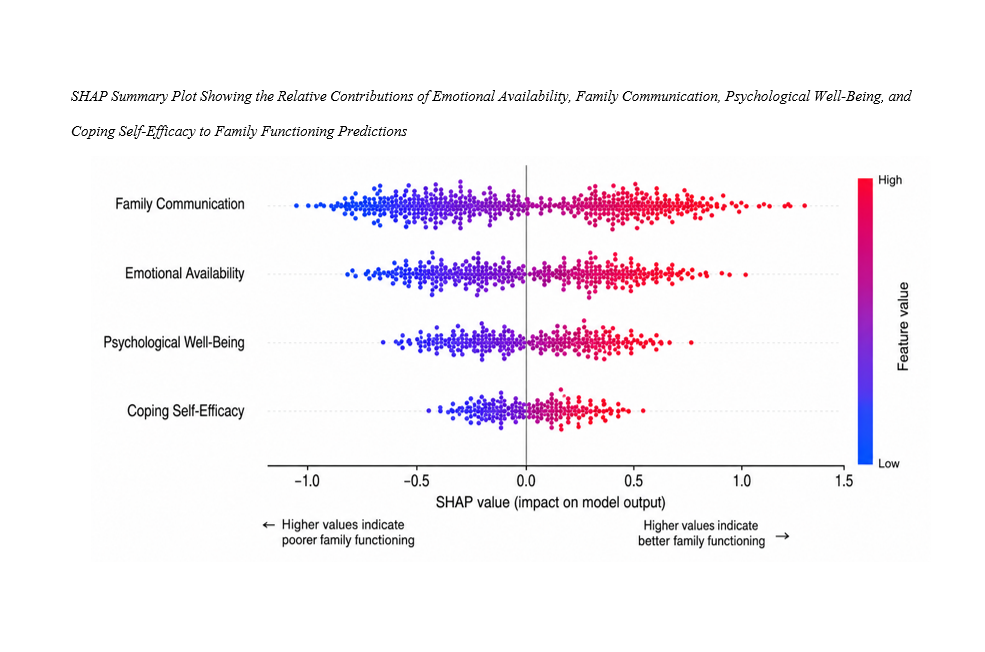
Findings: Significant associations were observed between family functioning and all predictor variables. Family communication demonstrated the strongest negative correlation with family dysfunction (r = -.76, p < .001), followed by emotional availability (r = -.71, p < .001), psychological well-being (r = -.68, p < .001), and coping self-efficacy (r = -.64, p < .001). The Random Forest model achieved strong predictive performance, yielding an R² of .847 on the testing dataset and a cross-validation R² of .836. Feature importance analysis identified family communication (37.2%) as the most influential predictor, followed by emotional availability (28.6%), psychological well-being (20.4%), and coping self-efficacy (13.8%). Permutation importance and SHAP analyses confirmed the stability of this predictor hierarchy and revealed that communication and emotional availability exerted the greatest impact on model predictions.
Conclusion: The findings indicate that family functioning can be predicted with high accuracy using emotional availability, family communication, psychological well-being, and coping self-efficacy. Relational factors, particularly communication quality and emotional availability, emerged as the most influential determinants of family functioning. The results support the application of machine learning approaches in family psychology and highlight key targets for interventions designed to strengthen family relationships and promote adaptive family functioning.
Downloads
References
Baldini, V., Gnazzo, M., Varallo, G., Vincenzo, M. D., Scorza, M., Franceschini, C., Ronchi, D. D., Fiorillo, A., & Plazzi, G. (2025). A Comprehensive Approach to Adolescent Suicide Prevention: Insights From a Narrative Review Perspective. Frontiers in psychology, 16. https://doi.org/10.3389/fpsyg.2025.1612067
Cao, H., Leerkes, E. M., & Zhou, N. (2023). Origins and Development of Maternal Self-Efficacy in Emotion-Related Parenting During the Transition to Parenthood: Toward an Integrative Process Framework Beyond Bandura’s Model. Psychological review, 130(6), 1612-1652. https://doi.org/10.1037/rev0000382
Chong, Y. Y., Yau, P. T., Kwan, J. Y. M., & Chien, W. T. (2024). Roles of Psychological Flexibility, Parenting Competence, and Asthma Management Self-Efficacy in the Functioning Outcomes of Parents of Children With Asthma Co-Occurring With Attention-Deficit/Hyperactivity Disorder. European Journal of Investigation in Health Psychology and Education, 14(11), 2835-2849. https://doi.org/10.3390/ejihpe14110186
Fares‐Otero, N. E., Carranza-Neira, J., Womersley, J. S., Schalinski, I., Vieta, E., Spies, G., & Seedat, S. (2025). Child Maltreatment and Resilience in Adulthood: A Systematic Review and Meta-Analysis. Psychological medicine, 55. https://doi.org/10.1017/s0033291725001205
Finkelstein, S. D. (2025). Does Coparenting Quality Mediate the Link Between Postpartum Parenting Stress and Perceptions of Emotion Regulation During Parenting? Family Process, 64(4). https://doi.org/10.1111/famp.70084
Ge, X. (2025). Bullying Victimization, Suicidal Behavior, and Help-Seeking in Chinese Adolescents: A Legal-Psychological Study of Resilience and Responsibility. Frontiers in psychology, 16. https://doi.org/10.3389/fpsyg.2025.1625188
Gkargkavouzi, A., & Halkos, G. (2025). Psychological Resilience to Climate Change: The Role of Self‐Efficacy, Mindfulness, Perceived Nature Restorativeness, and Subjective Well‐Being. Sustainable Development. https://doi.org/10.1002/sd.70401
Gorla, L., Lansford, J. E., Godwin, J., & Dodge, K. A. (2026). Parent–child Communication and Third Generation’s Difficulties: Roles of Parental Depression and Self-Efficacy. Journal of Family Psychology, 40(4), 544-554. https://doi.org/10.1037/fam0001399
Guillén, V., Arnal, A., Pérez, S., García‐Alandete, J., Fernández‐Felipe, I., Grau, A., Botella, C., & Marco, J. (2023). Family Connections in the Treatment of Relatives of People With Eating Disorders and Personality Disorders: Study Protocol of a Randomized Control Trial. BMC psychology, 11(1). https://doi.org/10.1186/s40359-023-01138-x
Harsono, C. S., & Febriyana, N. (2026). Understanding and Addressing Bullying in Children and Adolescents. Journal of Korean Academy of Child and Adolescent Psychiatry, 37(1), 51-62. https://doi.org/10.5765/jkacap.250040
Hoang, A., Sanders, M. R., Turner, K., Morawska, A., Cobham, V. E., Chainey, C., & Simmons, E. (2024). Connecting Families, Schools, and Communities: A Systems‐contextual Approach to Sustainable Futures for Children. Sustainable Development, 32(5), 4505-4517. https://doi.org/10.1002/sd.2911
Hu, Y., Weng, Y., Ning, P., Han, L., & Zhang, Y. (2025). The Relationship Between Psychological Capital and Subjective Academic Achievement Among Middle School Students: The Chain Mediating Role of Adolescent Internalizing Problems and Life Attitude. BMC psychology, 13(1). https://doi.org/10.1186/s40359-025-03495-1
Lin, J., & Guo, W. (2024). The Research on Risk Factors for Adolescents’ Mental Health. Behavioral Sciences, 14(4), 263. https://doi.org/10.3390/bs14040263
Lin, S. C., Kehoe, C. E., Pozzi, E., Liontos, D., & Whittle, S. (2023). Research Review: Child Emotion Regulation Mediates the Association Between Family Factors And internalizing Symptoms in Children and Adolescents – A Meta‐analysis. Journal of Child Psychology and Psychiatry, 65(3), 260-274. https://doi.org/10.1111/jcpp.13894
Ma, S., Jia, N., & Zhang, W. (2025). Constructing a Predictive Model of Negative Academic Emotions in High School Students Based on Machine Learning Methods. Scientific reports, 15(1). https://doi.org/10.1038/s41598-025-04146-6
O’Brien, K. E., Shepard, A., & Donnelly, L. I. (2023). Coworker Support Amplifies Strain in the COVID‐19 Pandemic for Working Parents. Scandinavian journal of psychology, 65(3), 421-432. https://doi.org/10.1111/sjop.12988
Postigo‐Zegarra, S., Valero‐Moreno, S., Romero‐Reignier, V., & Schoeps, K. (2025). Teachers' Perceived Interplay Between Emotional Intelligence, School Climate and Burnout: A Mixed‐Method Study. Psychology in the Schools, 62(6), 1841-1851. https://doi.org/10.1002/pits.23435
Sparpana, A., & Brock, R. L. (2025). The Interplay Between Prenatal Psychological Flexibility and Couple Secure Base in Promoting Postpartum Parenting. Journal of Family Psychology, 39(7), 929-941. https://doi.org/10.1037/fam0001389
Strasser, K., Arias, P., Alessandri, F., Turner, P., Villarroel, T. E. E., Aldunate, C. P., & Montt, M. E. (2023). Adolescents’ Academic Self-Efficacy and Emotions During the COVID-19 Pandemic: A Latent Profile Analysis of Family and School Risk Factors. School Psychology, 38(2), 88-99. https://doi.org/10.1037/spq0000523
Taştekin, E., Kaymaz, Ç., Işik‐Uslu, A. E., Yüksel‐Doğan, R., Bozkurt‐Yükçü, Ş., & Tok, A. İ. (2025). Coparenting and Mindful Parenting Partially Mediate the Relationship Between Mothers' Stress and Parental Burnout. Family Relations. https://doi.org/10.1111/fare.70027
Tietbohl-Santos, B., Shintani, A. O., Montezano, B. B., Biazin, P., Signori, G. M., Pulice, R. F., Vecchia, G. F. D., Bebber, J. C., Noronha, L. T., & Passos, I. C. (2024). Protective Factors Against Depression in High-Risk Children and Adolescents: A Systematic Review of Longitudinal Studies. Brazilian Journal of Psychiatry. https://doi.org/10.47626/1516-4446-2023-3363
Tobe, H., Sakka, M., Kita, S., Ikeda, M., & Kamibeppu, K. (2022). The Efficacy of a Resilience-Enhancement Program for Mothers Based on Emotion Regulation: A Randomized Controlled Trial in Japan. International journal of environmental research and public health, 19(22), 14953. https://doi.org/10.3390/ijerph192214953
Voltmer, K., & Salisch, M. v. (2023). Promoting Subjective Well-Being and a Sustainable Lifestyle in Children and Youth by Strengthening Their Personal Psychological Resources. Sustainability, 16(1), 134. https://doi.org/10.3390/su16010134
Yang, J. (2025). Influencing Factors of Family Resilience in Stroke Patients and Family Caregivers: A Systematic Review and Meta-Analysis. Frontiers in Public Health, 13. https://doi.org/10.3389/fpubh.2025.1716213
Yang, X. (2025). Effectiveness of Digital Health on Psychological Well-Being in Parents of Children With Cancer: A Systematic Review and Meta-Analysis of Randomized Controlled Trials. BMC Cancer, 25(1). https://doi.org/10.1186/s12885-025-15050-7
Zhang, B., & Zhang, X. (2024). Correlation Between Self-Efficacy, Parental Parenting Patterns, and Severe Depression in Adolescents. World journal of psychiatry, 14(12), 1827-1835. https://doi.org/10.5498/wjp.v14.i12.1827
Zhang, Z., Chen, H., Ye, Y., Chen, H., Guo, H., & Zhou, J. (2025). Entropy-Based Risk Network Identification in Adolescent Self-Injurious Behavior Using Machine Learning and Network Analysis. Translational psychiatry, 15(1). https://doi.org/10.1038/s41398-025-03511-3
Zhou, Y.-B. (2025). Effects of Parental Burnout and Psychological Intrusion on Adolescent Resilience. Scientific reports, 15(1). https://doi.org/10.1038/s41598-025-22522-0
Downloads
Additional Files
Publication Timeline
- Submitted
- Revised
- Accepted