Investigating the Effectiveness of Schema Therapy on Intolerance of Uncertainty, Rejection Sensitivity, and Self-Critical Rumination in Women Victims of Emotional Abuse
Keywords:
Schema therapy, intolerance of uncertainty, rejection sensitivity, self-critical rumination, women victims of emotional abuseAbstract
Objective: The present study aimed to investigate the effectiveness of schema therapy on intolerance of uncertainty, rejection sensitivity, and self-critical rumination among women victims of emotional abuse.
Methods and Materials: In terms of purpose, this study was applied research, and in terms of design, it was a quasi-experimental study employing a pretest–posttest design with follow-up and a control group. The statistical population consisted of all women victims of emotional abuse who referred to counseling centers, psychological clinics, and support centers for victims of unhealthy relationships in Tehran in 2025. The research sample was selected using purposive and convenience sampling methods and included 30 women who, after meeting the inclusion criteria and completing informed consent forms, were randomly assigned to an experimental group (n = 15) and a control group (n = 15). The experimental group received schema therapy intervention during 10 weekly 60-minute sessions, whereas the control group received no intervention during this period. Data were collected using the Intolerance of Uncertainty Questionnaire (Carleton et al., 2007), the Rejection Sensitivity Scale (Downey & Feldman, 1996), and the Self-Critical Rumination Questionnaire (Smart et al., 2016). The instruments demonstrated adequate validity and reliability in both Iranian and international samples. Data were collected at three stages, including pretest, posttest, and follow-up, and were analyzed using repeated-measures analysis of variance in IBM SPSS Statistics.
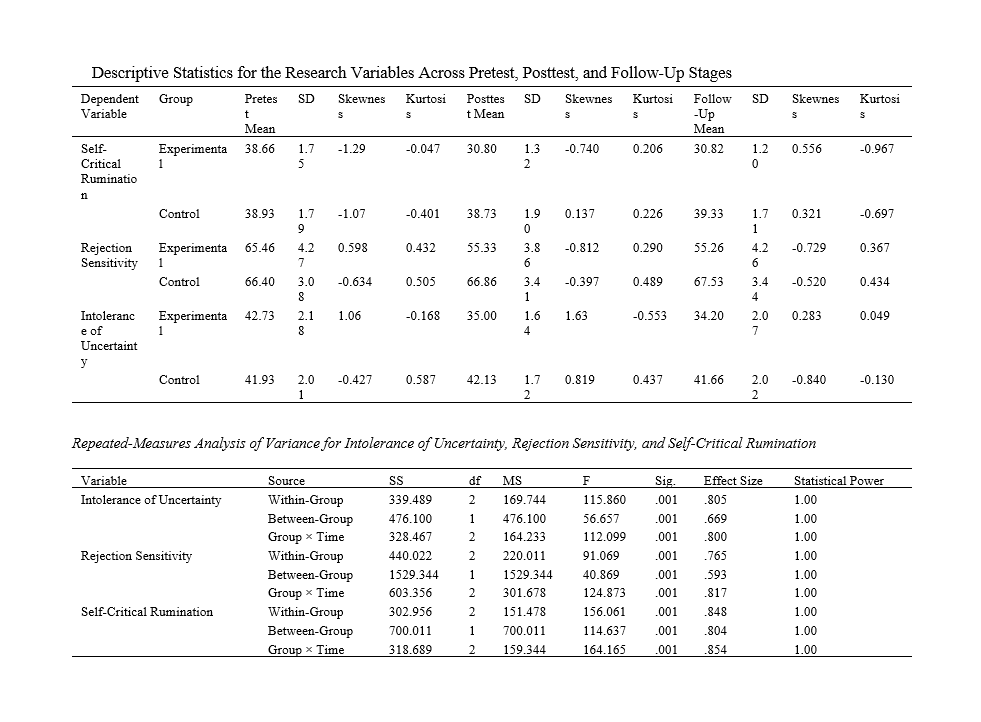
Findings: The findings indicated that schema therapy significantly reduced intolerance of uncertainty, rejection sensitivity, and self-critical rumination in the experimental group compared with the control group (p < .001), and these improvements remained stable at the follow-up stage. Furthermore, the large effect sizes and complete statistical power indicated the strong and robust effectiveness of the intervention.
Conclusion: Based on the findings, it can be concluded that schema therapy is an effective approach for reducing the cognitive-emotional vulnerabilities of women victims of emotional abuse and may be implemented as an empowering psychological intervention in counseling and support service centers.
Downloads
References
Abedini, G., Khezri-Moghadam, N., & Mousavi, S. H. (2025). Predicting Attitude toward Infidelity Based on Marital Communication Transparency and Rejection Sensitivity with the Mediating Role of Social Network Use in Conflicted Couples. Thought and Behavior in Clinical Psychology(77), 113-128.
Alipour Parvaj, H., Alikhani, H., & Hamzepour Haghighi, T. (2025). The Mediating Role of Self-Critical Rumination in the Relationship between Cyberbullying Victimization and Psychological Distress in Adolescents. Rooyesh-e-Ravanshenasi, 14(11), 211-220.
Bell, K. M., Holmberg, D., & Chapman, Z. A. (2025). The Perils of the Unknown: Intolerance of Uncertainty and Intimate Partner Violence across the First Four Pandemic Waves. Journal of interpersonal violence, 40(9-10), 2381-2404. https://doi.org/10.1177/08862605241270064
Besharat, M. A., Mirjalili, R., & Bahrami Ehsan, H. (2015). The Moderating Role of Metacognitive Beliefs and Deficit in Cognitive Emotion Regulation in Relationship between Intolerance of Uncertainty and Worry in Patients with Obsessive-Compulsive Disorder. Journal of Modern Psychological Researches, 10(37), 1-24.
Cabras, C., Mondo, M., Diana, A., & Sechi, C. (2020). Relationships between Trait Emotional Intelligence, Mood States, and Future Orientation among Female Italian Victims of Intimate Partner Violence. Heliyon, 6(11), e05538. https://doi.org/10.1016/j.heliyon.2020.e05538
Carleton, R. N., Norton, P. J., & Asmundson, G. J. G. (2007). Fearing the Unknown: A Short Version of the Intolerance of Uncertainty Scale. Journal of anxiety disorders, 21, 105-117.
Crapolicchio, E., Vezzali, L., & Regalia, C. (2021). I Forgive Myself: The Association between Self-Criticism, Self-Acceptance, and PTSD in Women Victims of IPV, and the Buffering Role of Self-Efficacy. Journal of Community Psychology, 49(2), 252-265. https://doi.org/10.1002/jcop.22454
Davis, M., Gilbar, O., & Padilla-Medina, D. M. (2021). Intimate Partner Violence Victimization and Perpetration among U.S. Adults during the Earliest Stage of the COVID-19 Pandemic. Violence and Victims, 36(5), 583-603. https://doi.org/10.1891/VV-D-21-00005
Downey, G., & Feldman, S. I. (1996). Implications of Rejection Sensitivity for Intimate Relationships. Journal of personality and social psychology, 70(6), 1327-1343. https://doi.org/10.1037/0022-3514.70.6.1327
Duchesne, S., Donnadieu, A. C., Chariot, P., & Louis-Sylvestre, C. (2021). Screening for Domestic Violence during Pregnancy Follow-Up: Evaluation of an Intervention in an Antenatal Service. Archives of Women’s Mental Health, 24(2), 293-301. https://doi.org/10.1007/s00737-020-01058-4
Dugas, M. J., Koerner, N., & Freeston, M. H. (2026). State of the Science: Intolerance of Uncertainty. Behavior therapy, 57(1), 17-36. https://doi.org/10.1016/j.beth.2025.08.009
Farmanbar, F., Maredpour, A., & Malekzadeh, M. (2023). The Effectiveness of Schema Therapy on Ambivalence in Emotional Expression, Self-Differentiation, Mentalization and Sensitivity to Rejection in Patients with Borderline Personality Disorder Culture in Damavand Schools. Sociology of Education, 8(2), 245-261.
Fearn, M., Marino, C., Spada, M. M., & Kolubinski, D. C. (2022). Self-Critical Rumination and Associated Metacognitions as Mediators of the Relationship between Perfectionism and Self-Esteem. Journal of Rational-Emotive & Cognitive-Behavior Therapy, 40(1), 155-174. https://doi.org/10.1007/s10942-021-00404-4
Ghaei, F., Abbasi, G., & Hassanzadeh, R. (2025). The Efficacy of Schema Therapy Based on Mindfulness on the Emotion Reactivity and Internal Shame of Betrayed Women. Journal of Psychological Science, 23(144), 141-158.
Karakurt, G., Koc, E., D’Silva, R., Oğuztüzün, Ç., Choudhary, A., Goto, T., & Bolen, S. (2025). Systematic Review on the Treatment of Emotional Abuse Victimization in Women by an Intimate Partner. Journal of family violence, 1-14. https://doi.org/10.1177/08862605241270064
Khayatan, F., Hadian, S., & Golparvar, M. (2025). Comparing Effectiveness of Emotional Schema Therapy, Forgiveness-Based Compassion Therapy and Cognitive-Behavioral Therapy on Affective Capital in Women Victims of Domestic Violence. TB, 23(6), 92-108. http://tbj.ssu.ac.ir/article-1-3704-en.html
Khoshkam, S., Bahrami, F., Rahmatollahi, F., & Najararpourian, S. (2014). Psychometric Properties of the Rejection Sensitivity Questionnaire in University Students in Iran. Psychological Research, 17(1), 24-44. https://sid.ir/paper/66320/fa
Kirk, L., & Bezzant, K. (2020). What Barriers Prevent Health Professionals Screening Women for Domestic Abuse? A Literature Review. British Journal of Nursing, 29(13), 754-760. https://doi.org/10.12968/bjon.2020.29.13.754
Martinez-Sanchis, M., Navarrete, J., Cebolla, A., Molinari, G., Vara, M. D., Banos, R. M., & Herrero, R. (2021). Exploring the Mediator Role of Self-Critical Rumination between Emotion Regulation and Psychopathology: A Validation Study of the Self-Critical Rumination Scale (SCRS) in a Spanish-Speaking Sample. Personality and individual differences, 183, 111115. https://doi.org/10.1016/j.paid.2021.111115
Mishra, M., & Allen, M. S. (2023). Rejection Sensitivity and Romantic Relationships: A Systematic Review and Meta-Analysis. Personality and individual differences, 208, 112186. https://doi.org/10.1016/j.paid.2023.112186
Mishra, M., Reis, S., & Allen, M. S. (2024). Predicting Relationship Outcomes from Rejection Sensitivity in Romantic Couples: Testing Actor and Partner Effects. Current Psychology, 43(36), 29095-29107. https://link.springer.com/article/10.1007/s12144-024-06431-5
Najari, F., Niknam, M., & Dokaneifard, F. (2023). Comparing the Effectiveness of Treatment Based on Acceptance and Commitment and Schema Therapy on Mental Health in Women after Betrayal. Rooyesh-e-Ravanshenasi Journal, 12(1), 97-108.
Panchyshyn, V., Tekok-Kilic, A., Frijters, J. C., & Tardif-Williams, C. (2023). Sensory Sensitivity, Intolerance of Uncertainty and Sex Differences Predicting Anxiety in Emerging Adults. Heliyon, 9(3), 1-9. https://doi.org/10.1016/j.heliyon.2023.e14071
Parham, R. (2023). Comparison of the Effectiveness of Acceptance and Commitment Therapy and Mindfulness-Based Cognitive Therapy on the Intolerance of Uncertainty of Women Affected by Infidelity. Rooyesh, 12(4), 45-54. http://frooyesh.ir/article-1-4522-fa.html
Rasouli, R., Peymanpak, F., & Karimi, S. (2024). Predicting Covert Relational Aggression Based on the Dark Triad of Personality with the Mediation of Shame and Rejection Sensitivity in a Sample of Iranian Women. Women and Family Studies(63), 2.
Richter, M., Kouri, G., Meuwly, N., & Schoebi, D. (2024). Rejection in Romantic Relationships: Does Rejection Sensitivity Modulate Emotional Responses to Perceptions of Negative Interactions? BMC psychology, 12(1), 365. https://link.springer.com/article/10.1186/s40359-024-01864-w
Shahian, H., Molaei, M., & Saadat, S. (2024). Validation of the Persian Version of the Self-Critical Rumination Scale in Students. Rooyesh-e-Ravanshenasi, 13(6), 231-240.
Smart, L. M., Peters, J. R., & Baer, R. A. (2016). Development and Validation of a Measure of Self-Critical Rumination. Assessment, 23(3), 321-332. https://doi.org/10.1177/1073191115573300
Torres García, A. V., Vega-Hernández, M. C., Anton Rubio, C., & Pérez-Fernández, M. (2021). Mental Health in Women Victims of Gender Violence: Descriptive and Multivariate Analysis of Neuropsychological Functions and Depressive Symptomatology. International journal of environmental research and public health, 19(1), 346. https://www.mdpi.com/1660-4601/19/1/346
Wessells, M. G., & Kostelny, K. (2022). The Psychosocial Impacts of Intimate Partner Violence against Women in LMIC Contexts: Toward a Holistic Approach. International journal of environmental research and public health, 19(21), 14488. https://pmc.ncbi.nlm.nih.gov/articles/PMC9653845/
Young, J. E., & Brown, G. (2019). Young Schema Questionnaire. In Cognitive Therapy for Personality Disorders: A Schema-Focused Approach (Vol. 2, pp. 63-76). https://psycnet.apa.org/record/2016-02395-000
Downloads
Additional Files
Publication Timeline
- Submitted
- Revised
- Accepted