Support Vector Machine Classification of High- and Low-Functioning Families Based on Communication, Adaptability, Emotional Security, and Conflict Management
DOI:
https://doi.org/10.61838/kman.aftj.5669Keywords:
Family Functioning, Support Vector Machine, Machine Learning, Family Communication, Family Adaptability, Emotional Security, Conflict ManagementAbstract
Objective: The present study aimed to develop and evaluate a Support Vector Machine (SVM) classification model capable of distinguishing high-functioning and low-functioning families based on family communication, adaptability, emotional security, and conflict management.
Methods and Materials: This cross-sectional predictive study was conducted among 796 families residing in Portugal. Participants were recruited using a stratified multistage sampling procedure from urban and suburban regions. Family functioning served as the target classification variable and was assessed using the Family Assessment Device. Predictor variables included family communication measured by the Family Communication Scale, family adaptability assessed through the Family Adaptability and Cohesion Evaluation Scales IV, emotional security measured by the Security in the Family System Scale, and conflict management evaluated using the Conflict Resolution Styles Inventory. Data preprocessing included standardization, missing-value imputation, and feature preparation. Families were classified into high-functioning and low-functioning groups according to established Family Assessment Device cutoff criteria. An SVM classifier with radial basis function and linear kernels was developed and optimized using five-fold cross-validation and grid search procedures. Model performance was evaluated using accuracy, precision, recall, specificity, F1-score, area under the receiver operating characteristic curve (AUC), confusion matrix analyses, permutation importance, and SHAP analyses.
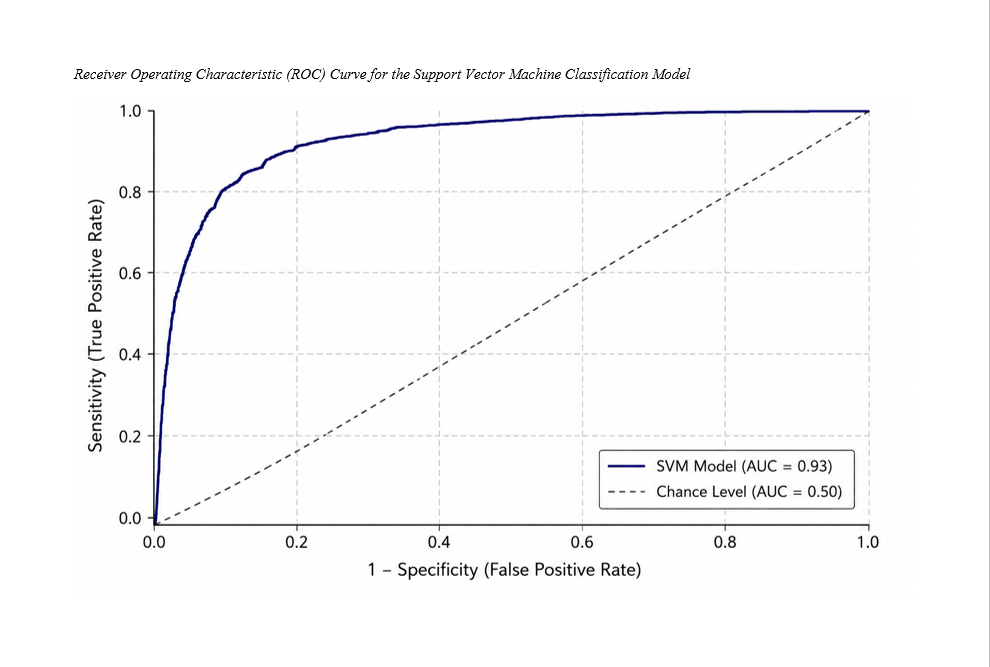
Findings: All predictor variables demonstrated significant positive associations with family functioning. The optimized SVM model achieved a testing accuracy of 89.37%, precision of 0.88, recall of 0.89, specificity of 0.88, and an F1-score of 0.88. Receiver operating characteristic analysis indicated excellent discriminative performance with an AUC of 0.93. Feature importance analyses revealed that emotional security was the strongest predictor of family functioning, accounting for 32.7% of model contribution, followed by family communication (28.4%), family adaptability (21.9%), and conflict management (17.0%). SHAP analyses further confirmed that higher levels of all four predictors increased the probability of classification into the high-functioning family group.
Conclusion: The findings demonstrate that communication, adaptability, emotional security, and conflict management constitute powerful indicators of family functioning and can be effectively utilized within machine learning frameworks to classify families with high accuracy. Emotional security emerged as the most influential predictor, highlighting its central role in healthy family systems. The results support the application of SVM-based predictive models as valuable tools for family assessment, early identification of at-risk families, and the development of targeted preventive and intervention programs.
Downloads
References
Abdelrasheed, N. S. G., & Saeed, M. A. (2024). The Impact of Mindfulness-Based Cognitive Therapy in Enhancing Psychological Resilience Among Basic Education Teachers in Oman: Longitudinal Study. International Journal of Linguistics Literature & Translation, 7(4), 163-176. https://doi.org/10.32996/ijllt.2024.7.4.19
Abela, K. R., Hussain, A., & Law, D. M. (2025). Interweaving Threads: Untangling the Moderating Relationship of Parent-Child Conflict and Closeness in the Association Between Interparental Conflict and Emotion Regulation. Emerging Adulthood, 13(2), 410-423. https://doi.org/10.1177/21676968241311950
Ahmed, M. M., & John, J. (2025). Trauma and Resilience Among the Survivors of Conflict in Jammu and Kashmir. Psychological Trauma Theory Research Practice and Policy. https://doi.org/10.1037/tra0002008
Ambrosi, C. C., Kavanagh, P. S., Evans, S., & Havighurst, S. S. (2025). Tuning in to Kids Together: Piloting an Emotion‐Focused Coparenting Program. Family Process, 64(1). https://doi.org/10.1111/famp.70002
Bi, S. (2025). Typologies of Family Dynamics in Chinese Families and Implications for Child Adjustment: A Person-Centered Approach. Journal of Family Psychology, 39(5), 652-663. https://doi.org/10.1037/fam0001343
Călinici, M. S., Călinici, T., & Crişan, H. (2024). Mindfulness Based Emotional Intelligence Training to Reduce Emotional Vulnerability for Medical Students. Revista Romaneasca pentru Educatie Multidimensionala, 16(2), 581-593. https://doi.org/10.18662/rrem/16.2/873
Camargo, A., Vargas, R., Rincón-Rodríguez, A., Jiménez, E., & Trujillo‐Güiza, M. L. (2025). Psychosocial Factors Influencing Resilience in a Sample of Victims of Armed Conflict in Colombia: A Quantitative Study. Behavioral Sciences, 15(6), 816. https://doi.org/10.3390/bs15060816
Castillo‐López, Á. G. d., Berenguer-Soler, M., Pineda, D., & José, A. G. d. C. (2024). Emotional Flooding in Couple Relationships: Psychosocial Aspects and Regulatory Strategies. https://doi.org/10.5772/intechopen.1006183
Chiang, S. C., & Bai, S. (2024). Testing Family-of-Origin Sensitization: Parent-Adolescent Conflict, Emotional Reactivity, and Adolescent Internalizing Psychopathology. Development and Psychopathology, 37(4), 2172-2180. https://doi.org/10.1017/s0954579424001779
Chorão, A. L., Canavarro, M. C., & Pires, R. (2022). Explaining Parenting Stress Among Adoptive Parents: The Contribution of Mindfulness, Psychological Flexibility, and Self-Compassion. International journal of environmental research and public health, 19(21), 14534. https://doi.org/10.3390/ijerph192114534
Dąbkowska, M., Kobierecka-Dziamska, A., & Prusaczyk, M. (2021). Anxiety, Coping Strategies and Resilience Among Children and Adolescents During COVID-19 Pandemic: A Systematic Review. https://doi.org/10.5772/intechopen.97828
Dewi, P. Y. A., & Primayana, K. H. (2023). The Importance of the Spiritual Quotient in Society Life. Purwadita Jurnal Agama Dan Budaya, 7(1), 93. https://doi.org/10.55115/purwadita.v7i1.3148
Flores, C. P. (2024). Emotional Foundations and Educational Development. https://doi.org/10.5772/intechopen.1004010
Flujas-Contreras, J. M., García‐Palacios, A., & Becerra, I. G. (2021). Effectiveness of a Web-Based Intervention on Parental Psychological Flexibility and Emotion Regulation: A Pilot Open Trial. International journal of environmental research and public health, 18(6), 2958. https://doi.org/10.3390/ijerph18062958
Gannamraju, S. K. (2025). Lived Experiences of Spiritual Emotional Intelligence: A Bhagavad Gitā-Based Indigenous Model of Psychological Wellbeing. Frontiers in psychology, 16. https://doi.org/10.3389/fpsyg.2025.1730103
Happaney, K., & Zelazo, P. D. (2022). Development of Executive Function Skills in Childhood. 427-451. https://doi.org/10.1017/9781108399838.023
Hoegler, S., Moreno, F., Boxer, P., & Cummings, E. M. (2025). Measures of Adolescents’ Emotional Security and Exposure to Violence in Relation to the Community, Police, and Gangs: Evidence for Validity in a Sample of Honduran Youth. Peace and Conflict Journal of Peace Psychology, 31(3), 339-360. https://doi.org/10.1037/pac0000798
Kalra, G. K., Beauty, & Modi, K. (2025). Rethinking Contours of Family Through Diverse Lenses: Beyond the Conventional Context. Institutionalised Children Explorations and Beyond, 12(2), 239-251. https://doi.org/10.1177/23493003251364952
Kanter, J. B., Lannin, D. G., Ratliff, H. C., Rauer, A., Sprecher, S., Ogolsky, B. G., & Yazedjian, A. (2025). The Efficacy of Relationship Education for Improving Children's Outcomes: A Multi‐Informant, Multi‐Method Study. Family Process, 64(1). https://doi.org/10.1111/famp.70001
Kefala, C., Iliopoulou, T., Pilafas, G., & Louka, P. (2024). Transformative Vengeance: Unveiling the Intricacies of Revenge as a Catalyst for Change Within Family Dynamics. Health & Research Journal, 10(4), 265-275. https://doi.org/10.12681/healthresj.34961
Kordovani, S., Pour, S. K., & Nejad, F. S. T. (2024). Comparison of the Effectiveness of Integrated Behavioral Couple Therapy and Schema-Focused Couple Therapy on Conflict Resolution Styles in Conflicting Couples. Aftj, 5(2), 68-78. https://doi.org/10.61838/kman.aftj.5.2.8
Laifer, L. M., Ramsdell, E. L., Stasik-O’Brien, S. M., Martin, R. C. B., & Brock, R. L. (2024). Trajectories of Maternal and Paternal Internalizing Symptoms From Pregnancy to 2 Years Postpartum: Identifying Modifiable Risk and Protective Factors. Depression and Anxiety, 2024(1). https://doi.org/10.1155/2024/5164261
Lappan, S. N. (2025). Suggested Guidelines for Applying a Systemic Lens to Psychedelic-Assisted Psychotherapy. Psychedelic Medicine. https://doi.org/10.1177/28314425251404021
Lee, J. Y. S., Whittingham, K., & Mitchell, A. E. (2024). Parental Insightfulness, Parental Sensitivity, Parent and Child Mental Health, and Attachment in Autistic Children: A Systematic Review. Review Journal of Autism and Developmental Disorders. https://doi.org/10.1007/s40489-024-00482-x
Lobato, D., Montesinos, F., Polín, E., Flujas-Contreras, J. M., Becerra, I. G., & Budziszewska, L. (2025). Psychological Intervention in Parents of Children With Neurodevelopmental Disorders Using a Brief Protocol Based on Acceptance and Commitment Therapy. Journal of Applied Research in Intellectual Disabilities, 38(5). https://doi.org/10.1111/jar.70131
Lockhart, E. N. S. (2025). “But I’m Their Parent—Why Can’t I Know?” Parental Expectations and the Ethics of Confidentiality in Family Therapy With Transgender Adolescents. The Family Journal, 34(1), 181-193. https://doi.org/10.1177/10664807251329592
Lu, F., Zhang, L., Lyu, R., Wu, X. L., & Wang, Y. (2025). Intergenerational Parenting Styles and Children’s Problem Behaviors: The Mediating Role of the Grandparent–Parent Relationship. Behavioral Sciences, 15(8), 1029. https://doi.org/10.3390/bs15081029
Madsen, J., Jobson, L., Slewa‐Younan, S., Mohammad, Y., Riman, I., Othman, L., & King, K. (2025). Arab Australian Men’s Perspectives on Mental Health: Exploring Beliefs About Causes, Help-Seeking Attitudes, and Experiences. Psychology of Men & Masculinity, 26(4), 610-623. https://doi.org/10.1037/men0000520
Maralani, F. M., & Pfeiffer, S. I. (2024). The Unique Social-Emotional Challenges That Bright Immigrant Youth Face. Gifted Education International, 41(1), 137-157. https://doi.org/10.1177/02614294241279354
Mercer, M., Ezzedeen, S. R., & Singh, P. (2025). Love Without Borders: The Relationship Between Intercultural Marriage and Family-to-Work Enrichment. International Journal of Cross Cultural Management, 25(3), 587-608. https://doi.org/10.1177/14705958251357448
Mofor, G. Z., Chianebeng, J. K., & Doumtsop, M. (2024). Resilience Through Mobility: Urban Residents’ Adaptation Strategies in Conflict-Affected Bamenda, Cameroon. International Journal of Regional Development, 11(2), 19. https://doi.org/10.5296/ijrd.v11i2.22217
Moreira, A., Vives, J., & Ballespí, S. (2024). Transgenerational Association of Mentalization With Child Mental Health: A Scoping Review. Family Process, 64(1). https://doi.org/10.1111/famp.13085
Mosley, M. A., Yoshida, N. R., & Turner, F. A. (2025). Communication Is Key: The Mediating Effect of Demand–Withdraw Patterns on Partner Phubbing and Couple Satisfaction. Journal of marital and family therapy, 51(3). https://doi.org/10.1111/jmft.70053
Peng, G., Liang, Q., Li, S., Li, X., Mu, W., & Zhou, M. (2025). Parental Marital Quality and School Bullying Victimization: A Moderated Mediation Model of Parent–Child Attachment and Child Gender. Children, 12(7), 825. https://doi.org/10.3390/children12070825
Reich, A., Lifshitz, H., Shnitzer-Meirovich, S., & Gur, A. (2025). Psychological Flexibility, Parental Reflective Functioning, Parental Efficacy and Coping in Parents of Children With Autism. Research and Practice for Persons With Severe Disabilities, 50(3), 177-194. https://doi.org/10.1177/15407969251316501
Rosell-Bellot, G., Izquierdo-Sotorrío, E., Arco, A. H., Rueda-Extremera, M., & Brenlla, M. E. (2025). Treating Complex Trauma in Adolescence: A Case Study of Brief Focal Psychotherapy After Vicarious Gender Violence and Child Abuse. Behavioral Sciences, 15(6), 784. https://doi.org/10.3390/bs15060784
Ruskin, D., Young, M., Sugar, C., & Nofech‐Mozes, J. (2021). Mindfulness and Acceptance Interventions for Parents of Children and Adolescents Diagnosed With Chronic Medical Conditions: A Systematic Review. The Journal of Alternative and Complementary Medicine, 27(2), 120-135. https://doi.org/10.1089/acm.2020.0191
Sairanen, E., Lappalainen, R., Lappalainen, P., & Hiltunen, A. J. (2022). Effects of an Online Acceptance and Commitment Therapy Intervention on Children’s Quality of Life. Journal of Child and Family Studies, 31(4), 1079-1093. https://doi.org/10.1007/s10826-022-02234-z
Sánchez, J. G. S. (2023). Benefits of Emotional Intelligence in School Adolescents: A Systematic Review. Revista De Psicología Y Educación - Journal of Psychology and Education, 18(2), 83. https://doi.org/10.23923/rpye2023.02.237
Sansone, A. (2024). The Central Role of Mindful Parenting in Child’s Emotional Regulation and Human Flourishing: A Blueprint Perspective. Frontiers in psychology, 15. https://doi.org/10.3389/fpsyg.2024.1420588
Shafik, W. (2024). Science of Emotional Intelligence. 284-310. https://doi.org/10.4018/979-8-3693-4453-8.ch015
Somech, L. Y. (2024). The Mediating Role of Marital Quality in Parenting Intervention: Effects on Preschoolers' Conduct Problems and Effortful Control. Journal of marital and family therapy, 51(1). https://doi.org/10.1111/jmft.12746
Tang, Y. K. (2025). Exploring Family Dynamics in Living Funerals: Rituals to Relationships. Australian and New Zealand Journal of Family Therapy, 46(1). https://doi.org/10.1002/anzf.1618
Taştekin, E., Kaymaz, Ç., Işik‐Uslu, A. E., Yüksel‐Doğan, R., Bozkurt‐Yükçü, Ş., & Tok, A. İ. (2025). Coparenting and Mindful Parenting Partially Mediate the Relationship Between Mothers' Stress and Parental Burnout. Family Relations. https://doi.org/10.1111/fare.70027
Taukeni, S. G. (2021). The Science of Emotional Intelligence. https://doi.org/10.5772/intechopen.90978
Teräsahjo, T. (2025). Mentalization and Mindfulness: A Scoping Review. Journal of Psychotherapy Integration. https://doi.org/10.1037/int0000380
Todosijević, M., & Kojić, D. (2022). Differentiation of Self as a Predictor of Capacity for Mentalization. Годишњак За Психологију, 19(1), 65-79. https://doi.org/10.46630/gpsi.19.2022.04
Treviño, A. L. (2025). Creative Rituals: Family Art Therapy in the Context of Divorce in Mexico. Journal of marital and family therapy, 52(1). https://doi.org/10.1111/jmft.70107
Uditha, S., & Bulathwatta, A. (2025). Predictability of the Psychological Impact of the Economic Crisis on Family Functioning Within the Family Context in Sri Lanka. Frontiers in psychology, 16. https://doi.org/10.3389/fpsyg.2025.1587710
Wang, X., Yang, X., & Li, X. (2025). The Influence of Mentalization and Psychological Flexibility on the Mental Health of Graduate Students in China: A Cross-Sectional Study. Frontiers in Psychiatry, 16. https://doi.org/10.3389/fpsyt.2025.1482079
Xie, S., Chen, S., Xia, M., Chen, X., & Chi, X. (2025). Investigating the Interplay Among Family Climate, Mother–child Closeness, and Young Children’s Psychosocial Functioning: Integrating Large-Scale Surveys With Daily Diary Design. Translational Issues in Psychological Science. https://doi.org/10.1037/tps0000464
Zhang, Y., Song, K., & Niu, G. (2025). Family Dynamics and Digital Distractions: A Survey-Based Study on How Co-Parenting and Parental Phubbing Shape Preschoolers’ Media Use. Behavioral Sciences, 15(6), 752. https://doi.org/10.3390/bs15060752
Żmuda, A. (2024). Self-Compassion as a Resource in the Parenting Role. Kwartalnik Naukowy Fides et Ratio, 58(2), 9-17. https://doi.org/10.34766/fetr.v58i2.1267
Асланова, М. С., Gavrilova, M., & Iurina, E. (2024). Does Sibling Family Structure Matter in the Emotion Understanding Development in Preschoolers? Frontiers in psychology, 15. https://doi.org/10.3389/fpsyg.2024.1428087
Downloads
Additional Files
Publication Timeline
- Submitted
- Revised
- Accepted