Explaining the Causes of Women’s Tendency Toward Extramarital Relationships in Yazd: A Grounded Theory Study
Keywords:
Extramarital relationships, women, grounded theory, qualitative research, YazdAbstract
Objective: This study aimed to explain the causes of women’s tendency toward extramarital relationships in Yazd using a qualitative grounded theory approach.
Methods and Materials: This qualitative study was conducted using a grounded theory design. The study population included women aged 25 to 45 years living in Yazd who had experienced extramarital relationships or showed a tendency toward such relationships, as well as experts in family studies and Islamic psychology and relevant Islamic sources. Participants were selected through purposive sampling. The final sample consisted of 25 women and 7 experts. Data were collected through semi-structured interviews designed to explore personal, relational, psychological, cultural, and religious dimensions associated with women’s tendency toward extramarital relationships. Data analysis was conducted based on the Strauss and Corbin grounded theory strategy using MAXQDA 2020 software.
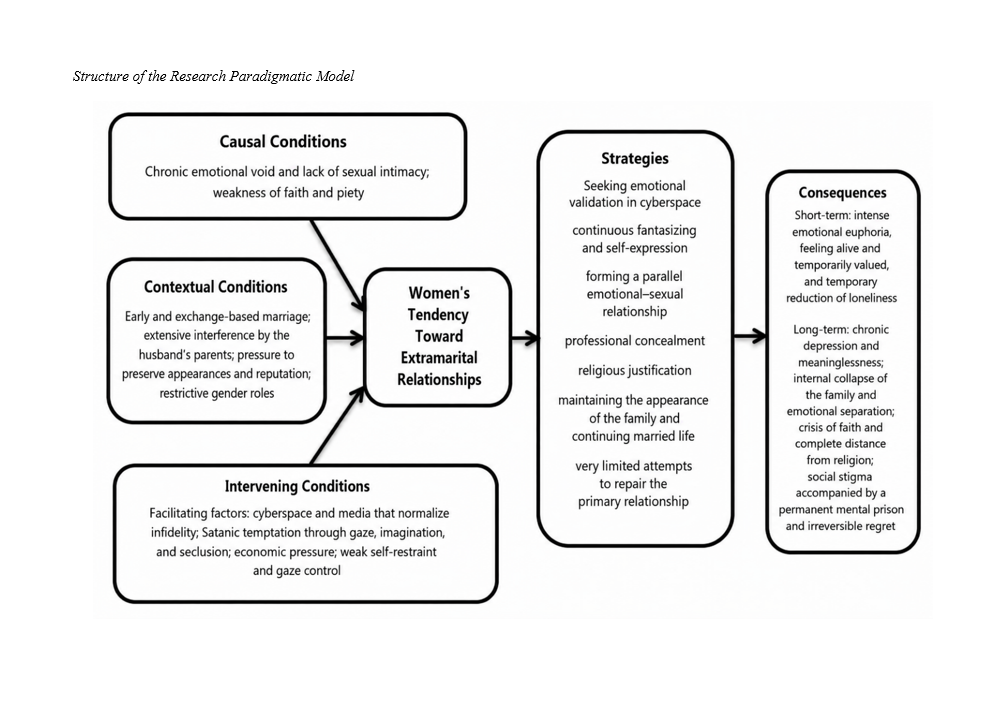
Findings: The analytical findings showed that, after open coding, 280 initial codes were extracted from the interviews and textual data. These codes were organized into 42 subcategories and 14 main categories. Through axial and selective coding, the central category was identified as “tendency toward extramarital relationships as a way of redefining identity and responding to unmet needs.” This core category indicated that women’s tendency toward extramarital relationships was not shaped by a single factor, but rather emerged from the interaction of unmet emotional, psychological, relational, identity-related, and contextual needs. The grounded theory model suggested that extramarital tendency may function as a compensatory response to perceived deprivation, lack of recognition, emotional neglect, weakened marital intimacy, and the search for self-worth and identity reconstruction.
Conclusion: The findings indicate that identifying the causes of women’s tendency toward extramarital relationships can enhance awareness among women, family specialists, counselors, and intervention providers. Understanding these causes may support the development of more effective preventive and therapeutic interventions in the field of marital and family relationships.
Downloads
References
Afshari Kashanian, O., Zahrakar, K., Mohsenzadeh, F., & Tajik Esmaeili, A. (2019). Identifying contextual factors of marital infidelity in women. Counseling Research, 18(71), 121-154.
Bah, Y. M. (2025). Support services for survivors of extramarital affairs: Lessons for social workers and child rights advocates. International Journal of Counseling and Psychotherapy, 2(2), 96-106. https://doi.org/10.64420/ijcp.v2i2.334
Choupani, M., Fatehizadeh, M., Esngerani, F., & De Castro Correia, A. M. (2021). Existential phenomena in men's marital infidelity. Family Research, 17(3), 483-513.
Costa, C. B. D., Haack, K. R., Oliveira, E. L. D., & Falcke, D. (2019). Infidelity from the perspective of men and women. Pensando familias, 23(1), 3-18.
Demarchli, P., Zargham Hajebi, M., & Navabinejad, S. (2023). The role of addiction to virtual networks, sensation seeking, and self-control in predicting attitudes toward marital infidelity in women with extramarital relationships. Applied Family Therapy, 4(4), 1-16.
Garavand, F., & Ahmadi, A. (2025). An analysis of the meaning of extramarital relationships from the perspective of married individuals: Case study of married individuals involved in extramarital relationships in Tehran. Social Problems of Iran, 15(2), 197-217.
Garbinsky, E. N., Gladstone, J. J., Nikolova, H., & Olson, J. G. (2020). Love, lies, and money: Financial infidelity in romantic relationships. Journal of Consumer Research, 47(1), 1-24. https://doi.org/10.1093/jcr/ucz052
Golkar, T., Golparvar, M., & Aghaei, A. (2022). Comparison of the effectiveness of an indigenous schema therapy package with Young's schema therapy on early maladaptive schemas and attitudes toward infidelity in conflicted couples. Disability Studies, 12(0).
Grigoropoulos, I. (2024). Unraveling the intrapersonal factors related to infidelity: The predictive value of light and dark personality traits in a convenient Greek women sample. Sexuality & Culture, 28(1), 400-424. https://doi.org/10.1007/s12119-023-10123-w
Ibrahim, A. M. A. (2021). Factors of the weakness of family cohesion and the relationship to divorce have working women from a social case work perspective. The Journal Future of Social Sciences, 5(3), 121-146.
Kalfin, K., Azahra, A. S., & Yuningsih, S. H. (2024). Family communication patterns in Javanese culture and their influence on children's emotional development: A qualitative study. International Journal of Linguistics, Communication, and Broadcasting, 2(1), 20-24. https://doi.org/10.46336/ijlcb.v2i1.90
Khaledian, M., Shahmoradi, S., & Madani, Y. (2023). Explaining the formation process of marital infidelity in women with substance-dependent husbands. Scientific Quarterly of Addiction Research, 17(67), 197-228.
Khodaei Beyrami, R., & Arvaneh, P. (2024). Meta-analysis of factors affecting tendency toward extramarital relationships in Iran: Extramarital relationships. Bioethics Journal, 14(39), 1-11.
Khosravi, A., Heidarnia, A., & Nazifi, M. (2019). The role of religious attitude in attitude toward marital infidelity with the mediation of subjective well-being in married women. Positive Psychology Research, 5(3), 13-28.
Mayeli, M. (2024). Extramarital relationships in women: A qualitative study. Social Problems of Iran, 15(1), 51-76.
Murphy, M., Phillips, C. A., & Blake, K. R. (2024). Why women cheat: Testing evolutionary hypotheses for female infidelity in a multinational sample. Evolution and Human Behavior, 45(5), 106595. https://doi.org/10.1016/j.evolhumbehav.2024.106595
Okeno, M. M., Kinuthia, R., & Wamalwa, M. (2025). The influence of extramarital sexual relations on marital stability: A case study of the Anglican Diocese of Butere, Kenya. African Journal of Empirical Research, 6(4), 242-253. https://doi.org/10.51867/ajernet.6.4.22
Olamijuwon, E., Odimegwu, C., & Chemhaka, G. (2021). Involuntary childlessness and marital infidelity among women in Sub-Saharan African countries: An assessment of the moderating role of women's education. Archives of Sexual Behavior, 50(2), 601-614. https://doi.org/10.1007/s10508-020-01770-3
Pichon, M., Treves-Kagan, S., Stern, E., Kyegombe, N., Stockl, H., & Buller, A. M. (2020). A mixed-methods systematic review: Infidelity, romantic jealousy and intimate partner violence against women. International journal of environmental research and public health, 17(16), 5682. https://doi.org/10.3390/ijerph17165682
Rezaei, M. (2024). Exploring factors related to extramarital relationships: An interpretive phenomenological study in Birjand. Strategic Studies of Culture, 4(1), 81-113.
Roman, D. (2020). Justifications of internet infidelity in Romanian women with extra-dyadic affairs: A qualitative study proposal. New Trends in Psychology, 2(1), 415-429.
Rosaline, S., & Kasaraneni, H. (2024). Surge in extramarital affairs during work from home: What we know so far. The Family Journal, 32(1), 95-101. https://doi.org/10.1177/10664807221123548
Shaleha, R. R. A. (2021). The cheating heart: Phenomenology of women who decided to have marital infidelity. Jurnal Psikologi, 20(2), 109-122. https://doi.org/10.14710/jp.20.2.109-122
Shamsi, M., Taghvaei, D., & Davoudi, H. (2022). Development of attachment-based mindfulness therapy and evaluation of its effectiveness on self-compassion and positive emotion toward spouse in women with experience of marital infidelity. Journal of Mashhad University of Medical Sciences, Faculty of Medicine, 65(5).
Sharifi Saei, M. H., & Azad Armaki, T. (2021). Factors in the formation of marital infidelity in Iran: A meta-synthesis study. Social Problems of Iran, 12(2), 33-74.
Tajbakhsh, G., Hosseini, M., & Mohammad Mirzaei, M. (2020). Grounded theory analysis of the formation process of marital infidelity. Contemporary Sociological Research, 9(17), 51-72.
Tamarchi, F., Asadpour, E., & Zahrakar, K. (2021). Presenting a paradigmatic model of contextual factors of marital infidelity: A grounded theory study. Journal of Psychological Science, 20(107), 2027-2043.
Thapa, R., Yang, Y., & Nget, M. (2019). Perceptions of sexual infidelity in rural Cambodia: A qualitative study of adolescent men. American Journal of Men's Health, 13(3), 1557988319848576. https://doi.org/10.1177/1557988319848576
Warach, B., & Josephs, L. (2021). The aftershocks of infidelity: A review of infidelity-based attachment trauma. Sexual and Relationship Therapy, 36(1), 68-90. https://doi.org/10.1080/14681994.2019.1577961
Wertz, F. J. (2024). Phenomenology and natural science: What kind of a discipline is psychology? Theory & Psychology, 34(3), 405-424. https://doi.org/10.1177/09593543241248128
Williams, K. (2018). Reconnecting after an affair: Relationship justice, spirituality, and infidelity treatment. In Socially Just Religious and Spiritual Interventions: Ethical Uses of Therapeutic Power (pp. 75-85). https://doi.org/10.1007/978-3-030-01986-0_7
Yan, J. (2023). Impact of family interaction with multiple children on the socialization of young children. Academic Journal of Humanities & Social Sciences, 6(14), 109-115. https://doi.org/10.25236/AJHSS.2023.061418
Yuan, S., & Weiser, D. A. (2019). Relationship dissolution following marital infidelity: Comparing European Americans and Asian Americans. Marriage & Family Review, 55(7), 631-650. https://doi.org/10.1080/01494929.2019.1589614
Zarei Mahmoudabadi, H. (2021). An analysis of the causes and contexts of marital infidelity among married women and men in Iran: A qualitative meta-synthesis study. Biannual Journal of Family Psychology, 8(2), 26-38.
Zomorodian, N., & Akbari, H. (2021). How couples' extramarital relationships are formed. Social Work Research, 8(28), 227-262.
Downloads
Additional Files
Publication Timeline
- Submitted
- Revised
- Accepted