Emotional Security and Perceived Family Functioning in Relation to Adolescents’ Emotional and Behavioral Problems: The Mediating Role of Adolescents’ Cognitive Appraisals of Interparental Conflict
Keywords:
Adolescents, Cognitive Appraisal, Emotional and Behavioral Problems, Emotional Security, Family Functioning, Interparental ConflictAbstract
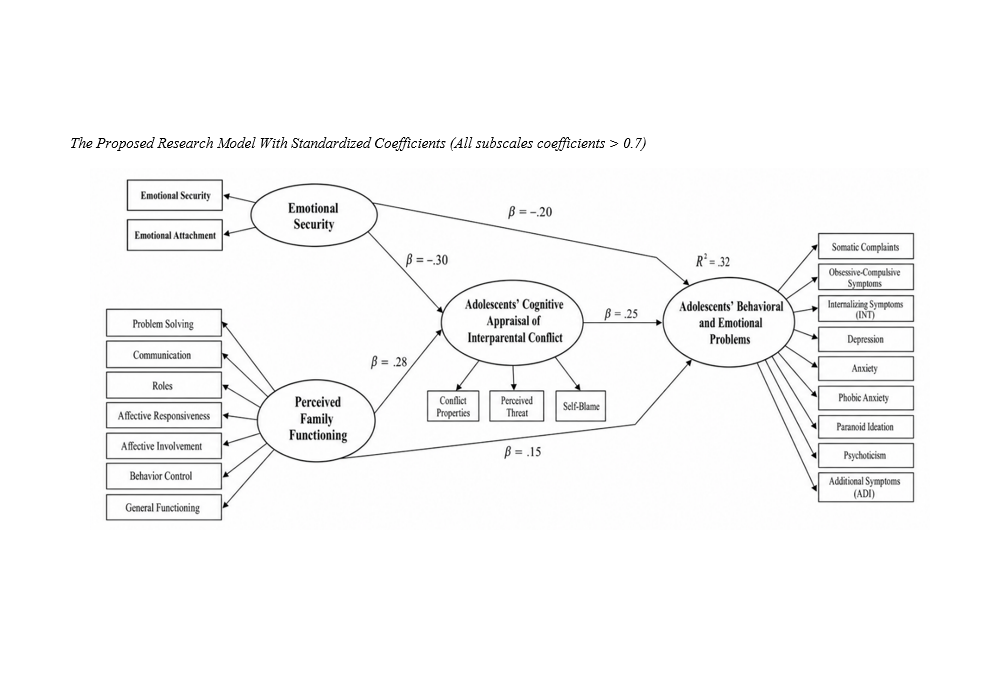
Objective: This study aimed to investigate the relationships of emotional security and perceived family functioning with adolescents’ emotional and behavioral problems, with particular emphasis on the mediating role of adolescents’ cognitive appraisals of interparental conflict.
Methods and Materials: This descriptive-correlational study employed structural equation modeling. The statistical population comprised all adolescents enrolled in lower- and upper-secondary schools in District 5 of Tehran during the 2024–2025 academic year. A sample of 251 students was selected using multistage random sampling. Data were collected using the Security in the Interparental Subsystem Scale developed by Koss et al. (2007), the McMaster Family Assessment Device developed by Epstein et al. (1983), the Children’s Perception of Interparental Conflict Scale developed by Grych and Fincham (1992), and the Symptom Checklist developed by Derogatis et al. (1973). The hypothesized structural model and the direct and indirect relationships among the study variables were examined using AMOS version 24.
Findings: Structural equation modeling indicated that the proposed model demonstrated an acceptable fit to the observed data. The model explained 32% of the variance in adolescents’ emotional and behavioral problems. Emotional security and perceived family functioning had significant direct effects on emotional and behavioral problems. Both variables also exerted significant indirect effects through adolescents’ cognitive appraisals of interparental conflict. Thus, adolescents’ interpretations and evaluations of conflict between their parents significantly mediated the associations between family-related factors and psychological difficulties.
Conclusion: The findings highlight cognitive appraisal as an important psychological mechanism through which emotional security and perceived family functioning influence adolescents’ emotional and behavioral adjustment. Preventive and therapeutic interventions may therefore be strengthened by simultaneously enhancing adolescents’ emotional security, improving family functioning and parent–adolescent relationships, reducing destructive interparental conflict, and modifying adolescents’ negative or threatening interpretations of such conflict.
Downloads
References
Davies, P. T., Parry, L. Q., Bascoe, S. M., Cicchetti, D., & Cummings, E. M. (2020). Interparental Conflict as a Curvilinear Risk Factor of Youth Emotional and Cortisol Reactivity. Developmental Psychology, 56(9), 1787-1802. https://doi.org/10.1037/dev0001037
Demetriou, C. (2025). Family Functioning and Adolescents' Mental Health Problems: A Mixed-Methods Analysis of Community and Clinical Samples. International Journal of Developmental Science. https://doi.org/10.1177/2192001X251326198
Dennis, S., Vetterly, S., & Cummings, E. M. (2024). Long-Term Effects of a Preventive Intervention on Multiple Components of Adolescents' Emotional Insecurity. Family Process. https://doi.org/10.1111/famp.13005
Dragomir, A. M. (2024). The Importance of Coparental Behaviors in the Development of Children's Emotional Security. Psihologie, Revistă Ştiinţifico-Practică, 45(2), 16-23.
Farmakopoulou, I., Lekka, M., & Gkintoni, E. (2024). Clinical Symptomatology of Anxiety and Family Function in Adolescents: The Mediating Role of Self-Esteem. Children, 11(3), 338.
Fosco, G. M., Weymouth, B. B., & Feinberg, M. E. (2023). Interparental Conflict, Family Climate, and Threat Appraisals: Early Adolescent Exposure and Young Adult Psychopathology Risk. Journal of Family Psychology. https://doi.org/10.1037/fam0001096
Hoegler, S., Mills, A. L., Feda, A., & Cummings, E. M. (2022). Randomized Preventive Intervention for Families: Adolescents' Emotional Insecurity and Attachment to Fathers. Journal of Family Psychology, 37(1). https://doi.org/10.1037/fam0001042
Jordan, K., Patel, K., Srinivasan, R., & Lewis, G. (2024). Familial Clustering of Adolescent Emotional Problems in a Nationally Representative Sample in Britain: A Multilevel Investigation. BJPsych Open, 10(S1), S49-S50. https://doi.org/10.1192/bjo.2024.178
Kim, Y., Dhammasaccakarn, W., Laeheem, K., & Rinthaisong, I. (2024). The Impact of Family Functioning Factors on Smartphone Addiction and Phubbing among Muslim Adolescents in Thailand. Children, 11(5), 522. https://doi.org/10.3390/children11050522
Kumar, S., Kumar, K., Avti, P., & Anand, A. (2024). Mental Health Issues among Adolescents: Challenges and Management. Current Psychiatry Research and Reviews, 20. https://doi.org/10.2174/0126660822308733240820065218
Labib, B., Khader, Y., Abu Khudair, S., Al Nsour, M., & Tanaka, E. (2024). The Prevalence of Behavioral and Emotional Problems and Their Associated Factors among Children and Adolescents in Jordan: Findings from a National School-Based Survey. Pediatric Reports. https://doi.org/10.3390/pediatric16040103
Li, Y. (2024). Effects of Hormonal Changes during Puberty on Cognition and Mood. Transactions on Materials, Biotechnology and Life Sciences, 7, 868-873. https://doi.org/10.62051/cwnnrc05
Martínez-Líbano, J., Kosch Serey, A., & Barahona-Fuentes, G. (2025). Emotional Regulation and Subjective Well-Being in Adolescents: A Systematic Review. Mental Health: Global Challenges Journal, 8(1), 14-26. https://doi.org/10.56508/mhgcj.v8i1.240
Nebhinani, N., & Jain, S. (2019). Adolescent Mental Health: Issues, Challenges, and Solutions. Annals of Indian Psychiatry, 3(1), 4. https://doi.org/10.4103/aip.aip_24_19
O'Hara, K. L., Cummings, E. M., & Davies, P. T. (2023). Interparental Conflict and Adolescent Emotional Security across Family Structures. Family Process. https://doi.org/10.1111/famp.12872
Quichocho, D., & Lucier-Greer, M. (2021). The Role of Interparental Conflict in Adolescent Siblings' Distress: A Multi-Informant Study of Military Families. Children and Youth Services Review, 120, 105708. https://doi.org/10.1016/j.childyouth.2020.105708
Setordzi, M., & Adjorlolo, S. (2025). Family Functioning, Psychological Distress and Suicidal Tendencies among Adolescents in Ghana. South African Journal of Psychiatry, 31(0). https://doi.org/10.4102/sajpsychiatry.v31i0.2382
Wang, Q. (2026). Adolescent Non-Suicidal Self-Injury from Bowen's Family Systems Theory: Interparental Conflict, Parent-Child Triangulation, and Differentiation of Self. Journal of affective disorders, 396, 120824. https://doi.org/10.1016/j.jad.2025.120824
Yang, Z., Cui, Y., Yang, Y., Wang, Y., Zhang, H., Liang, Y., Zhang, Y., & Shang, L. (2021). The Relationship between Mental Health Problems and Systemic Family Dynamics among High School and University Students in Shaanxi Province, China. International Journal of Public Health, 66, 1603988. https://doi.org/10.3389/ijph.2021.1603988
Zhang, Y. (2018). Family Functioning in the Context of an Adult Family Member with Illness: A Concept Analysis. Journal of clinical nursing, 27(15-16), 3205-3224. https://doi.org/10.1111/jocn.14500
Downloads
Additional Files
Publication Timeline
- Submitted
- Revised
- Accepted