The Mediating Role of Emotion Regulation in the Relationship Between Attachment Insecurity, Perceived Partner Responsiveness, and Marital Satisfaction Among Female Student-Teachers at Farhangian University
Keywords:
Attachment Insecurity, Perceived Partner Responsiveness, Emotion Regulation, Marital Satisfaction, Female Student-Teachers, Farhangian UniversityAbstract
Objective: This study aimed to investigate the mediating role of emotion regulation in the relationships between attachment insecurity, perceived partner responsiveness, and marital satisfaction among female student-teachers at Farhangian University.
Methods and Materials: The present study employed a descriptive-correlational, cross-sectional design using structural equation modeling. The statistical population consisted of married female student-teachers enrolled at Farhangian University campuses in Tehran during the 2025–2026 academic year. A total of 320 participants were selected through a multistage convenience sampling procedure. Data were collected using the Experiences in Close Relationships-Revised Questionnaire, the Perceived Partner Responsiveness Scale, the Difficulties in Emotion Regulation Scale, and the ENRICH Marital Satisfaction Scale. Data analysis was conducted using IBM SPSS Statistics and AMOS. Pearson correlation coefficients were used to examine bivariate relationships among the study variables, and structural equation modeling was applied to assess direct and indirect effects. The significance of mediation effects was evaluated using a bootstrap procedure with 5,000 resamples and 95% confidence intervals.
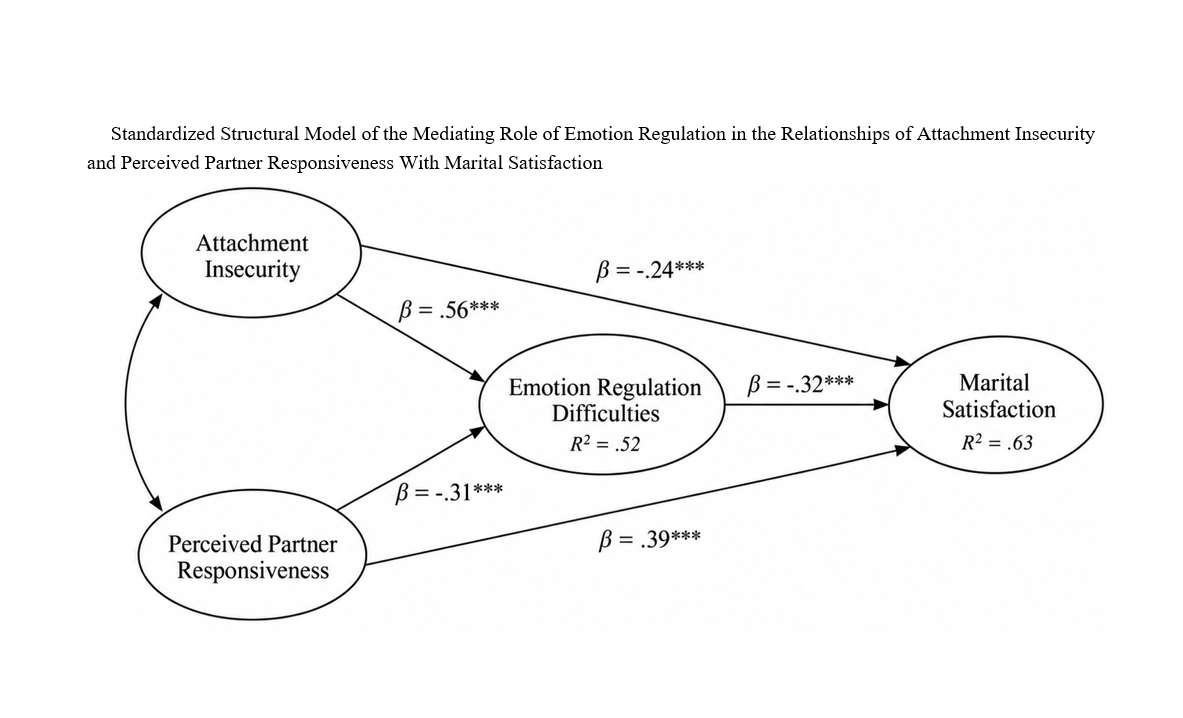
Findings: Attachment insecurity had a significant positive effect on emotion regulation difficulties (β = .56, p < .001) and a significant negative effect on marital satisfaction (β = -.24, p < .001). Perceived partner responsiveness significantly predicted lower emotion regulation difficulties (β = -.31, p < .001) and higher marital satisfaction (β = .39, p < .001). Emotion regulation difficulties also significantly predicted lower marital satisfaction (β = -.32, p < .001). Bootstrap analysis showed that emotion regulation difficulties significantly mediated the relationship between attachment insecurity and marital satisfaction (β = -.18, 95% CI [-.25, -.12]) and the relationship between perceived partner responsiveness and marital satisfaction (β = .10, 95% CI [.06, .15]). The model explained 52% of the variance in emotion regulation difficulties and 63% of the variance in marital satisfaction.
Conclusion: The findings indicate that emotion regulation is a significant partial mediator linking attachment insecurity and perceived partner responsiveness with marital satisfaction, suggesting that both attachment-related vulnerability and perceived relational responsiveness influence marital adjustment partly through emotional regulatory processes.
Downloads
References
Adair, K., Boulton, A., & Algoe, S. (2019). The effect of mindfulness on relationship satisfaction via perceived responsiveness: findings from a dyadic study of heterosexual romantic partners. Mindfulness, 9(2), 597-609.
Araujo, F. V. d., Lanzarote-Fernández, M. D., Sousa-Gomes, V., & Moreira, D. (2026). Relationship Between Adverse Childhood Experiences, Attachment, and Emotional Regulation: A Review of the Literature. Psychological Trauma Theory Research Practice and Policy. https://doi.org/10.1037/tra0002099
Attaky, A., Kok, G., & Dewitte, M. (2020). Attachment Insecurity and Sexual and Relational Experiences in Saudi Arabian Women: The Role of Perceived Partner Responsiveness and Sexual Assertiveness. Journal of Sexual Medicine. https://doi.org/10.1016/j.jsxm.2020.02.029
Bergeron, S., Pâquet, M., Steben, M., & Rosen, N. O. (2021). Perceived partner responsiveness is associated with sexual well-being in couples with genito-pelvic pain. Journal of Family Psychology, 35(5), 628-638. https://doi.org/10.1037/fam0000829
Cook, W. L., Dezangré, M., & De Mol, J. (2018). Sources of perceived responsiveness in family relationships. Journal of Family Psychology, 32(6), 743-752. https://doi.org/10.1037/fam0000411
Fivecoat, H. C., Mattson, R. E., Cameron, N. M., & Johnson, M. D. (2024). Social Support and Perceived Partner Responsiveness Have Complex Associations With Salivary Cortisol in Married Couples. Journal of Social and Personal Relationships, 41(7), 1913-1935. https://doi.org/10.1177/02654075241229755
Gosselin, C., Daspe, M. È., Brassard, A., Lussier, Y., & Vaillancourt‐Morel, M. P. (2024). Attachment as an Intermediary Variable Between Childhood Maltreatment and Perceived Partner Responsiveness in Adolescents and Young Adults. Journal of marital and family therapy, 50(2), 434-452. https://doi.org/10.1111/jmft.12688
Jahanbakhsh, Z., & Vafaeizadeh, M. (2025). The Mediating Effect of Resilience in the Relationship Between Cognitive Emotion Regulation Strategies and Test Anxiety Among Student-Teachers at Farhangian University. Quarterly Journal of Educational Psychology, 21(75), 259-283.
Khalili, K. M., Shafqati, S., Eshaghi, M. F., & Rafieipour, A. (2024). Expectancy Test Anxiety Based on Basic Psychological Needs and Cognitive Emotional Regulation among Students at Farhangian University. https://www.sid.ir/paper/410735/en
Kocyigit, M. (2025). Emotion regulation and couple burnout in marriage: The mediating role of marital satisfaction. Current Psychology. https://doi.org/10.1007/s12144-024-07253-1
Kumar, R. M., & Singh, R. M. (2024). Couple identity in Indian arranged marriages: Perceived partner responsiveness as the mediator of attachment styles and couple identity. Couple and family psychology: Research and practice, 13(2), 143. https://doi.org/10.1037/cfp0000220
Lu, S., He, Y., Li, Q., Chen, Z., & Fang, X. (2024). Dyadic Effects of Attachment Styles on Marital Satisfaction among Chinese Couples: The Mediating Role of Perceived Partner Responsiveness. Journal of Social and Personal Relationships, 41(12), 3770-3790. https://doi.org/10.1177/02654075241277227
Messina, I., Spataro, P., Gagliardini, G., Rossi, T., & Grecucci, A. (2026). Attachment Orientations and Borderline Personality Features: The Mediating Role of Difficulties in Interpersonal Emotion Regulation. Borderline personality disorder and emotion dysregulation, 13(1), 4. https://doi.org/10.1186/s40479-025-00323-1
Odebunmi, O., & Сабіна, Н. Ю. (2025). Emotional Regulation as a Mediator of Personality Traits and Marital Satisfaction Among Academic Staff in Colleges of Education in Oyo State. Mejaee. https://doi.org/10.70382/mejaee.v7i8.028
Polack, R. G., Bar-Nahum, L. E., Newhouse, S., Anderson, R., Heiman, J. R., Rafaeli, E., & Janssen, E. (2015). Perceived Partner Responsiveness Mediates the Association Between Sexual and Marital Satisfaction: A Daily Diary Study in Newlywed Couples. Archives of Sexual Behavior, 45(1), 109-120. https://doi.org/10.1007/s10508-014-0448-2
Raposo, S., & Muise, A. (2021). Perceived partner sexual responsiveness buffers anxiously attached individuals’ relationship and sexual quality in daily life. Journal of Family Psychology, 35(4), 500-509. https://doi.org/10.1037/fam0000823
Razzaghi, M., Zemestani, M., & Mashhadi, A. (2025). Effectiveness of Emotional Schema Therapy on Anxiety Symptoms, Emotion Regulation, and Marital Satisfaction in Women with Anxiety Disorders: A Preliminary Study. International Journal of Cognitive Behavior Therapy, 18, 334-358. https://doi.org/10.1007/s41811-025-00238-3
Richter, M., & Schoebi, D. (2023). Rejection Sensitivity in Intimate Relationships: Implications for Perceived Partner Responsiveness. https://doi.org/10.31234/osf.io/bfjv9
Ruan, Y., Reis, H. T., Clark, M. S., Hirsch, J. L., & Bink, B. D. (2020). Can I tell you how I feel? Perceived partner responsiveness encourages emotional expression. Emotion, 20(3), 329-335. https://doi.org/10.1037/emo0000650
Salavou, V., Papanikolaou, K., Pehlivanidis, A., & Giannakopoulos, G. (2026). Mentalization and Emotion Regulation in Adolescent Attachment: A Scoping Review. Children, 13(3), 420. https://doi.org/10.3390/children13030420
Tiller, J., Maguire, T., & Newman-Taylor, K. (2025). Attachment Style Predicts Emotion Regulation, Help-Seeking, and Recovery in Psychosis. Mental Health Science, 3(1), e70002. https://doi.org/10.1002/mhs2.70002
Trevethan, M., & Francis, S. E. (2025). Protective Factors for Adverse Childhood Experiences: The Role of Emotion Regulation and Attachment. Journal of Child and Family Studies, 34(1), 25-40. https://doi.org/10.1007/s10826-024-02989-7
Walker, S., & Kunst, H. (2025). Helping or Holding Back? How Attachment Shapes Emotion Regulation of Others in Close and Distant Relationships. https://doi.org/10.31234/osf.io/qtpfs_v2
Wu, L., Xie, R., Zhang, Y., & Ding, W. (2025). Actor-partner interdependence of parents' parenting stress on marital satisfaction: The mediating role of emotion dysregulation. Journal of affective disorders, 120831. https://doi.org/10.1016/j.jad.2025.120831
Yuan, Q., Fan, Z., & Leng, J. (2022). The Effect of Emotional Reactivity on Marital Quality in Chinese Couples: The Mediating Role of Perceived Partner Responsiveness. Frontiers in psychology, 12, 787899. https://doi.org/10.3389/fpsyg.2021.787899
Zoppolat, G., Alonso-Ferres, M., Righetti, F., Balzarini, R. N., & Slatcher, R. B. (2025). Shifting Signals: Fluctuations in Perceived Partner Responsiveness Predict Ambivalence in Romantic Relationships. https://doi.org/10.31219/osf.io/rwu58_v1
Downloads
Additional Files
Publication Timeline
- Submitted
- Revised
- Accepted