Comparison of the Effectiveness of Emotional Freedom Technique (EFT) Training and Self-Compassion Training on Resilience, Anxiety, and Parent–Child Relationships in Parents of Children with Autism
Keywords:
Anxiety; Autism Spectrum Disorder; Emotional Freedom Technique; Parent–Child Relationship; Resilience; Self-CompassionAbstract
Objective: This study aimed to compare the effectiveness of Emotional Freedom Technique (EFT) training and self-compassion training on resilience, anxiety, and parent–child relationships among parents of children with autism.
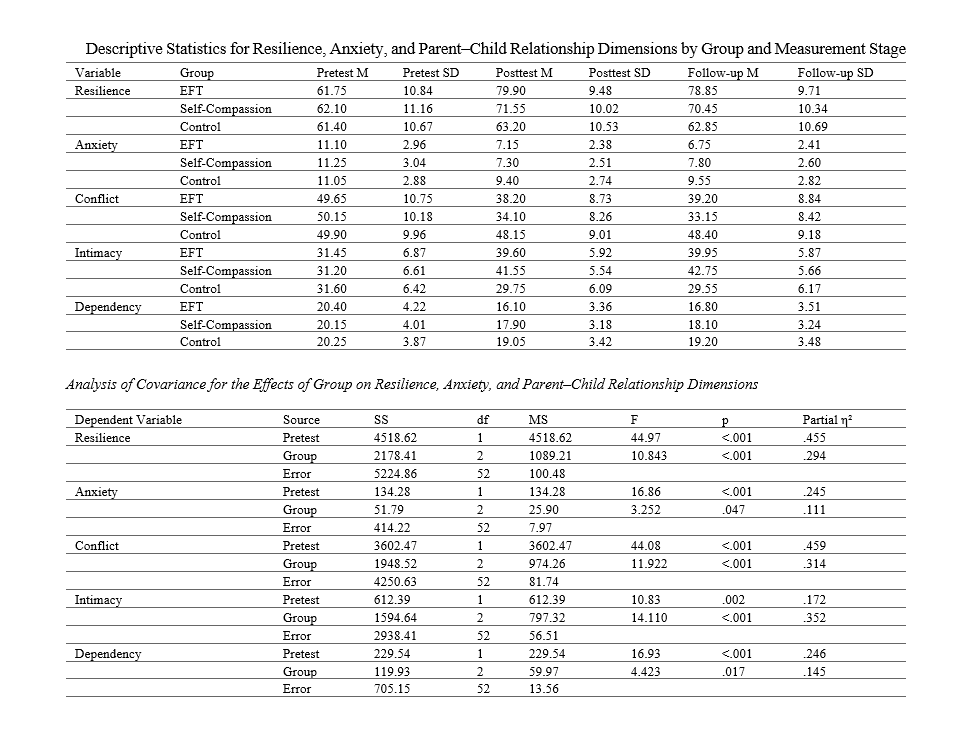
Methods and Materials: This quasi-experimental study employed a pretest–posttest design with two intervention groups and one control group, together with a one-month follow-up. The statistical population consisted of parents of children with autism in Tehran, Iran. Using convenience sampling, 60 eligible participants were selected and randomly assigned to three groups of 20 participants: EFT training, self-compassion training, and control. Data were collected using the Connor–Davidson Resilience Scale, the anxiety subscale of the Depression Anxiety Stress Scales-21 (DASS-21), and Pianta’s Parent–Child Relationship Scale. The intervention groups received their respective training programs, while the control group received no intervention during the study period. Data were analyzed using analysis of covariance and Bonferroni post-hoc comparisons in SPSS version 26.
Findings: Analysis of covariance showed significant group effects on resilience, F(2,52)=10.843, p<.001, partial η²=.294; anxiety, F(2,52)=3.252, p=.047, partial η²=.111; conflict, F(2,52)=11.922, p<.001, partial η²=.314; intimacy, F(2,52)=14.110, p<.001, partial η²=.352; and dependency, F(2,52)=4.423, p=.017, partial η²=.145. Bonferroni comparisons indicated that both EFT and self-compassion training significantly improved resilience and intimacy and reduced anxiety and conflict compared with the control group. EFT produced a significantly greater improvement in resilience than self-compassion training (p=.032). EFT also significantly reduced dependency compared with the control group (p=.016), whereas the effect of self-compassion training on dependency was not significant.
Conclusion: Both EFT and self-compassion training were effective in improving psychological and relational outcomes among parents of children with autism, although EFT demonstrated greater effectiveness in enhancing resilience and showed a significant advantage in reducing parent–child dependency.
Downloads
References
Akram, M. U., Syed Muhammad Zulfiqar Hyder, N., & Jameel, N. (2025). Relationship Between Children’s Autism Spectrum Disorder and Parental Anxiety and Burnout. Pakistan Journal of Medical Sciences, 41(2), 366-371. https://doi.org/10.12669/pjms.41.2.9979
Arjmandnia, A. A., Vadoudi, S., & Fekri, M. (2021). Designing a Cognitive-Behavioral Empowerment Program for Mothers of Children with Autism Spectrum Disorder and Its Effectiveness in Improving Mother-Child Interaction. Journal of Empowering Exceptional Children, 12(4), 99-108.
Asgarinejad, F., & Habibi, M. (2021). The Effectiveness of Mindfulness-Based Cognitive Therapy in Increasing Resilience among Mothers of Children with Autism. Quarterly Journal of New Ideas in Psychology, 10(14), 1-10.
Boehm, T. L., Carter, E. W., & Taylor, J. L. (2015). Family Quality of Life during the Transition to Adulthood for Individuals with Intellectual Disability and/or Autism Spectrum Disorders. American Journal on Intellectual and Developmental Disabilities, 120(5), 395-411. https://doi.org/10.1352/1944-7558-120.5.395
Brei, N. G., Schwarz, G. N., & Klein-Tasman, B. P. (2015). Predictors of Parenting Stress in Children Referred for an Autism Spectrum Disorder Diagnostic Evaluation. Journal of Developmental and Physical Disabilities, 27(5), 617-635. https://doi.org/10.1007/s10882-015-9439-z
Eikeseth, S., Klintwall, L., Hayward, D., & Gale, C. (2015). Stress in Parents of Children with Autism Participating in Early and Intensive Behavioral Intervention. European Journal of Behavior Analysis, 16(1), 112-120. https://doi.org/10.1080/15021149.2015.1066566
Farsani, Z., Salehi, R., & Rabiei, M. (2020). Examining the Role of Self-Compassion and Psychological Capital (Hope, Resilience, Self-Efficacy, and Optimism) in Predicting Depression and Death Anxiety in Patients with Cancer. Rooyesh-e-Ravanshenasi Journal, 9(10), 103-114.
Hosseini Ardakani, A. (2020). The Effectiveness of Emotion-Focused Therapy on Social Anxiety and Interpersonal Dependency in Women Referring to Health Houses. Journal of New Ideas in Psychology, 4(9), 23-37.
Hosseinzadeh, S., & Zoroufi, M. (2019). The Effectiveness of Self-Compassion-Based Training on Emotional Problems of Mothers of Children with Autism in Tabriz First International Conference on Religion, Spirituality and Quality of Life, Mashhad, Iran.
Johnson, S. M. (2019). The Practice of Emotionally Focused Couple Therapy. Routledge.
Karampour, M., Hashemi Razini, H., Gholamali Lavasani, M., & Vakili, S. (2021). The Effectiveness of a Functional Communication Training Intervention Program on Stereotyped Behaviors, Challenging Behaviors, and Self-Injurious Behaviors in Children with Autism Spectrum Disorder. Quarterly Journal of Child Mental Health, 8(3), 44-57.
Karimi, M. (2021). Self-Compassion and Coronavirus Anxiety First International Conference on Educational Sciences, Psychology and Humanities,
McConnell, D., & Savage, A. (2015). Stress and Resilience among Families Caring for Children with Intellectual Disability: Expanding the Research Agenda. Current Developmental Disorders Reports, 2(2), 100-109. https://doi.org/10.1007/s40474-015-0040-z
Moradi, S., & Mirkoohi, M. (2020). Comparison of the Roles of Hope and Resilience in Predicting Life Satisfaction among Older Adults. Gerontology, 5(2), 71-81.
Narlu, M. (2020). Emotionally Focused Couples Therapy and Spirituality. Spiritual Psychology and Counseling, 5(2), 129-141. https://doi.org/10.37898/spc.2020.5.2.97
Narzisi, A., Posada, M., Barbieri, F., Chericoni, N., Ciuffolini, D., Pinzino, M., & Muratori, F. (2020). Prevalence of Autism Spectrum Disorder in a Large Italian Catchment Area: A School-Based Population Study within the ASDEU Project. Epidemiology and Psychiatric Sciences, 29(5), 1-10. https://doi.org/10.1017/S2045796018000483
Neff, K. D., & Dahm, K. A. (2015). Self-Compassion: What It Is, What It Does, and How It Relates to Mindfulness. In Handbook of Mindfulness and Self-Regulation (pp. 121-137). Springer New York. https://doi.org/10.1007/978-1-4939-2263-5_10
Osborne, L. A., McHugh, L., Saunders, J., & Reed, P. (2008). Parenting Stress Reduces the Effectiveness of Early Teaching Interventions for Autistic Spectrum Disorders. Journal of Autism and Developmental Disorders, 38(6), 1092-1103. https://doi.org/10.1007/s10803-007-0497-7
Rezaei, S., Ameri, E., & Ghanizadeh, S. (2020). The Effectiveness of Water Polo Exercise in Improving Communication Skills and Social Interactions of Children with Autism. Scientific Journal of Sport Psychology, 5(2), 25-39.
Rostami, M., & Saadati, N. (2018). The Effectiveness of Compassion-Focused Therapy in Improving Self-Compassion among Mothers of Educable Children with Disabilities First International Congress and Fifth National Congress on Education and Health of Preschool Children, Tehran, Iran.
Salim, N. S. M., Idris, I. B., Nor, N. K., Roslan, S., Rashid, N. A., Ibrahim, R., & Rahman, A. F. A. (2026). Factors Associated With Resilience Among Parents of Children With Autism Spectrum Disorder: A Systematic Review. PLoS One, 21(6), e0351969. https://doi.org/10.1371/journal.pone.0351969
Sari, D. K., & Mariyati, L. I. (2024). Resilience of Parents With Autism Spectrum Disorder (ASD) in SLB Aisyiyah Tulangan Sidoarjo. ACSc, 1(1), 8. https://doi.org/10.47134/acsc.v1i1.5
Tezcan, M. E., Çaltıner, Ş. N. İ., Demirel, H. R., Korucu, B. N., Şen, B., & Ekici, F. (2025). The Relationship Between Executive Functioning and Burnout, Depressive, Anxiety and Broad Autism Phenotype Symptoms in Parents of Children With Autism Spectrum Disorder. Online Türk Sağlık Bilimleri Dergisi, 10(2), 170-177. https://doi.org/10.26453/otjhs.1672755
Walker, V. L., Lyon, K. J., Loman, S. L., & Sennott, S. (2018). A Systematic Review of Functional Communication Training (FCT) Interventions Involving Augmentative and Alternative Communication in School Settings. Augmentative and Alternative Communication, 34(2), 118-129. https://doi.org/10.1080/07434618.2018.1461240
Walsh, M. J., Baxter, L. C., Smith, C. J., & Braden, B. B. (2019). Age Group Differences in Executive Network Functional Connectivity and Relationships with Social Behavior in Men with Autism Spectrum Disorder. Research in Autism Spectrum Disorders, 63(3), 63-77. https://doi.org/10.1016/j.rasd.2019.02.008
Wang, H., & Zhao, J. (2026). The association between parental resilience and emotional/behavioural problems in children with autism spectrum disorders: The mediating role of parenting style. PLoS One, 21(2), e0329989. https://doi.org/10.1371/journal.pone.0329989
Yavari, F., Aghaei, A., & Golparvar, M. (2021). Comparison of the Effectiveness of Mindfulness-Based Cognitive Therapy and Emotion-Focused Metacognitive Couple Therapy on Family Behavior Control and Marital Intimacy in Couples with a Child with Hyperactivity. Analytical-Cognitive Psychology, 12(44), 1-16.
Zarezadeh, S. (2021). The Effectiveness of Acceptance and Commitment Therapy in Reducing Symptoms of Anxiety and Depression in Mothers of Children with Autism Spectrum Disorder: A Case Study. Exceptional Education, 3(163) 1-14.
Zeng, S., Hu, X., Zhao, H., & Stone-MacDonald, A. K. (2020). Examining the Relationships of Parental Stress, Family Support and Family Quality of Life: A Structural Equation Modeling Approach. Research in Developmental Disabilities, 96(4), 103523. https://doi.org/10.1016/j.ridd.2019.103523
Downloads
Additional Files
Publication Timeline
- Submitted
- Revised
- Accepted