LightGBM-Based Prediction of Marital Satisfaction Using Emotional, Sexual, and Communication Indicators
Keywords:
marital satisfaction, LightGBM, machine learning, sexual satisfaction, emotional support, marital communication, emotion regulation, SHAPAbstract
Objective: This study aimed to develop and evaluate a Light Gradient Boosting Machine (LightGBM) model for predicting marital satisfaction based on emotional, sexual, communication, demographic, and relationship-related indicators among married adults in Canada.
Methods and Materials: This cross-sectional predictive study included 462 married adults residing in Canada. Participants completed standardized measures of marital satisfaction, emotional intelligence, perceived emotional support, sexual satisfaction, sexual communication, sexual-need compatibility, and marital communication patterns, together with demographic and relationship-related questionnaires. Marital satisfaction was modeled as a continuous outcome. The dataset was divided into training and independent test sets using an 80:20 allocation. Five-fold cross-validation was applied within the training set for hyperparameter optimization. LightGBM performance was compared with multiple linear regression, Elastic Net, random forest, and XGBoost models. Predictive performance was assessed using R², root mean squared error (RMSE), and mean absolute error (MAE). SHapley Additive exPlanations (SHAP) were used to determine predictor importance and interpret nonlinear and interaction effects.
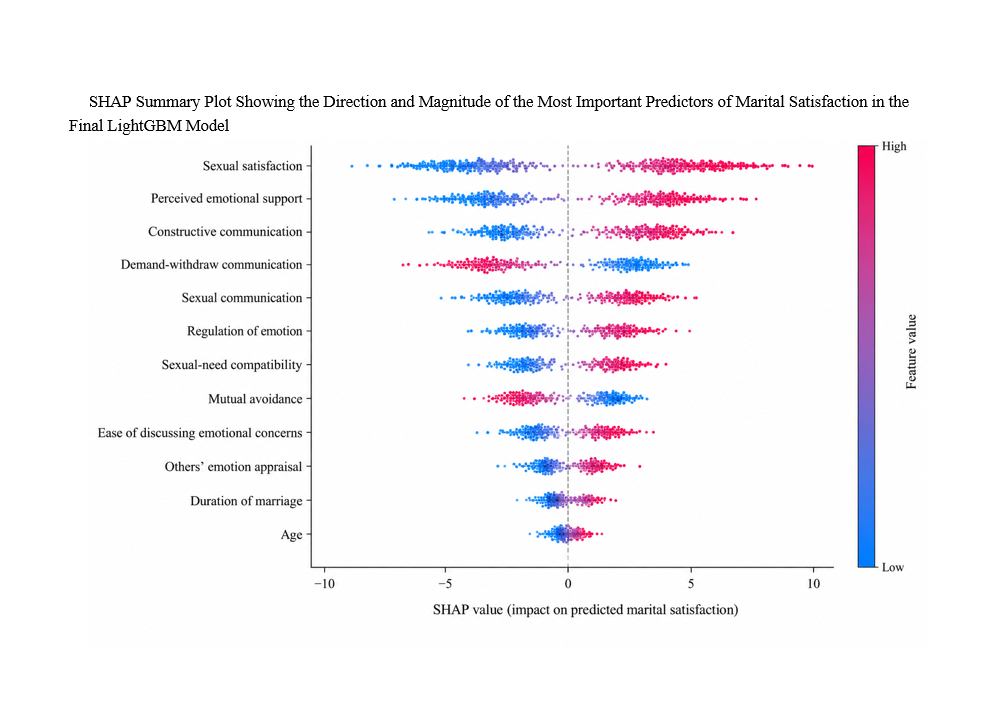
Findings: LightGBM demonstrated the strongest predictive performance, explaining 77.2% of the variance in marital satisfaction in the independent test set (R² = .772, RMSE = 3.09, MAE = 2.34), compared with XGBoost (R² = .739), random forest (R² = .704), Elastic Net (R² = .617), and multiple linear regression (R² = .598). SHAP analysis identified sexual satisfaction as the most influential predictor, followed by perceived emotional support, constructive communication, demand-withdraw communication, sexual communication, emotion regulation, sexual-need compatibility, and mutual avoidance. Age and duration of marriage showed comparatively small predictive contributions. Important interactions were observed between sexual satisfaction and sexual communication and between emotional support and constructive communication.
Conclusion: Marital satisfaction was predicted with high accuracy by a multidimensional combination of sexual, emotional, and communication characteristics, with LightGBM outperforming conventional linear and alternative machine-learning models
Downloads
References
Andersen, M. L., Alvarenga, T. A., Fonseca, L. F. d., & Tufik, S. (2025). Interactions Between Co-Sleeping, Sleep Quality, and Relationship Health: The Benefits and Challenges of Shared Sleep Environments. Journal of Health Psychology, 30(14), 4550-4563. https://doi.org/10.1177/13591053251356355
Bahrami, N., Hosseini, M., Griffiths, M. D., & Alimoradi, Z. (2023). Sexual-Related Determinants of Life Satisfaction Among Married Women: A Cross-Sectional Study. BMC Women S Health, 23(1). https://doi.org/10.1186/s12905-023-02365-5
Buchanan, D. A. (2022). Examining the Marital Relationship After the Death of a Child. The Family Journal, 31(1), 165-173. https://doi.org/10.1177/10664807221104129
Cao, R. (2026). Dyadic Coping and Illness Uncertainty in Cancer Patient–Caregiver Dyads: Interactive Mechanisms, Heterogeneity, and Integrated Intervention Directions—A Narrative Review (2021–2025). Healthcare, 14(14), 2098. https://doi.org/10.3390/healthcare14142098
Castillo‐López, Á. G. d., Berenguer-Soler, M., & Pineda, D. (2025). Relationship Love Styles’ Effects on Conflict, Emotional Intelligence, and Sexual Satisfaction: A Latent Profile Analysis. Sage Open, 15(3). https://doi.org/10.1177/21582440251358988
Castro, R., Araújo, S., Marques, A., Ferreira, D., Rocha, H., Aguiar, S., Pieramico, S., Quinta-Gomes, A. L., Tavares, I. M., Carvalho, J., & Nobre, P. (2024). Mapping the Contributions of Dyadic Approaches to Couples’ Psychosocial Adaptation to Prostate Cancer: A Scoping Review. https://doi.org/10.31234/osf.io/ef6nd
Daniluc, R.-I., Craina, M., Tischer, A. A., Bondar, A.-C., Stelea, L., Bica, M. C., & Stana, L. G. (2025). Relationship Satisfaction and Body Image-Related Quality of Life as Correlates of Sexual Function During Pregnancy: A Systematic Review. Healthcare, 13(23), 3020. https://doi.org/10.3390/healthcare13233020
Duca, D. S., Ursu, A., Bogdan, I., & Rusu, P. P. (2023). Emotions and Emotion Regulation in Family Relationships. Revista Romaneasca pentru Educatie Multidimensionala, 15(2), 114-131. https://doi.org/10.18662/rrem/15.2/724
Enjezab, B., Yousofvand, F., Dehsorkhi, H. N., & Sorkhani, T. M. (2023). Communication Skills Training With the Transactional Analysis Approach Developed Menopausal Women’s Marital Adjustment – A Quasi-Experimental Study. Menopausal Review, 22(2), 64-70. https://doi.org/10.5114/pm.2023.127772
Farhan, S., & Ismail, Y. (2022). The Relationship of Body Shape Satisfaction With Personal Intimacy and Sexual Satisfaction Among Married Females. Pakistan Journal of Gender Studies, 22(1), 135-156. https://doi.org/10.46568/pjgs.v22i1.597
Figueiredo, M. H., Pinto, L. R., Leal, F., & Ferreira, M. M. P. (2024). The Transformative Change Towards the Reunion of the Marital Model - Clinical Case Study. International Journal of Health Science, 4(13), 2-9. https://doi.org/10.22533/at.ed.15941324260110
Finzi‐Dottan, R., & Gewirtz‐Meydan, A. (2023). In Love With a Trauma Survivor: When a History of Childhood Abuse Interferes With Relationship Satisfaction Among Couples. Journal of interpersonal violence, 39(3-4), 541-568. https://doi.org/10.1177/08862605231198009
Gyeong, S., & Shin, H. (2026). Divergent Network Pathways Linking Personality, Approach–avoidance Goals, and Marital Adjustment to Psychological Well-Being. Journal of Social and Personal Relationships, 43(7), 1953-1981. https://doi.org/10.1177/02654075261422436
Ibrahim, M., Palit, M., & Matthews, R. (2023). Intergenerational Attachment Styles, Emotional Regulation and Relational Outcomes in Couples Therapy. https://doi.org/10.5772/intechopen.108492
Jie, H. (2026). Dyadic Coping Experience of Breast Cancer Patients and Their Spouses: A Qualitative Research. https://doi.org/10.21203/rs.3.rs-9753741/v1
Küçükkaya, B., Yüksek, B., Shafaei, A., & Göçen, A. (2026). The Relationship Between Spousal Support, Menopausal Symptoms, and Sexual Attitudes in Menopausal Women: A Cross-Sectional Study. BMC Women S Health, 26(1). https://doi.org/10.1186/s12905-026-04371-9
Majumder, P., Dorai, D. R., Gopinathan, B., Pal, A., Mozumder, A. H., Mallik, S., Ahmad, N., Badawy, A. S., & Changalasetty, S. B. (2024). Balancing Acts: A Multi-Criteria Decision-Making Exploration of Psychological Factors in Marital Conflict and Intervention Strategies. https://doi.org/10.21203/rs.3.rs-3935051/v1
Mandal, E., & Lip, M. (2022). Mindfulness, Relationship Quality, and Conflict Resolution Strategies Used by Partners In Close Relationships. Current Issues in Personality Psychology, 10(2), 135-146. https://doi.org/10.5114/cipp.2021.111981
Özbay, A., & Balaban, Ö. (2024). Investigating the Relationship Between Emotional Intelligence and Sexual Satisfaction in Late Adolescent University Students. Sexuality Gender & Policy, 7(4), 382-403. https://doi.org/10.1002/sgp2.12117
Rowland, D. L., Ehsan, M. K., & Cooper, S. E. (2024). Changes in Spousal Intimacy in Women Suffering Trauma Symptoms From Domestic Abuse: A Culturally Embedded Intervention Study in Pakistan. International journal of environmental research and public health, 21(8), 1045. https://doi.org/10.3390/ijerph21081045
Salehi, M., Abkenar, B. N., & Rashidi, T. (2024). The Effectiveness of Gottman's Systemic Cognitive Couple Therapy on Marital Conflicts, Communication Patterns, and Alexithymia in Couples With Marital Conflict. Jarac, 6(3), 145-152. https://doi.org/10.61838/kman.jarac.6.3.16
Schmidt, A. M., Jubran, M., Salivar, E. G., & Brochu, P. M. (2022). Couples Losing Kinship: A Systematic Review of Weight Stigma in Romantic Relationships. Journal of Social Issues, 79(1), 196-231. https://doi.org/10.1111/josi.12542
Sentieiro, M. L., Ferreira, L. C., Miranda, M. P., & Vitória, B. A. (2025). Couples and Parenting Dynamics During Covid-19 Pandemic: A Systematic Review of the Literature. PLoS One, 20(2), e0315417. https://doi.org/10.1371/journal.pone.0315417
Teichmüller, K., Bas, L. M., Kindl, G., Kanske, P., Rittner, H. L., & Reiter, A. M. (2025). Empathy and Validation in Chronic Pain Couples: A Systematic Review. Pain Reports, 10(6). https://doi.org/10.1097/pr9.0000000000001343
Torani, R. A., & Fard, M. S. (2024). Efficacy of Emotion-Focused Couple Therapy on Intimacy, Marital Adjustment, and Forgiveness Among Couples With a History of Extramarital Affairs. Aftj, 5(2), 95-102. https://doi.org/10.61838/kman.aftj.5.2.11
Valente, M., Chirico, I., Girotti, C., Ottoboni, G., & Chattat, R. (2022). The Role of the Quality of Relationship in Couples Facing Treatment for Breast Cancer. American Journal of Clinical Oncology, 46(1), 36-42. https://doi.org/10.1097/coc.0000000000000962
Wang, C., Luo, F., Song, M. S., Wang, R., Zhang, Y., Li, X., & Xi, Q. (2025). Role of Music Therapy Combined With Dyadic Coping in Enhancing Psychosocial Adaptation and Marital Well-Being for Young and Middle-Aged Patients Returning to Work After Acute Myocardial Infarction. Noise and Health, 27(126), 223-232. https://doi.org/10.4103/nah.nah_182_24
Wang, Y., Zhang, J., Wang, S., Wu, Y., Hang, L., Hua, Y., & Shi, W. (2025). Feasibility and Preliminary Efficacy of a Systematic Transaction Model-Guided Dyadic Coping Nursing Intervention for Patients With Breast Cancer and Their Spousal Caregivers: A Pilot Study. Asia-Pacific Journal of Oncology Nursing, 12, 100621. https://doi.org/10.1016/j.apjon.2024.100621
Wickrama, K. A. S., O’Neal, C. W., & Klopack, E. T. (2022). Midlife Financial Strain and Later‐life Health and Wellbeing of Husbands and Wives: Linking and Moderating Roles of Couple Intimacy Trajectories. Family Process, 61(4), 1593-1609. https://doi.org/10.1111/famp.12749
Xie, Y., & Feeney, B. C. (2024). A Narrative Review of Mechanisms Linking Romantic Relationship Experiences to Sleep Quality. Sleep Advances, 5(1). https://doi.org/10.1093/sleepadvances/zpae049
Zaidi, S., Razia, E.-t., & Shoaib, S. (2022). Role of Emotional Intelligence in Dyadic Adjustment of Married Couples. Asian Journal of Social Sciences and Management Studies, 9(4), 70-74. https://doi.org/10.20448/ajssms.v9i4.4240
Downloads
Additional Files
Publication Timeline
- Submitted
- Revised
- Accepted