Predicting Marital Satisfaction Using Random Forest Based on Attachment, Communication, Intimacy, and Conflict Indicators
Keywords:
Marital Satisfaction, Random Forest, Attachment, Communication, Intimacy, Marital Conflict, Machine LearningAbstract
Objective: This study aimed to predict marital satisfaction among married adults in Canada using Random Forest regression based on attachment, communication, intimacy, and conflict indicators.
Methods and Materials: This cross-sectional predictive study was conducted on 646 married adults residing in Canada. Participants completed the Couples Satisfaction Index-16, Experiences in Close Relationships–Revised questionnaire, Communication Patterns Questionnaire–Short Form, Personal Assessment of Intimacy in Relationships scale, and selected dimensions of the Revised Conflict Tactics Scales. The predictor set included attachment anxiety and avoidance, constructive communication, mutual avoidance, demand-withdraw communication, emotional, social, sexual, intellectual, and recreational intimacy, negotiation, and psychological aggression. Random Forest regression was used to predict continuous marital satisfaction scores. The dataset was divided into training and independent test subsets using an 80:20 ratio, and hyperparameters were optimized through five-fold cross-validation. Predictive performance was evaluated using R², mean absolute error, mean squared error, and root mean squared error. Permutation importance and partial dependence analyses were used to interpret predictor contributions and nonlinear patterns.
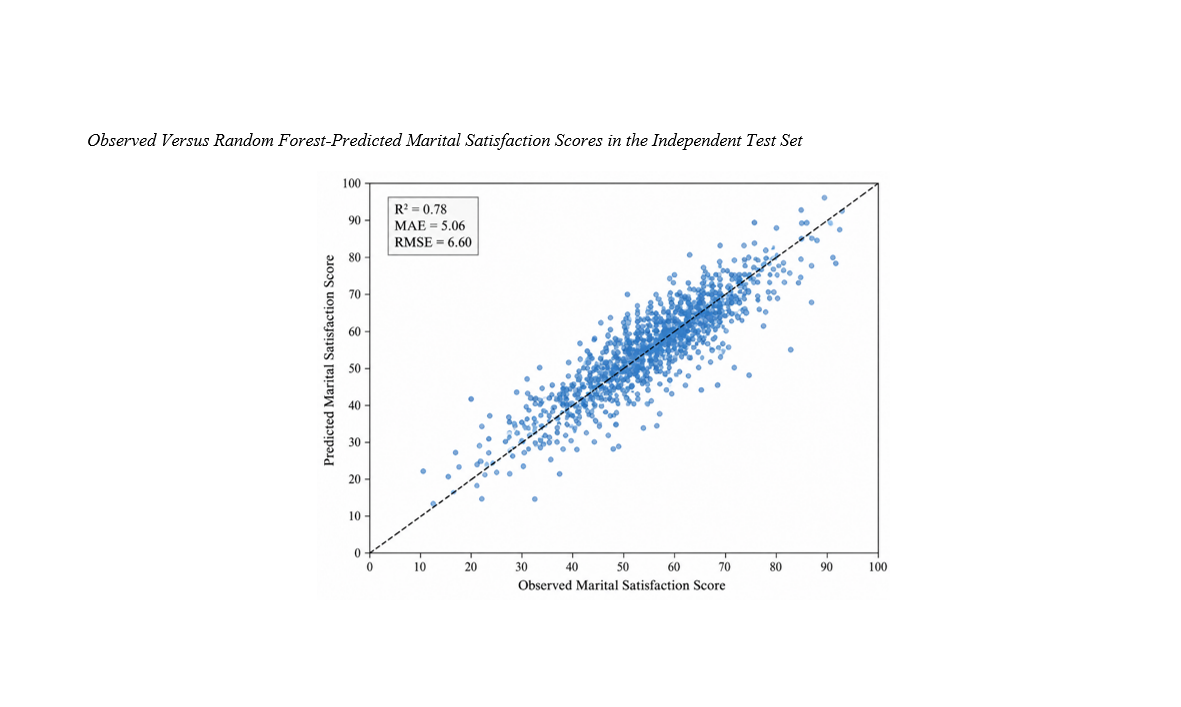
Findings: The Random Forest model demonstrated strong predictive performance, with an R² of .91 in the training set, .76 in five-fold cross-validation, and .78 in the independent test set. Test-set prediction error was MAE = 5.06, MSE = 43.52, and RMSE = 6.60. Emotional intimacy showed the greatest permutation importance, followed by constructive communication, attachment anxiety, sexual intimacy, psychological aggression, attachment avoidance, negotiation, and demand-withdraw communication. Partial dependence analyses indicated that higher emotional intimacy, constructive communication, sexual intimacy, and negotiation were associated with higher predicted marital satisfaction, whereas attachment anxiety, psychological aggression, attachment avoidance, and demand-withdraw communication were associated with lower predicted satisfaction.
Conclusion: Marital satisfaction can be predicted with substantial accuracy using a multidimensional Random Forest model, with emotional intimacy and constructive communication emerging as the strongest positive predictors and attachment insecurity and destructive conflict as the principal negative predictors.
Downloads
References
Adhikari, A., & Shilpa, K. S. (2025). Understanding Romantic Relationships Using Strength and Strain Model in the Context of COVID-19. Couple and Family Psychology Research and Practice, 14(4), 309-327. https://doi.org/10.1037/cfp0000267
Afshin, A., Ganji, F., & Yaghobiyan, R. (2024). Predicting Marital Intimacy Based on Attachment Styles, Early Maladaptive Schemas, and Love Styles in Married Female Students. Aftj, 5(1), 108-114. https://doi.org/10.61838/kman.aftj.5.1.12
Ashraf, R., Syed, U. E., Khan, A., & Bibi, N. (2024). The Moderating Role of Marital Adjustment in Relationship Between Perceived Maternal Parenting Styles and Family Functioning Among Fathers. Canadian Journal of Family and Youth / Le Journal Canadien De Famille Et De La Jeunesse, 16(2), 91-111. https://doi.org/10.29173/cjfy30003
Behrang, K., Koraei, A., Shahbazi, M., & Abbaspour, Z. (2022). Effects of Emotionally Focused Therapy on Sexual Assertiveness, Marital Forgiveness, and Marital Harmony in Maladjusted Couples. Journal of Research and Health, 12(3), 177-184. https://doi.org/10.32598/jrh.12.3.1986.1
Castillo‐López, Á. G. d., Berenguer-Soler, M., Pineda, D., & José, A. G. d. C. (2024). Emotional Flooding in Couple Relationships: Psychosocial Aspects and Regulatory Strategies. https://doi.org/10.5772/intechopen.1006183
Dargahi, S., Damirchi, E. S., Kivi, H. G., Sharif, A. R., & Nazari, A. (2022). Identifying Themes Relevant to Sexual Dissatisfaction of Dual Career Couples: Design and Effectiveness of a Psycho-Educational Package – A Mixed Method Study. Work a Journal of Prevention Assessment & Rehabilitation, 73(3), 1045-1058. https://doi.org/10.3233/wor-211075
Dehghanidowlatabadi, S., Pallathadka, H., Ismail, S. M., Àbdullaev, D., Ibrahim, F. M., & Prasad, K. D. V. (2025). Moderating Effect of Interpersonal Mindfulness Between Marital Conflict and Marital Intimacy Among Iranian Married Individuals. Brain and Behavior, 15(3). https://doi.org/10.1002/brb3.70392
Farooq, Z., Akhtar, N., & Zacchilli, T. L. (2024). Validation of Romantic Partner Conflict Scale (RPCS) in Pakistani Married Couples: Establishing Measurement Invariance. Interpersona an International Journal on Personal Relationships, 18(1), 79-103. https://doi.org/10.5964/ijpr.12555
Ghasemi, Y. (2023). The Relationship Between Attachment Symbols, Attachment Styles and Self-Differentiation With Marital Intimacy. Obstetrics Gynecology and Reproductive Sciences, 7(4), 01-08. https://doi.org/10.31579/2578-8965/168
Hasim, M. J. M., Hashim, N. H., & Mustafa, H. (2023). Married Life: Measuring Adult Romantic Attachment and Satisfaction. Couple and Family Psychology Research and Practice, 12(3), 119-131. https://doi.org/10.1037/cfp0000188
Ibrahim, M., Palit, M., & Matthews, R. (2023). Intergenerational Attachment Styles, Emotional Regulation and Relational Outcomes in Couples Therapy. https://doi.org/10.5772/intechopen.108492
Ji, W., Lan, R., Ma, P., Zhang, H., & Fan, L. (2023). Maternal Positive Coparenting and Adolescent Ego-Identity: The Chain Mediating Role of Fathers’ Marital Satisfaction and Adolescent Peer Relationships. Frontiers in psychology, 14. https://doi.org/10.3389/fpsyg.2023.1227941
Kamal, N. M., Rahman, N. A. A., & Wan Nor Hidayah Wan, A. (2023). Antecedents of Quality Interpersonal Communication in Marriage: A View From Divorcess. 132, 83-100. https://doi.org/10.15405/epsbs.2023.11.02.7
Kuswanto, M. S., Ginanjar, A. S., & Rumondor, P. C. B. (2024). The Role of Common Dyadic Coping as Mediator Between Attachment Styles and Marital Satisfaction in Transition to Parenthood. Jppi (Jurnal Penelitian Pendidikan Indonesia), 10(2), 665. https://doi.org/10.29210/020243058
Mohamad, Z. S., Bakar, K. A. A., Sallehudin, F. U., & May, W. G. C. (2022). The Positive State and Positive Mindset in Building a Positive Relationship: A Review Paper. Malaysian Journal of Social Sciences and Humanities (MJSSH), 7(7), e001640. https://doi.org/10.47405/mjssh.v7i7.1640
Nazemi, M., Majd, M. A., Ghamari, M., & Asadi, M. (2023). Qualitative Comparison of Satisfactory Stable Marriages and Marriages With Dissatisfaction in Infertile Couples. Jayps, 4(7) 1-18. https://doi.org/10.61838/kman.jayps.4.7.1
Ni, N., Ahrari, S., Zaremohzzabieh, Z., Zarean, M., & Roslan, S. (2025). A Meta-Analytic Study of Partner Phubbing and Its Antecedents and Consequences. Frontiers in psychology, 16. https://doi.org/10.3389/fpsyg.2025.1561159
Okonkwo, K. (2024). The Role of Attachment Styles in Marital Stability: A Psychological Approach to Strengthening Relationships. American Journal of Psychology, 6(4), 35-50. https://doi.org/10.47672/ajp.2474
Radpour, B., Behboodi, M., & Fard, F. D. (2023). The Effectiveness of Preventation and Relationship Enrichment Program (PREP) on Marital Conflicts and Sexual Satisfaction in Couples. Jarac, 5(3), 127-135. https://doi.org/10.61838/kman.jarac.5.3.17
Seo, M., Choo, H., & Bae, H. o. (2025). Communication and Couple Satisfaction of Women in Cross‐National Marriages and Korean Husbands: Mediating Effect of Intimacy. Journal of marital and family therapy, 52(1). https://doi.org/10.1111/jmft.70098
Shinde, S., Sanghvi, N., & Hinduja, D. (2023). Attachment Styles and Marital Satisfaction: A Study to Associate Attachment Patterns and Satisfaction in Marriages. International Journal of Research Publications, 132(1). https://doi.org/10.47119/ijrp1001321920235455
Shrestha, P. S., Shaver, S. R., Perlman, T. T., & Walsham, W. (2023). Emotional Dimensions of Infidelity: An Analysis of Psychological and Emotional Factors Affecting Relationship Infidelity. Jurnal Sosial Sains Terapan Dan Riset (Sosateris), 11(2), 88-103. https://doi.org/10.35335/85rbw180
Suresh, S., Das, A., Lokesh, S., Shah, A., & Satyanarayana, V. A. (2025). Couple Enrichment Clinic as a Model of Promotive and Preventive Mental Health Care in South India. Journal of marital and family therapy, 51(4). https://doi.org/10.1111/jmft.70067
Torani, R. A., & Fard, M. S. (2024). Efficacy of Emotion-Focused Couple Therapy on Intimacy, Marital Adjustment, and Forgiveness Among Couples With a History of Extramarital Affairs. Aftj, 5(2), 95-102. https://doi.org/10.61838/kman.aftj.5.2.11
Uluyol, F. M., & Özen‐Çıplak, A. (2024). Dyadic Relationship of Adult Attachment Patterns and Interpersonal Schemas in Marital Adjustment: Actor–partner Effect Model. Family Relations, 73(3), 2152-2169. https://doi.org/10.1111/fare.13002
Wendołowska, A., Czyżowska, N., & Czyżowska, D. (2022). The Role of Attachment and Dyadic Coping in Shaping Relational Intimacy: Actor–Partner Interdependence Model. International journal of environmental research and public health, 19(23), 16211. https://doi.org/10.3390/ijerph192316211
Xiao, X. (2024). The Effects of Parental Marital Quality on Preschool Children's Social–emotional Competence: The Chain Mediating Model of Parent–child and Sibling Relationships. Infant Mental Health Journal Infancy and Early Childhood, 46(1), 15-29. https://doi.org/10.1002/imhj.22148
Downloads
Additional Files
Publication Timeline
- Submitted
- Revised
- Accepted