Deep Neural Network Prediction of Couple Relationship Quality Using Multidimensional Relational and Psychological Features
Keywords:
couple relationship quality, deep neural network, relationship satisfaction, attachment, communication, psychological features, machine learningAbstract
Objective: This study aimed to develop and evaluate a deep neural network model for predicting couple relationship quality using multidimensional relational, psychological, contextual, and demographic features.
Methods and Materials: This quantitative cross-sectional predictive study was conducted with 680 adults involved in committed romantic relationships and residing in Canada. Participants completed standardized assessments of relationship quality, relationship satisfaction, communication quality, conflict processes, perceived partner responsiveness, emotional intimacy, commitment, trust, attachment anxiety and avoidance, depressive symptoms, anxiety, perceived stress, emotion regulation, self-esteem, psychological well-being, and selected contextual characteristics. The dataset was divided into training (n = 476), validation (n = 102), and independent test (n = 102) subsets. A feedforward deep neural network with four hidden layers was trained using the Adam optimizer, dropout regularization, batch normalization, and early stopping. Predictive performance was evaluated using mean absolute error, mean squared error, root mean squared error, and coefficient of determination and was compared with multiple linear regression, ridge regression, random forest regression, and gradient-boosted regression. SHAP analysis was used to interpret feature importance.
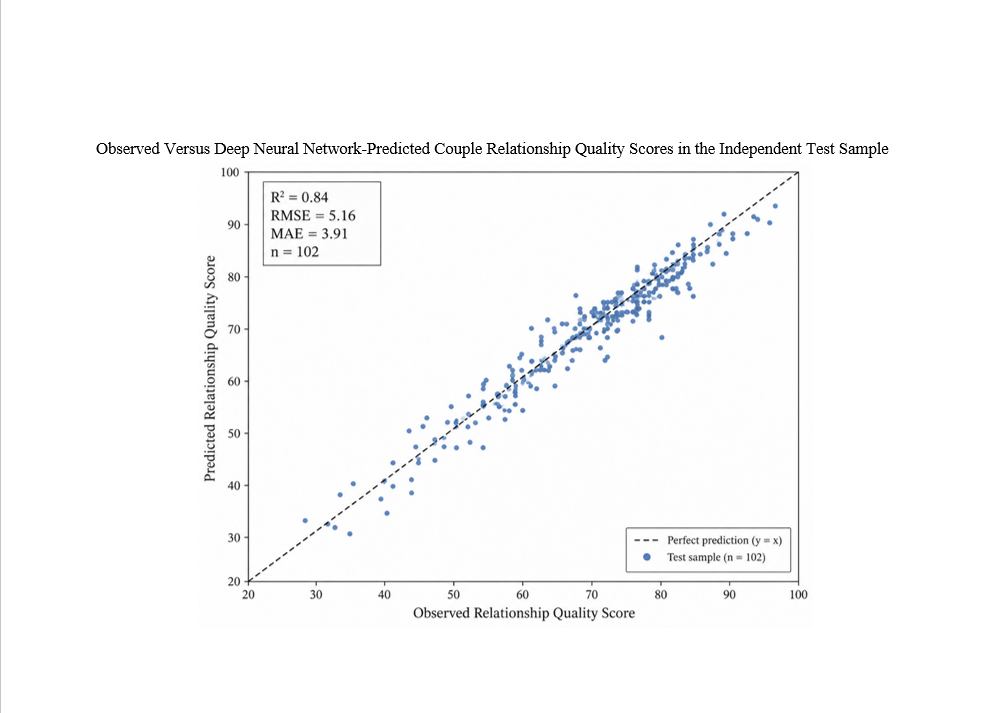
Findings: The deep neural network demonstrated the strongest predictive performance on the independent test set, with MAE = 3.91, MSE = 26.63, RMSE = 5.16, and R² = .84. It outperformed multiple linear regression (R² = .64), ridge regression (R² = .66), random forest regression (R² = .74), and gradient-boosted regression (R² = .78). The most influential predictors were relationship satisfaction, perceived partner responsiveness, destructive conflict, communication quality, emotional intimacy, attachment anxiety, commitment, trust, perceived stress, and attachment avoidance. Sensitivity analysis showed that removing relationship satisfaction reduced model performance to R² = .76, while the multidimensional full model retained the highest accuracy.
Conclusion: Deep neural networks can accurately predict couple relationship quality by integrating relational and psychological features and may provide a useful framework for identifying complex nonlinear patterns relevant to relationship assessment and intervention.
Downloads
References
Adamczyk, K., Kleka, P., & Frydrychowicz, M. (2022). Psychometric Functioning, Measurement Invariance, and External Associations of the Relationship Assessment Scale in a Sample of Polish Adults. Scientific reports, 12(1). https://doi.org/10.1038/s41598-022-26653-6
Aguilar‐Raab, C., Winter, F., Jarczok, M. N., Ditzen, B., & Warth, M. (2022). Feeling Low and Unhappy Together? An Actor-Partner-Interdependence Model Uncovering the Linkage Between Different Operationalizations of Relationship Quality and Depression in Different-Sex Couples. PLoS One, 17(11), e0274756. https://doi.org/10.1371/journal.pone.0274756
Arora, M., & Chauhan, T. (2024). The Relationship Between Sex-Roles and Romantic Relationship Satisfaction. International Journal for Multidisciplinary Research, 6(3). https://doi.org/10.36948/ijfmr.2024.v06i03.21213
Baez, G., Castillo, L. P. D., & Guzmán, J. A. P. (2023). Romantic Partnership and Perceived Risk of Separation During COVID-19 Lockdown in the Dominican Republic. Ciencia Y Sociedad, 48(4), 57-89. https://doi.org/10.22206/cys.2023.v48i4.2806
Bagheri, R., Ostovar, S., Griffiths, M. D., & Hashim, I. H. M. (2023). Server Connection Versus Marital Disconnection: An Investigation of the Effect of Internet Addiction on Couple Burnout in Iran. Technology in Society, 72, 102163. https://doi.org/10.1016/j.techsoc.2022.102163
Brock, R. L., & Gervais, S. J. (2025). The Psychometric Properties of a New Scale of Dehumanizing Deindividuation in Couples. Journal of Family Psychology, 39(2), 171-183. https://doi.org/10.1037/fam0001311
Brock, R. L., Ramsdell, E. L., Franz, M. R., Stasik-O’Brien, S. M., Gervais, S. J., & Calkins, F. C. (2023). Free to Be Me With You: Development of the Individuality in Couples Questionnaire. Psychological assessment, 35(7), 602-617. https://doi.org/10.1037/pas0001238
Brown, A. M., Landor, A. M., & Zeiders, K. H. (2023). Weathering Racism and Colorism: Exploring Concurrent and Short-Term Longitudinal Associations Between Discrimination, Colorism, Psychosocial Health, and Black and Latinx Emerging Adults’ Relationship Satisfaction. Journal of Social and Personal Relationships, 40(10), 3244-3268. https://doi.org/10.1177/02654075231170900
Castillo‐López, Á. G. d., Berenguer-Soler, M., Pineda, D., & José, A. G. d. C. (2024). Emotional Flooding in Couple Relationships: Psychosocial Aspects and Regulatory Strategies. https://doi.org/10.5772/intechopen.1006183
Cruwys, T., South, E. I., Halford, W. K., Murray, J., & Fladerer, M. P. (2022). Measuring “We‐ness” in Couple Relationships: A Social Identity Approach. Family Process, 62(2), 795-817. https://doi.org/10.1111/famp.12811
Estlein, R., Gewirtz‐Meydan, A., & Opuda, E. (2022). Love in the Time of COVID‐19: A Systematic Mapping Review of Empirical Research on Romantic Relationships One Year Into the COVID‐19 Pandemic. Family Process, 61(3), 1208-1228. https://doi.org/10.1111/famp.12775
Fernandes, M. I. A., Sousa, C., Conde, A. R., Silva, F. F. d., & Ferreira, M. J. (2023). Exploring the Relationship Between Capacity to Love and Well-Being: A Comparative Study of Emerging Adults and Middle-Aged Adults. Sexuality & Culture, 28(4), 1424-1445. https://doi.org/10.1007/s12119-023-10184-x
Genç, E., & Büyükada, E. (2026). The Impact of Obsessive‐Compulsive Relationship Symptoms on Marital Instability: Mediating Role of Infidelity Tendency. Journal of marital and family therapy, 52(2). https://doi.org/10.1111/jmft.70122
Glavač, T., Poštuvan, V., Schmeckenbecher, J., & Kapusta, N. D. (2024). Slovenian Validation of the Capacity to Love Inventory: Associations With Clinical Measures and Mindfulness. Frontiers in psychology, 15. https://doi.org/10.3389/fpsyg.2024.1440013
Kanth, D. B. (2022). Effects of Personal Relationships on Physical and Mental Health Among Young Adults- A Scoping Review. The Open Psychology Journal, 15(1). https://doi.org/10.2174/18743501-v15-e2208180
Khani, P., Dezfouli, M. A., Nasri, F., Rahemi, M., Ahmadloo, S., Afkhami, H., Saeidi, F., Tereshchenko, S., Bigdeli, M. R., & Modarressi, M. H. (2023). Genetic and Epigenetic Effects on Couple Adjustment in Context of Romantic Relationship: A Scoping Systematic Review. Frontiers in Genetics, 14. https://doi.org/10.3389/fgene.2023.1002048
Kreuzer, M., & Gollwitzer, M. (2021). Neuroticism and Satisfaction in Romantic Relationships: A Systematic Investigation of Intra- And Interpersonal Processes With a Longitudinal Approach. European Journal of Personality, 36(2), 149-179. https://doi.org/10.1177/08902070211001258
Lassri, D., & Zamir, O. (2026). The Role of Self-Compassion in the Association Between Childhood Maltreatment and Marital Quality: An Actor–partner Interdependence Model. Psychological Trauma Theory Research Practice and Policy, 18(1), 138-147. https://doi.org/10.1037/tra0001680
Madsen, J. W., Hernández, L., Sedov, I. A., & Tomfohr‐Madsen, L. (2023). Romantic Relationship Satisfaction Is Associated With Sleep in Undergraduate Students. Couple and Family Psychology Research and Practice, 12(1), 39-54. https://doi.org/10.1037/cfp0000163
Miscioscia, M., Carli, P. D., Sacchi, C., Tasker, F., & Simonelli, A. (2021). Attachment Matching and Coparental Interactions in Same-Sex and Different-Sex Couples Planning Parenthood. 153-179. https://doi.org/10.1007/978-3-030-51988-9_8
Nguyen, P. (2023). Investigating Assortative Mating Patterns by Expanding Personality Assessments Beyond Static and Universal Personality Traits: Written Doctoral Preliminary Exam. https://doi.org/10.31234/osf.io/c3q7x
Özdemir, P. G. (2025). Does Sacrifice Always Lead to Burnout in Romantic Relationships? The Role of Relational Equity and Appreciation. Journal of Social and Personal Relationships, 42(10), 3056-3081. https://doi.org/10.1177/02654075251359607
Park, C., & Harris, V. W. (2025). Consensus, Need Fulfillment, Commitment, and Satisfaction in Couple Relationships: Structural Equation Modeling. Journal of marital and family therapy, 51(1). https://doi.org/10.1111/jmft.70001
Quan, L., Zhang, K., & Chen, H. (2025). The Relationship Between Childhood Trauma and Romantic Relationship Satisfaction: The Role of Attachment and Social Support. Frontiers in Psychiatry, 15. https://doi.org/10.3389/fpsyt.2024.1519699
Relvas, A. P., Lacomba‐Trejo, L., Portugal, A., Chiarolanza, C., Major, S., Rosa, C., Sotero, L., & Randall, A. K. (2023). YES, WE COPE: Dyadic Coping as a Mediator Between Perceived Relationship Quality and Emotional Representation of COVID-19. Cognitive therapy and research, 47(4), 563-573. https://doi.org/10.1007/s10608-023-10379-4
Ricafrente, G. R., Sumicad, R., Lirazan, M. E., & Gerzon, K. J. (2024). Correlations of Personality Traits and Romantic Relationship Satisfaction. Journal of Psychology and Behavior Studies, 4(1), 38-50. https://doi.org/10.32996/jpbs.2024.1.5
Rice, T. M., Bryant, C. M., & Dush, C. M. K. (2025). Multidimensional Racism‐Related Stress and the Undermining of Black Romantic Relationships. Journal of marriage and family, 88(2), 413-424. https://doi.org/10.1111/jomf.70028
Rizzo, M., Matera, C., Caso, D., Donizzetti, A. R., Grano, C., Nerini, A., & Rollero, C. (2025). Satisfaction in Romantic Relationships: The Role of Body Appreciation, Sexual Esteem and Sexual Assertiveness. Behavioral Sciences, 15(12), 1730. https://doi.org/10.3390/bs15121730
Rostami, M. (2024). Beyond the Bedroom: How Resilience and Thought Control Influence Sexual Satisfaction. KMAN Counsel and Psych Nexus, 2(1), 10-16. https://doi.org/10.61838/kman.psychnexus.1.2.3
Shrestha, P. S., Shaver, S. R., Perlman, T. T., & Walsham, W. (2023). Emotional Dimensions of Infidelity: An Analysis of Psychological and Emotional Factors Affecting Relationship Infidelity. Jurnal Sosial Sains Terapan Dan Riset (Sosateris), 11(2), 88-103. https://doi.org/10.35335/85rbw180
Swets, J. A., Cox, C. R., & Ekas, N. V. (2024). Preliminary Evidence That Relationship Nostalgia Might Offset Romantic Conflict to Aid Relationship Commitment. Couple and Family Psychology Research and Practice, 13(4), 276-295. https://doi.org/10.1037/cfp0000248
Uluyol, F. M., & Özen‐Çıplak, A. (2024). Dyadic Relationship of Adult Attachment Patterns and Interpersonal Schemas in Marital Adjustment: Actor–partner Effect Model. Family Relations, 73(3), 2152-2169. https://doi.org/10.1111/fare.13002
Ventura‐León, J., Tocto‐Muñoz, S., Lino‐Cruz, C., Sánchez‐Villena, A. R., Martinez‐Munive, R., Talledo‐Sánchez, K., & Casiano‐Valdivieso, K. (2025). Validation and Reliability of the Negative Interaction Scale for Couple Relationships in Peru: A Bayesian Confirmatory Factor Analysis Approach. Family Process, 64(1). https://doi.org/10.1111/famp.70029
Warth, M., Stoffel, M., Winter, F., Jarczok, M. N., Aguilar‐Raab, C., & Ditzen, B. (2020). Instructed Partnership Appreciation in Depression: Effects on Mood, Momentary Relationship Satisfaction, and Psychobiological Arousal. Frontiers in Psychiatry, 11. https://doi.org/10.3389/fpsyt.2020.00701
Xu, M., Wu, S., Lin, C., Tang, R., & Gao, D. (2026). Tacit Cooperation Influenced Intimate Relationship Satisfaction: The Moderating Roles of Coordination Game Type and Developmental Stage of Relationship. Design for Augmented Humanity, 1(2), 159-172. https://doi.org/10.1177/29776481261453225
Zhu, M., Tan, J., Zuli, Z., Liang, L., Li, Q., Wen, J., Wang, Z., Zhang, A., Wu, G., Liu, J., & Shu, Y. (2026). Adult Attachment and Intimate Relationship Satisfaction Among University Students: The Chain Mediating Roles of Appreciation and Sense of Giving. Frontiers in Psychiatry, 17. https://doi.org/10.3389/fpsyt.2026.1758775
Downloads
Additional Files
Publication Timeline
- Submitted
- Revised
- Accepted