Structural Equation Modeling of Marital Burnout Based on Childhood Emotional Neglect, Attachment Anxiety, Emotion Dysregulation, and the Moderating Role of Partner Support
Keywords:
Marital Burnout, Childhood Emotional Neglect, Attachment Anxiety, Emotion Dysregulation, Partner Support, Structural Equation ModelingAbstract
Objective: This study aimed to test a structural equation model of marital burnout based on childhood emotional neglect, attachment anxiety, and emotion dysregulation and to examine the moderating role of perceived partner support in the associations of attachment anxiety and emotion dysregulation with marital burnout.
Methods and Materials: This cross-sectional correlational study was conducted among 412 married adults residing in Canada in 2026. Participants were recruited through community organizations, family and relationship support centers, social media advertisements, university community boards, and online research participation platforms. Data were collected using the Couple Burnout Measure, the Emotional Neglect subscale of the Childhood Trauma Questionnaire–Short Form, the attachment anxiety subscale of the Experiences in Close Relationships–Revised questionnaire, the Difficulties in Emotion Regulation Scale, and partner-focused items from the Multidimensional Scale of Perceived Social Support. Data were analyzed using Pearson correlations and structural equation modeling with maximum-likelihood estimation. Moderation was examined using interaction terms and simple-slope analysis.
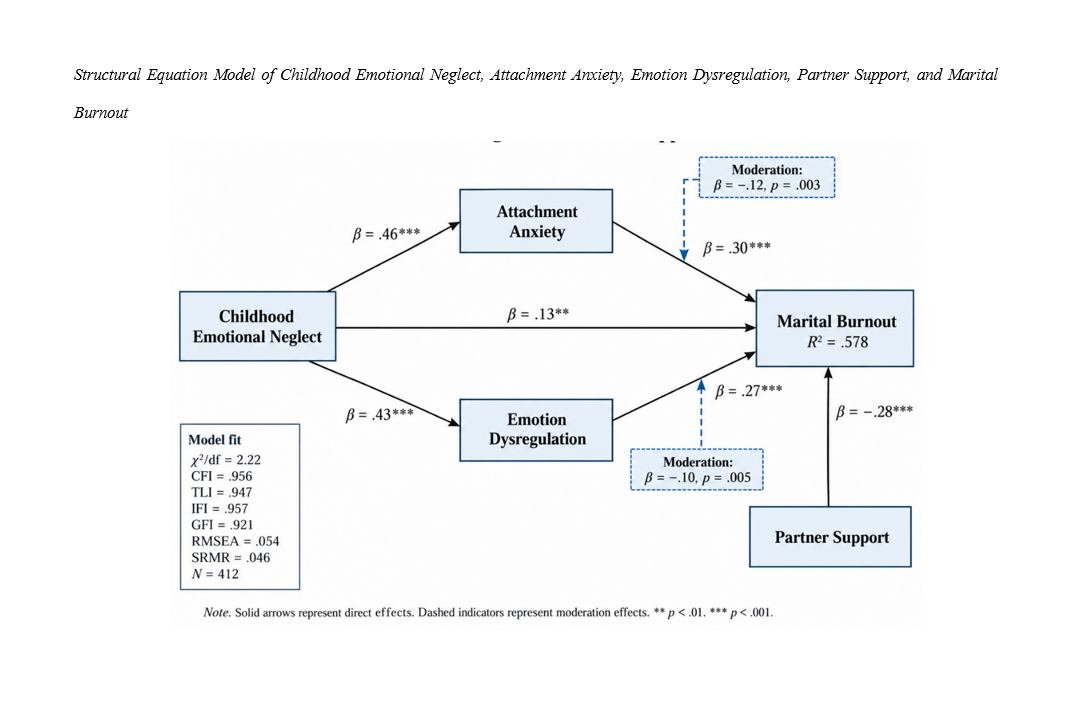
Findings: The structural model showed satisfactory fit, χ²/df = 2.22, CFI = .956, TLI = .947, IFI = .957, GFI = .921, RMSEA = .054, and SRMR = .046. Childhood emotional neglect significantly predicted attachment anxiety (β = .46, p < .001), emotion dysregulation (β = .43, p < .001), and marital burnout (β = .13, p = .001). Attachment anxiety (β = .30, p < .001) and emotion dysregulation (β = .27, p < .001) positively predicted marital burnout, whereas partner support negatively predicted marital burnout (β = -.28, p < .001). Partner support significantly moderated the effects of attachment anxiety (β = -.12, p = .003) and emotion dysregulation (β = -.10, p = .005) on marital burnout. The model explained 57.8% of the variance in marital burnout.
Conclusion: Marital burnout appears to reflect the combined influence of developmental adversity, attachment insecurity, emotion-regulation difficulties, and current relational resources, while perceived partner support may buffer the adverse associations of attachment anxiety and emotion dysregulation with marital burnout.
Downloads
References
Alsawalqa, R. O., Alkaraki, N. M., Aladaileh, L., Alnajdawi, A. M., & Alreesi, R. (2026). Intimate Partner Violence and Eating Disorders Among Married Women: The Mediating Role of Emotion Dysregulation. Frontiers in Sociology, 11. https://doi.org/10.3389/fsoc.2026.1747374
Anders, R., Breton, A., Lecuelle, F., Havy, M., Brunel, L., Gustin, M.-P., Franco, P., & Putois, B. (2026). Revising Parental Burnout Theory: Toward a Differentiation of Sleep-Related Burnout Subtypes. Children, 13(3), 394. https://doi.org/10.3390/children13030394
Çakmak, S., & Arıkan, G. (2024). From Burnout to Parental Burnout: How Does Caregiving Become a Burden? Psikiyatride Guncel Yaklasimlar - Current Approaches in Psychiatry, 16(1), 185-202. https://doi.org/10.18863/pgy.1267097
Carone, N., Tracchegiani, J., & Zagaria, A. (2025). Parental Burnout and Reflective Functioning in Regretful Parents: Associations With Childhood Maltreatment and Child Dysregulation. Journal of Social and Personal Relationships, 43(3), 911-937. https://doi.org/10.1177/02654075251391496
Chen, Z. (2023). The Relationship Between Father’s Parenting Behavior and Adult Attachment. Lecture Notes in Education Psychology and Public Media, 3(1), 1068-1075. https://doi.org/10.54254/2753-7048/3/2022602
ElBarazi, A. (2025). The Association Between Childhood Maltreatment and Post-Traumatic Stress Disorder (PTSD) Among Young Adults in Northern Syria. Journal of Child & Adolescent Trauma, 18(2), 305-317. https://doi.org/10.1007/s40653-025-00701-5
G., M., & R., D. R. (2024). Exploring the Relationship Between Attachment Styles and Loneliness Levels in Young Adults. International Journal for Multidisciplinary Research, 6(3). https://doi.org/10.36948/ijfmr.2024.v06i03.19869
Ibrahim, M., Palit, M., & Matthews, R. (2023). Intergenerational Attachment Styles, Emotional Regulation and Relational Outcomes in Couples Therapy. https://doi.org/10.5772/intechopen.108492
Kira, I. A. (2025). The Dynamics of Mothers Burnout in Arab Countries. https://doi.org/10.21203/rs.3.rs-7423321/v1
Kroener, J., Schaitz, C., Karabatsiakis, A., Maier, A., Connemann, B. J., Schmied, E., & Sosic-Vasic, Z. (2023). Relationship Dysfunction in Couples When One Partner Is Diagnosed With Borderline Personality Disorder: Findings From a Pilot Study. Behavioral Sciences, 13(3), 253. https://doi.org/10.3390/bs13030253
Lapointe, G. M., Drouin‐Maziade, C., Garon‐Bissonnette, J., Bordeleau, F., Lemieux, R., & Berthelot, N. (2025). Psychological Functioning in Pregnant Women Who Experienced Complex Trauma. Frontiers in Global Women S Health, 6. https://doi.org/10.3389/fgwh.2025.1611034
Mazandarani, A. A. (2026). The Interplay of Child Sleep Disturbances, Maternal Burnout, and Marital Quality in Iranian Mothers. Sleep Science, 19(02), 001-008. https://doi.org/10.1055/s-0046-1829072
Migalova, E., Fürstová, J., Hašto, J., Tavel, P., & Kaščáková, N. (2025). The Link of Adverse Childhood Experiences and Attachment to Maladaptive Personality Traits in Adults Diagnosed With Substance Use Disorder. BMC psychology, 13(1). https://doi.org/10.1186/s40359-025-03331-6
Paivio, S. C., & Pascual‐Leone, A. (2023). Trauma and Its Effects. 15-32. https://doi.org/10.1037/0000336-002
Paone, E., Trani, M. D., Visani, E., Monte, C. D., Campedelli, V., Silecchia, G., & Lai, C. (2024). Childhood Traumatic Experiences in People With Obesity With and Without Eating Disorders Who Are Seeking Bariatric Surgery: The Role of Attachment Relationships and Family Functioning. Eating and Weight Disorders - Studies on Anorexia Bulimia and Obesity, 29(1). https://doi.org/10.1007/s40519-024-01638-8
Paula, A., Condeles, P. C., Moreno, A. L., Ferreira, M. B. G., Fonseca, L. M. M., & Ruiz, M. T. (2022). Parental Burnout: A Scoping Review. Revista Brasileira de Enfermagem, 75(suppl 3). https://doi.org/10.1590/0034-7167-2021-0203
Purkiewicz, A., Regin, K. J., & Pietrzak‐Fiećko, R. (2026). Breastfeeding in the Context of Trauma and Previous Psychological Experiences: A Narrative Review. Nutrients, 18(3), 455. https://doi.org/10.3390/nu18030455
Quan, L., Zhang, K., & Chen, H. (2025). The Relationship Between Childhood Trauma and Romantic Relationship Satisfaction: The Role of Attachment and Social Support. Frontiers in Psychiatry, 15. https://doi.org/10.3389/fpsyt.2024.1519699
Ren, X., Cai, Y., Wang, J., & Chen, O. (2024). A Systematic Review of Parental Burnout and Related Factors Among Parents. BMC public health, 24(1). https://doi.org/10.1186/s12889-024-17829-y
Renkiewicz, G. K., & Hubble, M. W. (2023). Secondary Trauma Response in Emergency Services Systems (STRESS) Project: Quantifying and Predicting Vicarious Trauma in Emergency Medical Services Personnel. British Paramedic Journal, 7(4), 23-34. https://doi.org/10.29045/14784726.2023.3.7.4.23
Sokar, S. (2024). Childhood Maltreatment and the Quality of Marital Relationships: Examining Mediating Pathways and Gender Differences. Journal of Social and Personal Relationships, 41(7), 1959-1979. https://doi.org/10.1177/02654075241232168
Szeifert, N. M., Oláh, B., & Gonda, X. (2025). The Mediating Role of Adult Attachment Styles Between Early Traumas and Suicidal Behaviour. Scientific reports, 15(1). https://doi.org/10.1038/s41598-025-00831-8
Tracchegiani, J., Zagaria, A., Brumariu, L. E., & Carone, N. (2026). Caregiving, Maternal Burnout, and Child Dysregulation: Validating the Italian Caregiving Experiences Questionnaire. Family Relations, 75(3), 2128-2150. https://doi.org/10.1111/fare.70141
Vaillancourt‐Morel, M. P., Bussières, È.-L., Nolin, M.-C., & Daspe, M. È. (2023). Partner Effects of Childhood Maltreatment: A Systematic Review and Meta-Analysis. Trauma Violence & Abuse, 25(2), 1150-1167. https://doi.org/10.1177/15248380231173427
Wang, Q., Huang, C., Yu, Q., Tian, Y., Yang, J., Li, X., Chen, Z., Ning, M., Liu, Y., Zhang, D., Bin, C., & Li, Y. (2025). Association Between Adverse Childhood Experiences and Mental Health Among Nurses: A Propensity Score Matching Analysis. https://doi.org/10.21203/rs.3.rs-7364698/v1
Wu, Y., Zhao, Y., Zhong, P., Chen, C., Wu, Y., & Zheng, X. (2025). Age-Specific Prevalence and Predictors of Lifetime Suicide Attempts Using Machine Learning in Chinese Adults: A Nationwide Multi-Centre Survey. Epidemiology and Psychiatric Sciences, 34. https://doi.org/10.1017/s2045796025100231
Yakupova, V., & Suarez, A. (2023). Parental Burnout, Depression and Emotional Development of the Preschoolers. Frontiers in psychology, 14. https://doi.org/10.3389/fpsyg.2023.1207569
Yiting, L., Yanwen, S., & Jin, Y. (2026). Alexithymia in Nurses: A Context-Specific Concept Analysis Using Rodgers’s Evolutionary Methodology. BMC psychology, 14(1). https://doi.org/10.1186/s40359-026-04986-5
Zarifi, M., Menashadi, M. D., & ّFallah, M. H. (2026). Identifying the Harms Experienced by Married Women With Relationship Obsessive– Compulsive Disorder. https://doi.org/10.21203/rs.3.rs-8407007/v1
Downloads
Additional Files
Publication Timeline
- Submitted
- Revised
- Accepted