Identifying the Determinants of Effective Coparenting Among Dual-Earner Couples: A Qualitative Inquiry
Keywords:
Coparenting, dual-earner couples, shared parenting, work-family balance, qualitative research, IndonesiaAbstract
Objective: This study aimed to identify and explain the determinants of effective coparenting among dual-earner couples in Indonesia.
Methods and Materials: This qualitative study employed conventional qualitative content analysis. Participants were 24 individuals representing 12 dual-earner heterosexual couples in Indonesia, recruited through purposive sampling with maximum variation in age, occupation, education, duration of marriage, number of children, and work arrangements. Eligibility required both spouses to be employed, legally married, co-residing, and actively involved in parenting at least one dependent child. Data were collected through separate semi-structured, in-depth interviews with each spouse. Interviews lasted approximately 50–75 minutes, were audio-recorded with consent, transcribed verbatim, and analyzed concurrently with data collection. Analysis involved repeated reading, identification of meaning units, open coding, constant comparison, categorization, abstraction, and development of overarching themes. MAXQDA was used for data management. Credibility, dependability, confirmability, and transferability were strengthened through maximum-variation sampling, reflexive memoing, audit trails, participant clarification, and secondary review of selected transcripts.
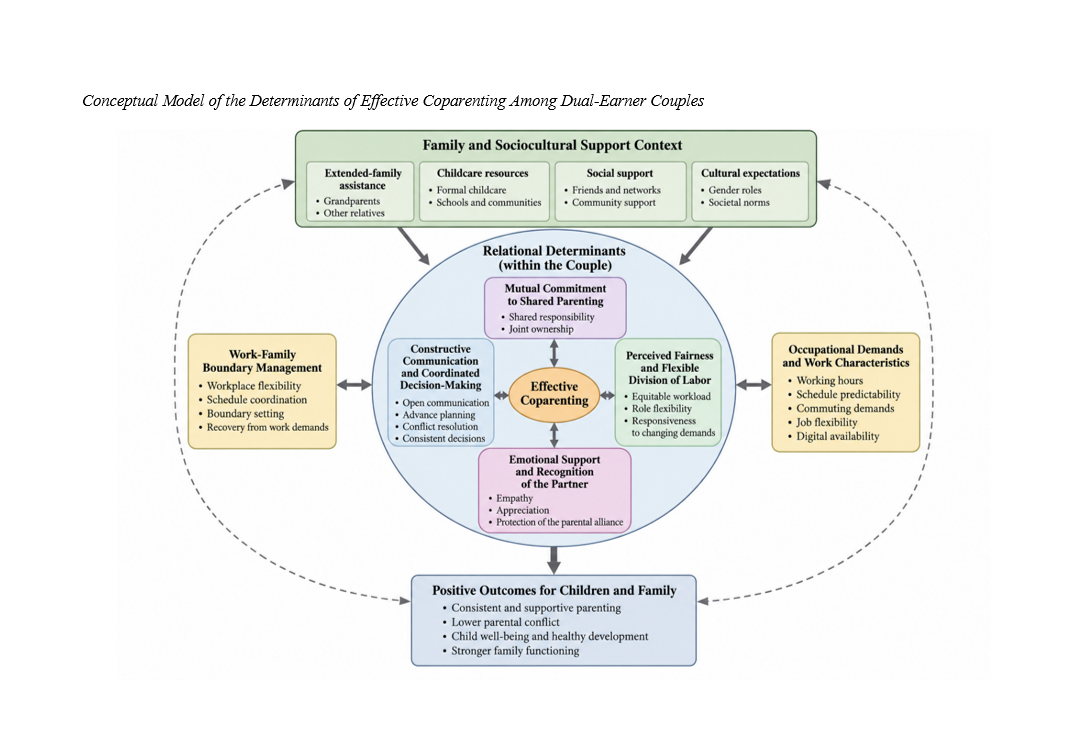
Findings: Analysis generated six interrelated determinants of effective coparenting: mutual commitment to shared parenting, constructive communication and coordinated decision-making, perceived fairness and flexible division of labor, emotional support and recognition of the partner, work-family boundary management, and family and sociocultural support context. Effective coparenting was characterized less by exact equality in parenting tasks than by shared responsibility, negotiated fairness, mutual reliability, adaptability, and acknowledgment of each partner’s contribution. Five broader patterns of coparenting functioning also emerged: highly coordinated, adaptive but strained, asymmetrical, reactive, and externally supported coparenting. Workplace flexibility, predictable schedules, and supportive extended-family involvement facilitated cooperation, whereas rigid gender expectations, unacknowledged task imbalance, reactive communication, and unpredictable work demands undermined the parental alliance.
Conclusion: Effective coparenting among dual-earner couples is a dynamic and multidimensional process shaped by the interaction of relational, occupational, and sociocultural determinants, with shared responsibility, flexible coordination, and mutual recognition forming its central foundation.
Downloads
References
Altenburger, L. E., & Schoppe‐Sullivan, S. J. (2021). Infant Negative Affect Moderates Longitudinal Associations Between Maternal Gatekeeping and Toddlers’ Social–emotional Difficulties. International Journal of Behavioral Development, 45(6), 513-523. https://doi.org/10.1177/01650254211023971
Aytaç-DiCarlo, F. K., & Schoppe-Sullivan, S. J. (2026). Jealousy of the Partner–infant Relationship and Maternal Gatekeeping at the Transition to Parenthood. Journal of Family Psychology. https://doi.org/10.1037/fam0001521
Aytaç-DiCarlo, F. K., & Schoppe‐Sullivan, S. J. (2023). Adult Attachment as a Predictor of Maternal Gatekeeping Among New Parents. Personal Relationships, 30(3), 1096-1116. https://doi.org/10.1111/pere.12481
Balenzano, C., Gemmano, C. G., & Manuti, A. (2025). Child‐Rearing Involvement and Parental Emotional Exhaustion: The Moderating Role of Supportive Relationships for Mothers and Fathers in Italian Dual‐Earner Families. Child & Family Social Work, 31(3), 1341-1353. https://doi.org/10.1111/cfs.70052
Calabrese, J. R., & Schoppe‐Sullivan, S. J. (2023). Parent Emotion Regulation and Parenting Self-Efficacy: The Moderating Role of Coparenting. Journal of Social and Personal Relationships, 40(12), 3832-3857. https://doi.org/10.1177/02654075231189464
Chen, J., Chen, M., & Fu, Y. (2024). Harsh Versus Supportive (Grand)parenting Practices and Child Behaviour Problems in Urban Chinese Families: Does Multigenerational Coresidence Make a Difference? Child & Family Social Work, 30(4), 750-764. https://doi.org/10.1111/cfs.13221
Cheung, A. K., & Lui, L. (2023). Outsourcing Domestic Work: A Double‐edged Sword for Marital Relations Among Dual‐earner Couples. Family Relations, 73(2), 1139-1158. https://doi.org/10.1111/fare.12912
Childress, S., LaBrenz, C. A., Findley, E., & Baiden, P. (2023). Adjusting Parenting Roles and Work Expectations Among Women With Children During COVID-19. Families in Society the Journal of Contemporary Social Services, 105(2), 252-268. https://doi.org/10.1177/10443894231183609
d’Orsi, D., Veríssimo, M., & Diniz, E. (2023). Father Involvement and Maternal Stress: The Mediating Role of Coparenting. International journal of environmental research and public health, 20(8), 5457. https://doi.org/10.3390/ijerph20085457
DeMartini, S. E., & Hazen, N. (2023). Divide and Conquer: Coparenting and Parent Involvement in Families With Young Children. Family Relations, 73(3), 1746-1762. https://doi.org/10.1111/fare.12962
Diniz, E., Brandão, T., Monteiro, L. g., & Veríssimo, M. (2021). Father Involvement During Early Childhood: A Systematic Review of the Literature. Journal of Family Theory & Review, 13(1), 77-99. https://doi.org/10.1111/jftr.12410
Favez, N., Max, A., Bader, M., & Tissot, H. (2022). When Fathers Feel Socially Constrained to Assume a Role: A Negative Predictor of the Coparental Relationship in Switzerland. Frontiers in psychology, 12. https://doi.org/10.3389/fpsyg.2021.752805
Feng, R., & Teti, D. M. (2025). The Link Between Nonstandard Work and Parental Distress Among New Parents: Coparenting as a Moderator. Family Relations, 74(2), 916-930. https://doi.org/10.1111/fare.13144
Güre, P., Gürmen, M. S., & Acar, İ. H. (2024). Dyadic Examination of Parents' General Psychological Distress and Coparenting in Families With Young Children: The Mediating Role of Couple Satisfaction. Journal of marital and family therapy, 51(1). https://doi.org/10.1111/jmft.12739
Heintz-Martin, V., Recksiedler, C., & Langmeyer, A. N. (2021). Household Debt, Maternal Well-Being, and Child Adjustment in Germany: Examining the Family Stress Model by Family Structure. Journal of Family and Economic Issues, 43(2), 338-353. https://doi.org/10.1007/s10834-021-09777-1
Iztayeva, A. (2021). Custodial Single Fathers Before and During the COVID-19 Crisis: Work, Care, and Well-Being. Social Sciences, 10(3), 94. https://doi.org/10.3390/socsci10030094
Jones, C., Foley, S., & Golombok, S. (2022). Parenting and Child Adjustment in Families With Primary Caregiver Fathers. Journal of Family Psychology, 36(3), 406-415. https://doi.org/10.1037/fam0000915
Moen, M. S., & Burchardt, S. M. (2022). Correlates and Predictors of Parenting Self-Efficacy in New Fathers. Journal of Family Psychology, 36(3), 396-405. https://doi.org/10.1037/fam0000910
Ni, P., Hong, P., Pan, L., Han, X., Zhai, S., & He, J. (2023). Work Arrangements and Father Involvement During COVID‐19 Lockdown: A Mixed Methods Study. Family Relations, 73(1), 54-73. https://doi.org/10.1111/fare.12915
Olsavsky, A. L., Mahambrey, M. S., Berrigan, M. N., & Schoppe‐Sullivan, S. J. (2020). Adult Attachment and Jealousy of the Partner–infant Relationship at the Transition to Parenthood. Journal of Social and Personal Relationships, 37(6), 1745-1765. https://doi.org/10.1177/0265407520908336
Park, S.-J., Barnett, M. A., & Mastergeorge, A. M. (2024). Dual Trajectories of Supportive Coparenting and Father Involvement: Parental Predictors and Influences. Family Relations, 74(1), 44-62. https://doi.org/10.1111/fare.13085
Ramos, C., Baylín, A., Haines, J., Miller, A. L., & Bauer, K. W. (2025). Associations Between Coparenting Quality, the Home Food Environment, and Child’s Body Mass Index. Childhood Obesity, 21(3), 319-328. https://doi.org/10.1089/chi.2024.0375
Richardson, E., Mallette, J. K., Futris, T. G., Dai, Y., & DeMeester, K. (2021). Foster Caregivers’ Parenting Stress as a Moderator of Change in Coparenting Following Relationship Education. Journal of Family Issues, 43(10), 2599-2623. https://doi.org/10.1177/0192513x211031521
Schoppe‐Sullivan, S. J., Donithen, R., Lee, J. K., Simon, L. T., & Wang, J. (2021). The Best and Worst of Times: Predictors of New Fathers’ Parenting Satisfaction and Stress. Adversity and Resilience Science, 2(2), 71-83. https://doi.org/10.1007/s42844-021-00032-y
Schoppe‐Sullivan, S. J., Nuttall, A. K., & Berrigan, M. N. (2021). Couple, Parent, and Infant Characteristics and Perceptions of Conflictual Coparenting Over the Transition to Parenthood. Journal of Social and Personal Relationships, 39(4), 908-930. https://doi.org/10.1177/02654075211048954
Schoppe‐Sullivan, S. J., Shafer, K., Olofson, E. L., & Dush, C. M. K. (2021). Fathers’ Parenting and Coparenting Behavior in Dual-Earner Families: Contributions of Traditional Masculinity, Father Nurturing Role Beliefs, and Maternal Gate Closing. Psychology of Men & Masculinity, 22(3), 538-550. https://doi.org/10.1037/men0000336
Schoppe‐Sullivan, S. J., Wang, J., Yang, J., Kim, M., Zhang, Y., & Yoon, S. (2023). Patterns of Coparenting and Young Children's Social–emotional Adjustment in Low-Income Families. Child development, 94(4), 874-888. https://doi.org/10.1111/cdev.13904
Tan, Y., Wu, D., Yang, L., Xi, X., & Lin, X. (2024). The Associations Between Mothers’ and Grandmothers’ Self-Control, Mother-Grandmother Coparenting Relationships and Caregiver-Child Attachment: An Actor-Partner Interdependence Mediation Model. Journal of Social and Personal Relationships, 42(1), 117-141. https://doi.org/10.1177/02654075241287233
Volling, B. L., & Palkovitz, R. (2021). Fathering: New Perspectives, Paradigms, and Possibilities. Psychology of Men & Masculinity, 22(3), 427-432. https://doi.org/10.1037/men0000354
Wang, J., Calabrese, J. R., Kim, M., & Schoppe‐Sullivan, S. J. (2026). Coparenting From Multiple Perspectives and Associations With Child and Family Functioning. Journal of Family Psychology, 40(1), 152-158. https://doi.org/10.1037/fam0001402
Wang, J., & Schoppe‐Sullivan, S. J. (2021). The Roles of Mothers' Perceptions of Grandmothers' Gatekeeping and Fathers' Parenting Competence in Maternal Gatekeeping. Family Relations, 70(5), 1435-1448. https://doi.org/10.1111/fare.12569
Wang, J., & Schoppe‐Sullivan, S. J. (2023). Do Associations Between Coparenting Relationships and Parenting Behaviors Differ for New Mothers and Fathers? Journal of Family Psychology, 37(5), 647-657. https://doi.org/10.1037/fam0001112
Wang, J., Yoon, S., Chang, Y., Nho, C. R., & Schoppe‐Sullivan, S. J. (2025). Predictors of Father Involvement Patterns Among Latino Fathers With Low Income. Journal of Family Psychology, 39(6), 827-836. https://doi.org/10.1037/fam0001300
Woodward, B., Franz, M. R., Laifer, L. M., & Brock, R. L. (2026). Interparental Processes Mitigating Risk for Psychological Aggression During the COVID-19 Pandemic. Journal of Family Psychology, 40(1), 61-71. https://doi.org/10.1037/fam0001415
Xiao, X. (2026). Marginalised Caregivers: A Qualitative Study of Grandmothers in Postpartum and Infant Care. Nursing Open, 13(7). https://doi.org/10.1002/nop2.70664
Xu, W., Parra, G. R., & Carter, M. (2024). Intergenerational Coparenting and Child Development Outcomes: A Systematic Review. Journal of Family Theory & Review, 16(4), 834-856. https://doi.org/10.1111/jftr.12594
Yan, J., Berrigan, M. N., Wang, J., Dush, C. M. K., & Schoppe‐Sullivan, S. J. (2023). Coparenting Relationship Quality and Breastfeeding Duration for Dual Earner New Parents. Journal of Social and Personal Relationships, 40(9), 2878-2891. https://doi.org/10.1177/02654075221150390
Downloads
Additional Files
Publication Timeline
- Submitted
- Revised
- Accepted