Conditional Process Structural Equation Modeling of Couple Relationship Quality Based on Economic Pressure, Psychological Distress, Hostile Couple Interaction, and Family Resilience
Keywords:
Economic pressure, Psychological distress, Hostile couple interaction, Family resilience, Couple relationship qualityAbstract
Objective: This study aimed to test a conditional process structural equation model of couple relationship quality based on economic pressure, psychological distress, and hostile couple interaction, with family resilience as a moderating protective factor among partnered adults in Canada.
Methods and Materials: A cross-sectional correlational design was used. The sample consisted of 428 married or cohabiting adults residing in Canada who were recruited through community networks, online advertisements, workplace mailing lists, and social media. Participants completed measures of economic pressure, psychological distress, hostile couple interaction, family resilience, and couple relationship quality. Data were analyzed using confirmatory factor analysis and conditional process structural equation modeling in SPSS 30 and Mplus 8.11. Model fit was evaluated using CFI, TLI, RMSEA, and SRMR. Direct, indirect, sequential mediation, moderation, and conditional indirect effects were estimated, with 5,000 bias-corrected bootstrap samples used to determine the significance of indirect effects.
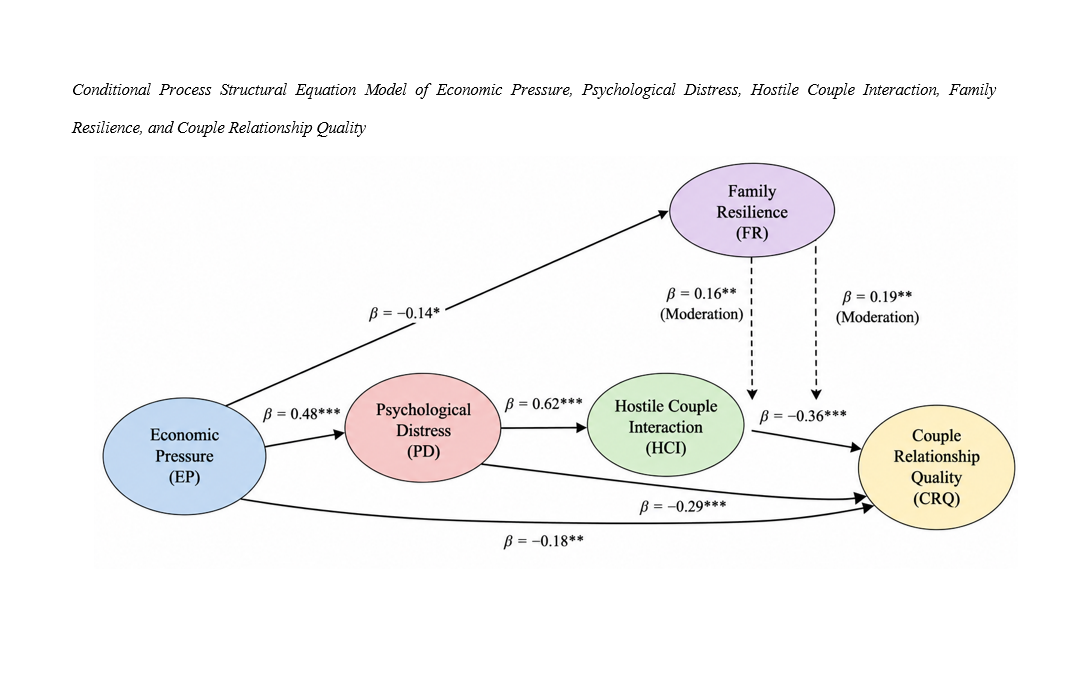
Findings: Economic pressure significantly predicted greater psychological distress (β = .47, p < .001), greater hostile couple interaction (β = .21, p < .001), and lower couple relationship quality (β = -.12, p = .014). Psychological distress predicted greater hostile interaction (β = .39, p < .001) and lower relationship quality (β = -.18, p < .001), while hostile interaction negatively predicted relationship quality (β = -.46, p < .001). The sequential indirect effect of economic pressure on relationship quality through psychological distress and hostile interaction was significant (β = -.084, 95% CI [-.132, -.049]). Family resilience positively predicted relationship quality (β = .35, p < .001) and significantly moderated the economic pressure–distress pathway (β = -.14, p = .004) and the hostile interaction–relationship quality pathway (β = .16, p = .001). The index of moderated mediation was significant (estimate = .041, 95% CI [.016, .074]).
Conclusion: Economic pressure was associated with poorer couple relationship quality through interconnected psychological and interpersonal mechanisms, whereas family resilience attenuated key adverse pathways and reduced the magnitude of the sequential indirect effect.
Downloads
References
Aborisade, R. A. (2025). Pay, or Your Wife Will See This! Male Victim-Survivors’ Experiences of Financial Sextortion in Nigeria. International Review of Victimology, 32(1), 167-187. https://doi.org/10.1177/02697580251347296
Ali‐Saleh, O., Hochwald, I. H., Tarabeia, J., & Basis, F. (2026). Intimate Partner Violence, Anxiety, Stress, and Depression Among Israeli Arab Married Women in the Shadow of the Second Wave of the COVID-19 Pandemic. Plos Global Public Health, 6(6), e0006670. https://doi.org/10.1371/journal.pgph.0006670
Bitton, M. S. (2023). Intimate Partner Violence in the Shadow of COVID‐19 and Its Associations With Stress, Function and Support Among the Israeli General Population. Stress and Health, 39(3), 673-683. https://doi.org/10.1002/smi.3217
Brown, A., & Satyanarayana, V. A. (2026). Patrilocality in South Asia as a Determinant of Maternal Mental Health: A Scoping Review. Journal of Public Health Research, 15(2). https://doi.org/10.1177/22799036261459194
Chen, Y., Tian, Y., Chen, Z., Ning, M., Yuan, J., Xie, X., Peng, J., & Li, Y. (2026). Prevalence and Characteristics of Intimate Partner Violence Among Nurses in Tertiary Hospitals in China: A National Cross-Sectional Study. https://doi.org/10.21203/rs.3.rs-9109718/v1
Falconier, M. K., Wojda, A. K., & Conway, C. A. (2024). Dyadic Coping Moderates the Association Between Economic Strain and Psychological Distress in Low-Income Couples. International Journal of Stress Management, 31(4), 353-366. https://doi.org/10.1037/str0000338
Gebremikael, D. B., Haile, T. G., Gebresilase, W. T., Tadese, Y., & Brhane, T. (2026). Magnitude of Antenatal Depression Among Women Attending Antenatal Care at Public Health Centers in Post-War Shire, Tigray Region, Ethiopia: A Facility Based Cross-Sectional Study. https://doi.org/10.64898/2026.08.24.26361194
Hakim, F. N. R. (2023). Remeasuring Justice for Women Victims of Intimate Partner Violence: A Sociocultural and Legal Framework. Deviance Jurnal Kriminologi, 7(2), 121. https://doi.org/10.36080/djk.2709
Hong, C., Stephenson, R. B., Santos, G. M., Garner, A., Howell, S., & Holloway, I. W. (2022). Intimate Partner Violence Victimization During the COVID-19 Pandemic Among a Global Online Sample of Sexual Minority Men. Journal of family violence, 38(8), 1535-1544. https://doi.org/10.1007/s10896-022-00461-y
Huang, W., Zhang, F., Sun, X., Yu, Q., Huang, J., & Su, Y. (2023). Association Between Intimate Partner Psychological Violence and Psychological Distress Among Nurses: The Role of Personality Traits and Social Support. Frontiers in psychology, 13. https://doi.org/10.3389/fpsyg.2022.1038428
James, R. (2024). An Empirical Investigation of Dating Violence: Prevalence, Patterns, and Psychological Impacts. International Journal of Scientific Research in Engineering and Management, 08(03), 1-5. https://doi.org/10.55041/ijsrem29656
John, N. A., Kapungu, C., Sebany, M., & Tadesse, S. (2022). Do Gender-Based Pathways Influence Mental Health? Examining the Linkages Between Early Child Marriage, Intimate Partner Violence, and Psychological Well-Being Among Young Ethiopian Women (18–24 years Old). Youth & Society, 55(6), 1155-1172. https://doi.org/10.1177/0044118x221079375
Khan, W. (2025). Psychosocial Concomitants of Infertility: A Narrative Review. Cureus. https://doi.org/10.7759/cureus.80250
Kita, S., Baba, K., Iwasaki‐Motegi, R., Kishi, E., Skowroński, D., Karystianis, G., & Kamibeppu, K. (2025). Comparisons of Intergenerational Transmission of Violence Between Genders: A Multiple-Group Structural Equation Modeling. Journal of interpersonal violence, 41(13-14), 4825-4860. https://doi.org/10.1177/08862605251353495
Kuku-Kuye, T. O., Olumodeji, A. M., Chionuma, J. O., & Oloke, I. I. (2025). Intimate Partner Violence and Relationship Quality Among Pregnant Women: Insights From a Multi-Centre Study. Scientific reports, 15(1). https://doi.org/10.1038/s41598-025-30267-z
López-Odar, D., Vara-Horna, A., Asencios-González, Z., & Callejas, E. (2026). Emotional Distress and Academic Presenteeism in Male University Perpetrators of Intimate Partner Violence: A Mediated Structural Model. Behavioral Sciences, 16(6), 947. https://doi.org/10.3390/bs16060947
Maepa, M. P., Kleinhans, A., & Lentoor, A. G. (2023). Perceived Stress and Association With Sociodemographic, Interpersonal Relationship and COVID-19 Lockdown Related Stress in South Africa. The Open Public Health Journal, 16(1). https://doi.org/10.2174/18749445-v16-e230116-2022-106
Marco, M. H. D., Baranyi, G., & Evans, D. P. (2024). Psychopathy, Psychological Distress, and Treatment History Among Perpetrators of Intimate Partner Femicide, Homicide, and Other Violent Crimes in Buenos Aires, Argentina. PLOS Mental Health, 1(2), e0000064. https://doi.org/10.1371/journal.pmen.0000064
Moshi, F. V., Nakamura, K., Tashiro, Y., Miyashita, A., Sato, H., & Ohnishi, M. (2025). Exploring Emotional Violence in Intimate Relationships During Pregnancy in Central Tanzania: A Qualitative Descriptive Study. East African Health Research Journal, 9(1), 96-105. https://doi.org/10.24248/eahrj.v9i1.827
Nahin, K. S. A., Hossen, A., Asha, A., Islam, T., & Rony, A. R. (2026). Reproductive Coercion as a Determinant of Anxiety and Depression Among Married Women in Bangladesh: A Nationally Representative Survey-Weighted Multinomial Analysis of the 2022 DHS. https://doi.org/10.21203/rs.3.rs-9519211/v1
Pan, C., & Luo, C. (2026). The Psychological Process and Support Needs of HIV-positive Individuals Who Disclose Their Status to Sexual Partners: A Qualitative Study. Frontiers in Public Health, 14. https://doi.org/10.3389/fpubh.2026.1870907
Schumann, N., Bozoyan, C., & Schmiedeberg, C. (2023). Economic Hardship and Intimate Partner Violence: An Analysis of Perpetrators in Germany. Journal of Family Research, 35, 267-285. https://doi.org/10.20377/jfr-884
Smith, T. W. (2022). Intimate Relationships and Coronary Heart Disease: Implications for Risk, Prevention, and Patient Management. Current Cardiology Reports, 24(6), 761-774. https://doi.org/10.1007/s11886-022-01695-4
Tashi, F. i. (2026). A Phenomenological Exploration of Women’s Perspectives of Domestic Violence and Help-Seeking Behaviors in Kano State, Nigeria. https://doi.org/10.21203/rs.3.rs-10617866/v1
Ting, A., & McLachlan, C. S. (2022). Intimate Relationships During COVID-19 Across the Genders: An Examination of the Interactions of Digital Dating, Sexual Behavior, and Mental Health. Social Sciences, 11(7), 297. https://doi.org/10.3390/socsci11070297
Wang, X., Yan, H., Li, C., Feng, Y., Gao, S., Zhang, J., Zhao, H., Zhang, J., Guo, C., & Zhao, M. (2026). Impact of Intimate Partner Violence on in Vitro Fertilization Outcomes Among Infertile Women: A Retrospective Cohort Study. Frontiers in Medicine, 13. https://doi.org/10.3389/fmed.2026.1914158
Wessells, M., & Kostelny, K. (2022). The Psychosocial Impacts of Intimate Partner Violence Against Women in LMIC Contexts: Toward a Holistic Approach. International journal of environmental research and public health, 19(21), 14488. https://doi.org/10.3390/ijerph192114488
Yang, L., Shaw, A., Nyman, T. J., & Hall, B. J. (2024). The Prevalence of Intimate Partner Violence and Risk Factors for Women and Men in China During the Shanghai 2022 Lockdown. Epidemiology and Psychiatric Sciences, 33. https://doi.org/10.1017/s2045796024000155
Downloads
Additional Files
Publication Timeline
- Submitted
- Revised
- Accepted