Predicting Infidelity Tendency From Relationship Dissatisfaction, Sexual Satisfaction, Attachment, and Impulsivity Using CatBoost
Keywords:
Infidelity tendency, CatBoost, relationship dissatisfaction, sexual satisfaction, attachment, impulsivity, machine learningAbstract
Objective: This study aimed to predict infidelity tendency among married adults from relationship dissatisfaction, sexual satisfaction, attachment anxiety, attachment avoidance, and impulsivity using the CatBoost machine-learning algorithm and to determine the relative predictive contribution of these factors.
Methods and Materials: This cross-sectional predictive study was conducted among 512 married adults residing in Qatar. Infidelity tendency was assessed using the Propensity Towards Infidelity Scale, relationship dissatisfaction using the reverse-scored Couples Satisfaction Index-16, sexual satisfaction using the New Sexual Satisfaction Scale, attachment anxiety and attachment avoidance using the Experiences in Close Relationships-Revised questionnaire, and impulsivity using the Barratt Impulsiveness Scale-11. The dataset was randomly divided into an 80% development sample and a 20% holdout test sample. CatBoost regression was trained using five-fold cross-validation and compared with multiple linear regression, random forest, and XGBoost. Predictive performance was evaluated using root mean squared error, mean absolute error, and coefficient of determination. Feature importance, SHAP values, and ablation analyses were used to interpret the final model.
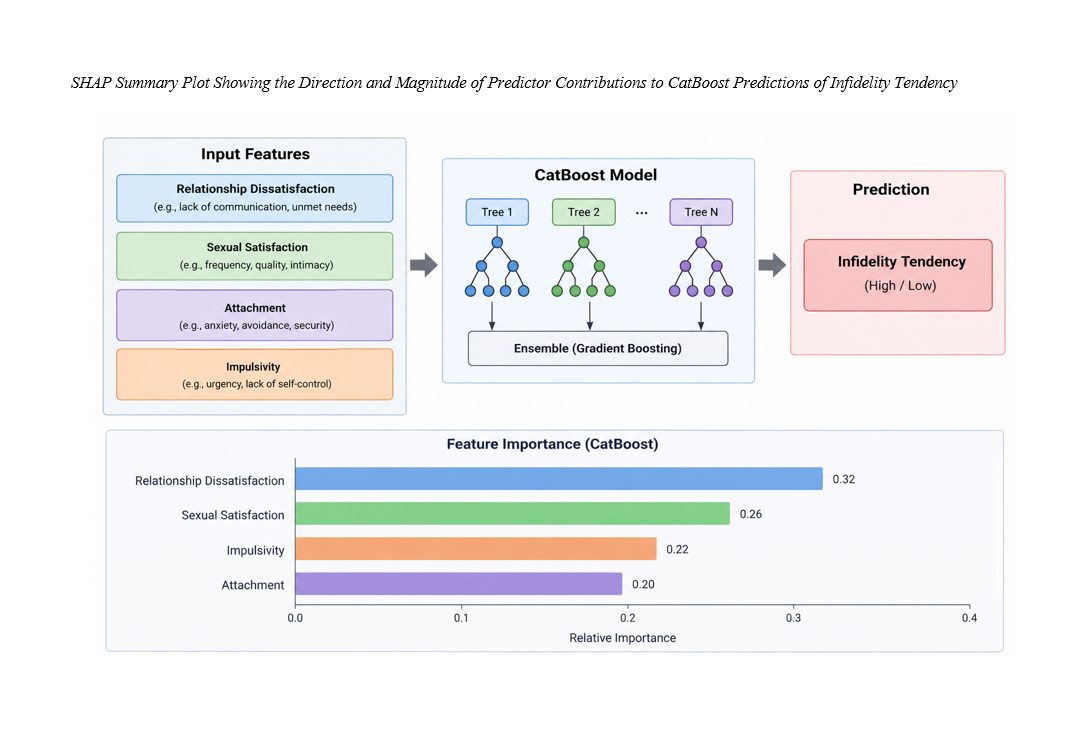
Findings: CatBoost demonstrated the best predictive performance, achieving a cross-validation RMSE of 5.34, MAE of 4.15, and R² of .66, and a holdout test RMSE of 5.42, MAE of 4.19, and R² of .64. Relationship dissatisfaction was the strongest predictor, accounting for 31.8% of normalized feature importance, followed by impulsivity at 24.6%, sexual satisfaction at 18.9%, attachment avoidance at 14.2%, and attachment anxiety at 10.5%. SHAP analysis indicated that greater relationship dissatisfaction, impulsivity, attachment avoidance, and attachment anxiety increased predicted infidelity tendency, whereas higher sexual satisfaction reduced predicted tendency. Removing relationship dissatisfaction produced the largest decline in model performance, reducing test R² from .64 to .54.
Conclusion: Infidelity tendency was most accurately predicted through the combined contribution of relational dissatisfaction, sexual functioning, attachment insecurity, and behavioral disinhibition. CatBoost provided superior predictive performance compared with conventional and alternative machine-learning models.
Downloads
References
Baboo, N. S., & Mohammadi, N. (2021). Investigating the Effect of Internet Addiction on the Tendency to Marital Infidelity in Couples in Shiraz. Propósitos y Representaciones, 9(SPE2). https://doi.org/10.20511/pyr2021.v9nspe2.1087
Beltrán-Morillas, A. M., Villanueva‐Moya, L., Sánchez-Hernández, M. D., Alonso-Ferres, M., Garrido‐Macías, M., & Expósito, F. (2023). Infidelity in the Adolescence Stage: The Roles of Negative Affect, Hostility, and Psychological Well-Being. International journal of environmental research and public health, 20(5), 4114. https://doi.org/10.3390/ijerph20054114
Darbandi, B., Ahadi, H., & Khalatbari, J. (2024). Predicting the Tendency Towards Divorce in Couples Involved in Infidelity Based on Marital Intimacy and Satisfaction With the Mediation of Ethical Orientation Styles. Aftj, 5(1), 115-127. https://doi.org/10.61838/kman.aftj.5.1.13
Genç, E., & Büyükada, E. (2026). The Impact of Obsessive‐Compulsive Relationship Symptoms on Marital Instability: Mediating Role of Infidelity Tendency. Journal of marital and family therapy, 52(2). https://doi.org/10.1111/jmft.70122
Gonen, L. D., Tavor, T., & Spiegel, U. (2025). Examining Marital Infidelity via Game Theory. Mathematics, 13(14), 2235. https://doi.org/10.3390/math13142235
Hartnett, A. C., Croes, Z. L., Hertlein, B. R., & Lasslo, S. K. (2023). Understanding Dynamics Dating Infidelity: Behaviors, Motivations, and Implications for Relationship Well-Being. Jurnal Sosial Sains Terapan Dan Riset (Sosateris), 11(2), 120-137. https://doi.org/10.35335/ctkmr713
Karimi, S., Doostdari, F., Lotfabadi, N. B., Yosefi, R., Soleymani, M., & Kianimoghadam, A. S. (2023). The Role of Early Maladaptive Schemas in Predicting Legitimacy, Seduction, Normalization, Sexuality, Social Background, and Sensation Seeking in Marital Infidelity. Practice in Clinical Psychology, 11(3), 249-258. https://doi.org/10.32598/jpcp.11.3.848.2
Lișman, C. G., & Holman, A. C. (2021). Cheating Under the Circumstances in Marital Relationships: The Development and Examination of the Propensity Towards Infidelity Scale. Social Sciences, 10(10), 392. https://doi.org/10.3390/socsci10100392
Lișman, C. G., & Holman, A. C. (2023). Dark, Dissatisfied and Disengaged: Propensity Towards Marital Infidelity, the Dark Triad, Marital Satisfaction and the Mediating Role of Moral Disengagement. Psihologija, 56(2), 163-177. https://doi.org/10.2298/psi220410003l
Luo, W., & Yu, J. (2022). Sexual Infidelity Among the Married in China. Chinese Journal of Sociology, 8(3), 374-397. https://doi.org/10.1177/2057150x221108574
Malm, E. K., Oti-Boadi, M., Adom-Boakye, N. A., & Andah, A. (2022). Marital Satisfaction and Dissatisfaction Among Ghanaians. Journal of Family Issues, 44(12), 3117-3141. https://doi.org/10.1177/0192513x221126752
Mateizer, A., & Avram, E. (2022). Mobile Dating Applications and the Sexual Self: A Cluster Analysis of Users’ Characteristics. International journal of environmental research and public health, 19(3), 1535. https://doi.org/10.3390/ijerph19031535
Mazinani, B., & O’Connor, B. P. (2026). An Updated and Revised Dyadic Model of Partner Violence. Behavioral Sciences, 16(9), 1468. https://doi.org/10.3390/bs16091468
Mejía-Cruz, D., Ávila-Chauvet, L., & Villalobos-Gallegos, L. (2024). Attachment Styles and Hypersexuality in Mexican Emerging Adults: Assessing the Influence on Couple and Sexual Satisfaction. https://doi.org/10.20944/preprints202406.0462.v1
Muhlisa, N. A., Siswanti, D. N., & Khumas, A. (2023). The the Relationship Between Sexual Satisfaction and Husband's Infidelity Intentions. Arrus Journal of Social Sciences and Humanities, 3(4), 452-458. https://doi.org/10.35877/soshum1885
Munévar, F. R., Patiño, L. E. P., Ortegón, L. M., Rodríguez, M. C., Zapata, C. D., & Niño, Y. R. (2021). Validación Del Inventario Multidimensional De Infidelidad (IMIN) en Población Colombiana. International Journal of Psychological Research, 14(1), 33-47. https://doi.org/10.21500/20112084.4710
Nezamalmolki, M., Bahrainian, S. A., & Shahabizadeh, F. (2023). Effectiveness of Emotion-Focused Couples Therapy on Sexual Function, Marital Intimacy, and Impulsivity in Women Affected by Marital Infidelity. PWJ, 4(4), 39-47. https://doi.org/10.61838/kman.pwj.4.4.5
Nezamalmolki, M., Bahrainian, S. A., & Shahabizadeh, F. (2024). Effectiveness of Integrative Couple Therapy on Sexual Function, Marital Intimacy, and Impulsivity in Women Affected by Marital Infidelity. Jarac, 6(2), 19-26. https://doi.org/10.61838/kman.jarac.6.2.3
Ogwuche, C. H., Tyav-Tersoo, K. I., Onah, C., & Orafa, D. T. (2024). Marital Infidelity Among Married Couples: Roles of Emotional Intelligence and Narcissistic Personality Traits in Makurdi, Benue State. Journal of Innovation in Psychology Education and Didactics, 28(1), 27-26. https://doi.org/10.29081/jiped.2024.28.1.03
Pourmolaie, S., Rahbarjou, S. S. S., & Shamsaldini, A. (2023). Predicting Attitudes Towards Marital Infidelity Based on Marital Conflict and Marital Quality Among Women. PWJ, 4(3), 48-54. https://doi.org/10.61838/kman.pwj.4.3.6
Robatmili, S. (2024). Predicting Cheating Among Married Individuals Based on Sexual Satisfaction and Personality Traits: A Review. Open Access Research Journal of Biology and Pharmacy, 10(1), 023-025. https://doi.org/10.53022/oarjbp.2024.10.1.0035
Rodas, J. A., Abad, M., Barandica, A., León-Rojas, J. E., Figueira, J. A. V., & Oleas, D. (2026). Infidelity Conduct and Desire: The Differentiated Contribution of Broad Personality Traits. Frontiers in psychology, 17. https://doi.org/10.3389/fpsyg.2026.1939819
Salehzadeh, S., Bahram Ali Ghanbari Hashem, A., & Nejat, H. (2024). Structural Equation Modeling Modeling of the Tendency Toward Marital Infidelity Based on Significant Five Personality Factors Mediated by Attachment Styles and Sexual Satisfaction. Journal of Health Reports and Technology, 10(1). https://doi.org/10.5812/jhrt-142998
Șerban, I., Salvati, M., & Enea, V. (2022). Sexual Orientation and Infidelity-Related Behaviors on Social Media Sites. International journal of environmental research and public health, 19(23), 15659. https://doi.org/10.3390/ijerph192315659
Sevi, B., Urgancı, B., & Sakman, E. (2020). Who Cheats? An Examination of Light and Dark Personality Traits as Predictors of Infidelity. Personality and individual differences, 164, 110126. https://doi.org/10.1016/j.paid.2020.110126
Shabankare, M. G., Heidari, A., Makvandi, B., & Marashian, F. S. (2020). Relationship of Forgiveness and Feeling of Loneliness With Attitudes Toward Marital Infidelity Regarding the Moderating Role of Marital Satisfaction in Married Students. Ajnpp, 77-83. https://doi.org/10.32592/ajnpp.2021.8.2.103
Shrestha, P. S., Shaver, S. R., Perlman, T. T., & Walsham, W. (2023). Emotional Dimensions of Infidelity: An Analysis of Psychological and Emotional Factors Affecting Relationship Infidelity. Jurnal Sosial Sains Terapan Dan Riset (Sosateris), 11(2), 88-103. https://doi.org/10.35335/85rbw180
Ventura‐León, J., Reyes, A., Valencia, P. H., Tocto‐Muñoz, S., Gamboa‐Melgar, G., Ruiz‐Castro, J., & Lino‐Cruz, C. (2025). Exploring Infidelity Behavior Patterns in a Sample of Peruvian Young Adults: A Latent Class Analysis. Journal of marital and family therapy, 51(4). https://doi.org/10.1111/jmft.70066
Ventura‐León, J., Tocto‐Muñoz, S., Lino‐Cruz, C., Sánchez‐Villena, A. R., Martinez‐Munive, R., Talledo‐Sánchez, K., & Casiano‐Valdivieso, K. (2025). Myths of Romantic Love, Negative Interactions, Relationship Involvement, Satisfaction, Infidelity, and Jealousy in Peruvian Individuals With Couples: Directed and Undirected Network Analysis. Journal of marital and family therapy, 51(2). https://doi.org/10.1111/jmft.70014
Wagner, S. A., Mattson, R. E., Davila, J., Johnson, M. D., & Cameron, N. M. (2020). Touch Me Just Enough: The Intersection of Adult Attachment, Intimate Touch, and Marital Satisfaction. Journal of Social and Personal Relationships, 37(6), 1945-1967. https://doi.org/10.1177/0265407520910791
Weiser, D. A., Shrout, M. R., Thomas, A. V., Edwards, A. L., & Cravens, J. D. (2022). “I’ve Been Cheated, Been Mistreated, When Will I Be Loved”: Two Decades of Infidelity Research Through an Intersectional Lens. Journal of Social and Personal Relationships, 40(3), 856-898. https://doi.org/10.1177/02654075221113032
Yousefi, S., Bafghi, Z. R., Ahmadi, A., Joulaei, H., Bolhari, J., & Mirzai, M. (2023). Spirituality Enhanced With Cognitive-Behavioral Techniques in Extramarital Infidelity: A Literature Review. Zahedan Journal of Research in Medical Sciences, 26(2). https://doi.org/10.5812/zjrms-135837
Yousefpouri, M., Zomorodi, S., & Bazzāziān, S. (2024). Effectiveness of Acceptance and Commitment-Based Couples Therapy on Attitudes Towards Marital Infidelity and Emotional Regulation in Married Women. Aftj, 5(2), 103-111. https://doi.org/10.61838/kman.aftj.5.2.12
Zambrano, A. K. (2026). Genetic Predisposition and Infidelity: From Molecular Variation to Relationship Behavior—A Narrative Review. International Journal of Molecular Sciences, 27(19), 8510. https://doi.org/10.3390/ijms27198510
Downloads
Additional Files
Publication Timeline
- Submitted
- Revised
- Accepted