Predicting Co-Parenting Quality From Marital Adjustment, Parenting Self-Efficacy, and Psychological Distress Using Gradient Boosting Regression
Keywords:
Co, Parenting Quality, marital adjustment, parenting self, efficacy, psychological distressAbstract
Objective: This study aimed to predict co-parenting quality from marital adjustment, parenting self-efficacy, and psychological distress among Brazilian parents using Gradient Boosting Regression and to determine the relative predictive importance and nonlinear contribution of these variables.
Methods and Materials: This cross-sectional predictive study included 462 Brazilian parents who were married or cohabiting with the other biological or adoptive parent of at least one child aged 3–12 years. Co-parenting quality was assessed using the Coparenting Relationship Scale, marital adjustment using the Revised Dyadic Adjustment Scale, parenting self-efficacy using the efficacy component of the Parenting Sense of Competence Scale, and psychological distress using the Kessler Psychological Distress Scale. The dataset was divided into training (80%, n = 369) and holdout test (20%, n = 93) subsets. Gradient Boosting Regression was tuned using five-fold cross-validation. Predictive performance was evaluated using R², root mean squared error, mean absolute error, and mean absolute percentage error and was compared with multiple linear regression. Predictor importance was examined using permutation importance and SHAP values.
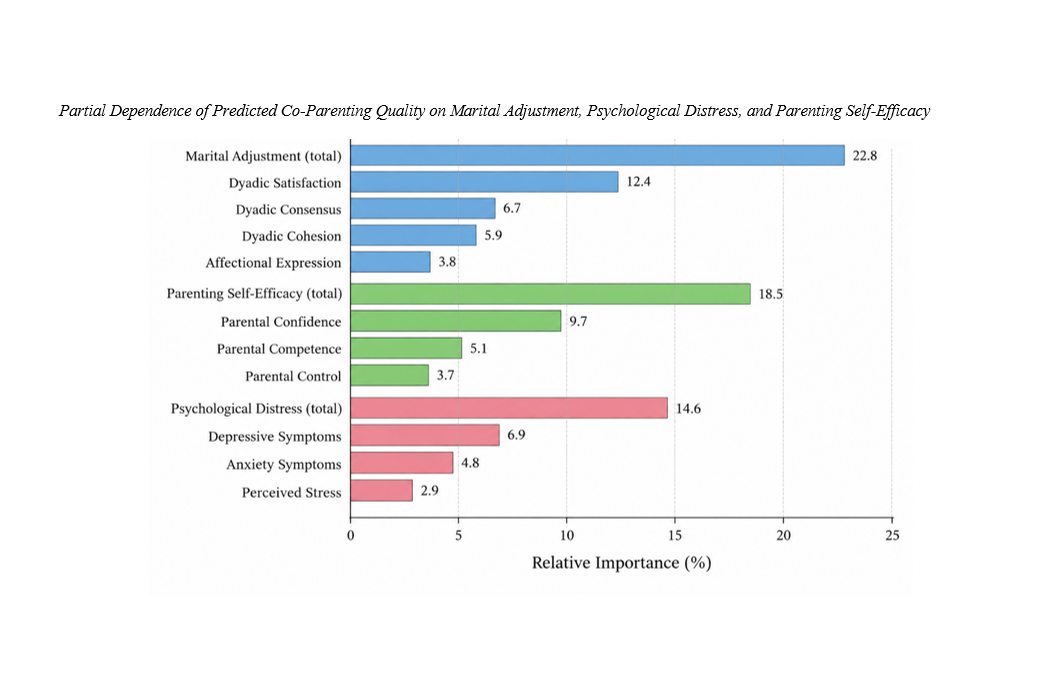
Findings: In the holdout sample, Gradient Boosting Regression explained 61% of the variance in co-parenting quality, with RMSE = 15.95, MAE = 12.41, and MAPE = 8.73%. The model outperformed multiple linear regression, which explained 49% of the variance and yielded RMSE = 18.23 and MAE = 14.52. Marital adjustment showed the greatest predictive importance, with normalized importance = .48, permutation importance = .264, and mean absolute SHAP value = 12.84. Psychological distress was the second most important predictor (.31; .171; 8.19), followed by parenting self-efficacy (.21; .108; 5.73). Partial-dependence patterns indicated positive nonlinear associations for marital adjustment and parenting self-efficacy and a negative nonlinear association for psychological distress.
Conclusion: Co-parenting quality was predicted with substantial accuracy from marital adjustment, psychological distress, and parenting self-efficacy, with Gradient Boosting Regression outperforming conventional linear modeling.
Downloads
References
Bayazy, Y. G., & Gur, A. (2024). Relationships Between Psychological Flexibility, Psychological Capital and Marital Quality Amongst Parents of Children With Autism Spectrum Disorder. Child & Family Social Work, 30(4), 1026-1037. https://doi.org/10.1111/cfs.13237
Brik, A. B., & Wang, Y. (2025). Factors Influencing Parental Adaptation: A Double ABC ‐X Model Approach. Family Relations, 74(5), 2585-2606. https://doi.org/10.1111/fare.70038
Chiș, R., Ignat, S., Rad, D., & Macsinga, I. (2022). The Mediation Role of an Individual’s and Couple’s Psychological Factors, Including Parenting in the Prediction of Relational and Marital Satisfaction. International journal of environmental research and public health, 19(17), 11011. https://doi.org/10.3390/ijerph191711011
Cıhan, H., & Var, E. Ç. (2022). Developing a Model on the Factors Affecting Family Resilience in the COVID-19 Pandemic: Risk and Protective Factors. Current Psychology, 42(23), 20259-20274. https://doi.org/10.1007/s12144-022-03008-y
Darwiche, J., Carneiro, C., Vaudan, C., Imesch, C., Nunes, C. E., Favez, N., & Roten, Y. d. (2022). Parents in Couple Therapy: An Intervention Targeting Marital and Coparenting Relationships. Family Process, 61(2), 490-506. https://doi.org/10.1111/famp.12773
Dias, V., Albuquerque, S., Beato, A., & Alves, S. (2026). Work–Family Conflict, Parental Mental Health, and Children’s Emotional and Behavioral Difficulties. Children, 13(2), 289. https://doi.org/10.3390/children13020289
Ding, Q., Ma, G., Deng, C., Shi, Y., Ye, Y., Huang, Z., & Gu, C. (2026). The Relationship Between Time Perspective and Parenting Concern Among Chinese Gynecological Cancer Patients: The Chain Mediating Role of Self-Disclosure and Perceived Partner Responsiveness. https://doi.org/10.21203/rs.3.rs-9074945/v1
Güçlü, O., & Hürmeydan, C. E. (2024). Being the Mother of a Special Child: Resilience and Marital Adjustment in Mothers of Children With Autism Spectrum Disorder. Psychiatry and Clinical Psychopharmacology, 34(1), 64-73. https://doi.org/10.5152/pcp.2023.22592
Higgins, L., Mannion, A., Chen, J. L., & Leader, G. (2022). Adaptation of Parents Raising a Child With ASD: The Role of Positive Perceptions, Coping, Self-Efficacy, and Social Support. Journal of Autism and Developmental Disorders, 53(3), 1224-1242. https://doi.org/10.1007/s10803-022-05537-8
Jang, H., Stephan, A. T., Ross, L. A., Jeong, M., & Mogle, J. A. (2024). Family Relationship Quality and Psychological and Cognitive Health Among Grandparent Caregivers: The Moderating Role of Co-Residence With Adult Children. Journal of Social and Personal Relationships, 42(3), 794-817. https://doi.org/10.1177/02654075241307976
Johnson, M. S., Skjerdingstad, N., Ebrahimi, O. V., Hoffart, A., & Johnson, S. U. (2021). Parenting in a Pandemic: Parental Stress, Anxiety and Depression Among Parents During the Government‐initiated Physical Distancing Measures Following the First Wave of COVID‐19. Stress and Health, 38(4), 637-652. https://doi.org/10.1002/smi.3120
Kestler‐Peleg, M., Greenblatt‐Kimron, L., Even‐Zohar, A., & Lavenda, O. (2023). Parental Self-Efficacy Among Israeli Older Adults. Canadian Journal on Aging / La Revue Canadienne Du Vieillissement, 42(4), 631-641. https://doi.org/10.1017/s0714980823000144
Kim, J. (2026). The Relationship Between Paternal Marital Conflict, Parenting Stress and Parenting Efficacy on Children's Self‐Regulation in Korea: The Mediating Role of Positive Parenting Style. Child & Family Social Work, 31(4), 2144-2157. https://doi.org/10.1111/cfs.70123
Latulippe, N., Brassard, A., Vaillancourt, S.-E., & Gosselin, P. (2026). Postpartum Depressive Symptoms in Parental Couples: The Roles of Perfectionism and Anxiety. Canadian Journal of Behavioural Science/Revue canadienne des sciences du comportement, 58(2), 93-103. https://doi.org/10.1037/cbs0000479
Li, S., Li, M., Cui, D., Xu, S., Wang, J., Li, L., Zhang, A., & He, L. (2023). A Latent Class Analysis of Psycho-Behavioural Adaptation in Children and Its Relationship With Sense of Parenting Competence and Psychological Distress of Parents. https://doi.org/10.21203/rs.3.rs-2988884/v1
Lubis, F., Abidin, F. A., Qodariah, L., Anindhita, V., & Purba, F. D. (2024). Coping Strategies and Psychological Distress Among Mothers During COVID-19 Pandemic: The Moderating Role of Social Support. PLoS One, 19(4), e0300365. https://doi.org/10.1371/journal.pone.0300365
Maleki, A., & Youseflu, S. (2023). A Systematic Review of the Correlation Between Marital Relationship and Breastfeeding Self-Efficacy, and Duration of Breastfeeding. Breastfeeding Medicine, 18(2), 86-96. https://doi.org/10.1089/bfm.2022.0210
Masulani-Mwale, C., Kauye, F., & Gladstone, M. (2022). Effectiveness of a Psychosocial Training Intervention in Reducing Psychological Distress Among Caregivers of Intellectually Disabled Children in Malawi – A Randomized Wait-List Trial. https://doi.org/10.1101/2022.04.11.22273704
Milbury, K., Ann‐Yi, S., Jones, M. H., Li, Y., Whisenant, M., Yousuf, S., Necroto, V., Chávez‐MacGregor, M., & Bruera, E. D. (2024). Patients With Advanced Cancer and Their Spouses Parenting Minor Children: The Role of the Relationship Context in Parenting Concerns. Psycho-Oncology, 33(3). https://doi.org/10.1002/pon.6310
Molero, F., Recio, P., & Sarriá, E. (2024). Affiliate Stigma and Marital Satisfaction in Spanish Parents of Children With Intellectual Disabilities. Stigma and Health, 9(2), 181-190. https://doi.org/10.1037/sah0000478
Moral, M., López, C. A. C., Lyon, T. R., & Adsuar, J. C. (2021). The Relationship Between Differentiation of Self and Psychological Adjustment to Separation. Healthcare, 9(6), 738. https://doi.org/10.3390/healthcare9060738
Nunes, C., Ferreira, L. I., Martins, C., Pechorro, P., & Ayala‐Nunes, L. (2022). The Enrich Marital Satisfaction Scale: Adaptation and Psychometric Properties Among at-Risk and Community Portuguese Parents. Journal of Social and Personal Relationships, 39(11), 3275-3295. https://doi.org/10.1177/02654075221095052
Özoğuz, N., Balkanas, M., & Tarakçıoğlu, M. C. (2025). Parental Distress, Marital Satisfaction, and Functional Impairments in Autistic Children: A Family Perspective From Türkiye. Autism, 29(12), 3156-3165. https://doi.org/10.1177/13623613251362263
Parent‐Lamarche, A., Marchand, A., & Saade, S. (2022). Psychological Distress in the Workplace: The Indirect Contribution of Work Organization Conditions to Work Performance. Work a Journal of Prevention Assessment & Rehabilitation, 72(4), 1469-1480. https://doi.org/10.3233/wor-210843
Partington, L. C., Mashash, M., & Hastings, P. D. (2022). Family Thriving During COVID-19 and the Benefits for Children’s Well-Being. Frontiers in psychology, 13. https://doi.org/10.3389/fpsyg.2022.879195
Sakakihara, A., Masumoto, T., Kurozawa, Y., The Japan, E., Children’s Study, G., Kamijima, M., Yamazaki, S., Ohya, Y., Kishi, R., Yaegashi, N., Hashimoto, K., Mori, C., Ito, S., Yamagata, Z., Inadera, H., Nakayama, T., Sobue, T., Shima, M., Nakamura, H., . . . Katoh, T. (2024). Associations Between Paternal Autism Traits and Parenting From the Japan Environment and Children’s Study. Scientific reports, 14(1). https://doi.org/10.1038/s41598-024-67978-8
Shariat, M., Abedinia, N., Charousaei, H., & Fatahi, F. (2022). The Relationship Between Paternal Postpartum Depression and Psychosocial Variables: a Longitudinal Study in Iran. Journal of family & reproductive health. https://doi.org/10.18502/jfrh.v16i4.11358
Strandh, M. R., Enebrink, P., Stålberg, K., Sörensdotter, R., Ljungman, L., & Wikman, A. (2024). Parenting Under Pressure: A Cross-Sectional Questionnaire Study of Psychological Distress, Parenting Concerns, Self-Efficacy, and Emotion Regulation in Parents With Cancer. Acta Oncologica, 63. https://doi.org/10.2340/1651-226x.2024.40404
Turgeon, J., Lonergan, M., Bureau, J. F., Schoppe‐Sullivan, S. J., & Lafontaine, M. F. (2023). Parenting Stress, General Distress, and Coparenting Quality: An Actor–Partner Interdependence Moderation Model. Personal Relationships, 30(3), 1117-1134. https://doi.org/10.1111/pere.12498
Williams, C. (2023). The Relationship Between Perceived Parental Competence and Bereavement Outcomes in Widows With Young Children. OMEGA - Journal of Death and Dying, 92(2), 553-573. https://doi.org/10.1177/00302228231186354
Zamir, O., Bentley, G., & He, Y. (2022). A Promotive Process of Resource Gain Against Harsh and Inconsistent Discipline in Mothers Coping With Breast Cancer: A Serial Mediation Model. Frontiers in Psychiatry, 13. https://doi.org/10.3389/fpsyt.2022.859604
Zelkowitz, R. L., Archibald, E. A., Gradus, J. L., & Street, A. E. (2023). Postdeployment Mental Health Concerns and Family Functioning In Veteran Men and Women. Psychological Trauma Theory Research Practice and Policy, 15(4), 705-714. https://doi.org/10.1037/tra0001237
Downloads
Additional Files
Publication Timeline
- Submitted
- Revised
- Accepted