Push Notifications and Habit Formation: Behavioral Impact on Daily Language Practice Consistency
DOI:
https://doi.org/10.61838/kman.aitech.4724Keywords:
Habit Formation, Language Learning, Mobile-Assisted Language Learning (MALL), Push NotificationsAbstract
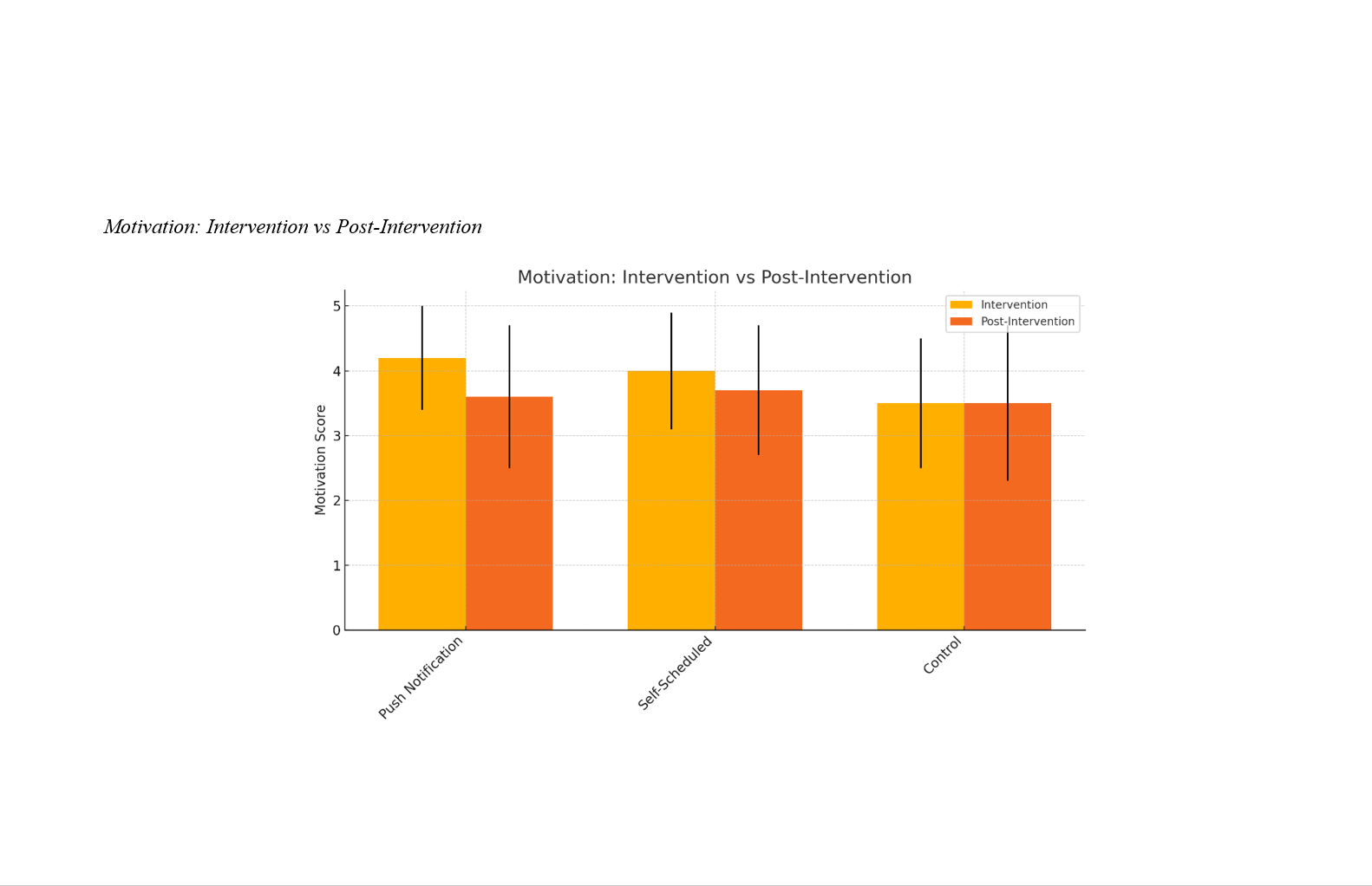
Push notifications are widely used to influence digital behavior, but their long-term impact on language learning habits remains underexplored. To bridge this gap, this study investigated the role of push notifications in shaping user habits and their impact on daily consistency in language learning practice. Grounded in behavioral psychology and habit formation theory, we conducted a randomized controlled trial (RCT) with 150 adult participants engaged in a 9-week mobile-assisted language learning (MALL) program. Participants were divided into three groups: one receiving algorithmically timed push notifications, one with self-scheduled practice reminders, and a control group with no notifications. Compliance rates, practice duration, and self-reported motivation levels were tracked alongside qualitative feedback. Data analysis revealed that the push notification group demonstrated significantly higher daily practice adherence (82% compliance) compared to the self-scheduled (67%) and control groups (49%). However, post-intervention data indicated a sharp decline in consistency for the notification group once reminders ceased, suggesting extrinsic dependency. Qualitative insights highlighted that personalized, context-aware notifications enhanced perceived utility, while overly frequent alerts led to user fatigue. The study underscores the dual-edged nature of push notifications as effective short-term behavioral cues but potential inhibitors of intrinsic habit formation. These findings broaden our understanding of digital nudges in skill acquisition and offer practical guidelines for designing adaptive notification systems that balance immediacy with sustainable engagement. Ethical considerations regarding user autonomy and dependency are also discussed, emphasizing the need for transparency in persuasive technology design.
Downloads
References
Acer, U., Mashhadi, A., Forlivesi, C., & Kawsar, F. (2015). Energy Efficient Scheduling for Mobile Push Notifications. EAI Endorsed Transactions on Energy Web, 2(5). https://doi.org/10.4108/eai.22-7-2015.2260067
Agravante, M. V., Fernandez, J. K., Perez, M. L., & Martinez, J. (2024). FLOU: Evaluating the intrinsic motivation of learners in gamifying academic programs through a gamified mobile application.
Asimakopoulos, G., Asimakopoulos, S., & Spillers, F. (2024). “It tracks me!”: An analysis of apple watch nudging and user adoption mechanisms. Health Informatics Journal, 30(4). https://doi.org/10.1177/14604582241291405
Bell, L., Garnett, C., Bao, Y., Cheng, Z., Qian, T., Perski, O., & Williamson, E. (2023). How notifications affect engagement with a behavior change app: results from a micro-randomized trial. JMIR mHealth and uHealth, 11, e38342. https://doi.org/10.2196/38342
Bidargaddi, N., Almirall, D., Murphy, S., Nahum-Shani, I., Kovalcik, M., Pituch, T., & Strecher, V. (2018). To prompt or not to prompt? a microrandomized trial of time-varying push notifications to increase proximal engagement with a mobile health app. JMIR mHealth and uHealth, 6(11), e10123. https://doi.org/10.2196/10123
Bolger, M. (2014). Servant Leadership as an enhancer of intrinsic motivation in MOOCs.
Burston, J. (2015). Twenty years of MALL project implementation: A meta-analysis of learning outcomes. ReCALL, 27(1), 4-20. https://doi.org/10.1017/S0958344014000159
El-Zalabany, H. (2024). Mobile notifications as an information medium: an ethnographic study of mobile human-information interaction attitudes of Egyptian and German higher education students. Cybrarians Journal, 71, 1-33. https://doi.org/10.70000/cj.2024.71.585
Evans, M., & Boucher, A. (2015). Optimizing the power of choice: supporting student autonomy to foster motivation and engagement in learning. Mind, Brain and Education, 9(2), 87-91. https://doi.org/10.1111/mbe.12073
Fogg, B. (2009). A behavior model for persuasive design.
Fraser, K., & Conlan, O. (2020). Enticing notification text & the impact on engagement.
Gavilán, D., & Martínez-Navarro, G. (2022). Exploring user’s experience of push notifications: a grounded theory approach. Qualitative Market Research: An International Journal, 25(2), 233-255. https://doi.org/10.1108/qmr-05-2021-0061
Guo, Z., Liu, Y., Gao, J., Adams, M., & Kalinowska-Żeleźnik, A. (2024). Push, overload, and exhaustion. International Journal of Cyber Behavior, Psychology and Learning, 14(1), 1-17. https://doi.org/10.4018/ijcbpl.362809
Jankovič, A., Kolenik, T., & Pejović, V. (2022). Can personalization persuade? Study of Notification Adaptation in Mobile Behavior Change Intervention Application. Behavioral Sciences, 12(5), 116. https://doi.org/10.3390/bs12050116
Karakaya, K., & Bozkurt, A. (2022). Mobile-assisted language learning (MALL) research trends and patterns through bibliometric analysis: Empowering language learners through ubiquitous educational technologies. System, 110, 102925. https://www.sciencedirect.com/science/article/pii/S0346251X2200207X
Kaukuntla, P. R. (2023). Quantifying the effectiveness of push notifications on user conversion and retention in digital communities using Time-Series analysis and A/B testing. International Journal for Multidisciplinary Research, 5(6). https://doi.org/10.36948/ijfmr.2023.v05i06.38183
Kunkel, T., Hayduk, T., & Lock, D. (2023). Push it real good: the effects of push notifications promoting motivational affordances on consumer behavior in a gamified mobile app. European Journal of Marketing, 57(9), 2592-2618. https://doi.org/10.1108/ejm-06-2021-0388
Kuriachan, A., Thomas, R. R., & Sukanya, R. (2024). Place-Based strategies, multichannel merger, and Context-Driven alerts for engagement with mobile marketing.
Lally, P., & Gardner, B. (2011). Promoting habit formation. Health Psychology Review, 7(Sup1), S137-S158. https://doi.org/10.1080/17437199.2011.603640
Leaf, C., Wasserman, C., Leaf, A., Kopooshian, N., Turner, R., & Paulson, R. (2024). Habit formation and automaticity: psychoneurobiological correlates of gamma activity. Neuroregulation, 11(1), 2-24. https://doi.org/10.15540/nr.11.1.2
Li, N., Du, Y., & Chen, G. (2013). Survey of cloud messaging push notification service. 2013 International Conference on Information Science and Cloud Computing Companion, 273-279. https://doi.org/10.1109/ISCC-C.2013.132
Loewen, S., Crowther, D., Isbell, D. R., Kim, K. M., Maloney, J., Miller, Z. F., & Rawal, H. (2019). Mobile-assisted language learning: A Duolingo case study. ReCALL, 31(3), 293-311. https://doi.org/10.1017/S0958344019000065
Mashhadi, A., Mathur, A., & Kawsar, F. (2014). The myth of subtle notifications. In Proceedings of the 2014 ACM International Joint Conference on Pervasive and Ubiquitous Computing: Adjunct publication, 111-114. https://doi.org/10.1145/2638728.2638759
Mbbs, A. (2021). Understanding the study habits of Saudi residents in a psychiatry programme. Journal of Taibah University Medical Sciences, 16(1), 34-42. https://doi.org/10.1016/j.jtumed.2020.10.011
Mehnaz, M. (2022). Developing push-notifications to enhance user engagement in an EdTech platform in Bangladesh: A morphosyntactic study [Bachelor’s thesis, University of Liberal Arts Bangladesh]].
Nagpal, P., & M, R. (2024). Investigating the nexus of intrinsic motivation, learner engagement, and satisfaction in the completion of MOOC courses. SPAST Reports, 1(2). https://doi.org/10.69848/sreports.v1i2.4959
Nation, I. S. P. (2013). Learning vocabulary in another language. Cambridge University Press. https://doi.org/10.1017/CBO9781139858656
Nedunchezhian, A. (2025). User state-based notification volume optimization: a novel approach. World Journal of Advanced Engineering Technology and Sciences, 15(1), 65-71. https://doi.org/10.30574/wjaets.2025.15.1.0182
Nobbe, L., Breitwieser, J., Biedermann, D., & Brod, G. (2024). Smartphone-based study reminders can be a double-edged sword. Npj Science of Learning, 9(1). https://doi.org/10.1038/s41539-024-00253-7
Oinas-Kukkonen, H., & Harjumaa, M. (2009). Persuasive Systems design: key issues, process model, and system features. Communications of the Association for Information Systems, 24, 486-500. https://doi.org/10.17705/1cais.02428
Ozdemir, Ş. (2019). Digital nudges and dark patterns: the angels and the archfiends of digital communication. Digital Scholarship in the Humanities, 35(2), 417-428. https://doi.org/10.1093/llc/fqz014
Pelne, L., Kale, S., Kubde, R., Bhusari, V., & Choubey, V. (2021). Neglect application for block the unwanted notification. International Journal of Computational and Electronic Aspects in Engineering, 2(2). https://doi.org/10.26706/ijceae.2.2.20210409
Pielot, M., Cardoso, B., Katevas, K., Serrà, J., Matic, A., & Oliver, N. (2017). Beyond interruptibility. Proceedings of the ACM on Interactive, Mobile, Wearable and Ubiquitous Technologies, 1(3), 1-25. https://doi.org/10.1145/3130956
Roffarello, A., & Russis, L. (2021). Understanding, discovering, and mitigating habitual smartphone use in young adults. ACM Transactions on Interactive Intelligent Systems, 11(2), 1-34. https://doi.org/10.1145/3447991
Sanfilippo, M. R., & Lev-Aretz, Y. (2017). Breaking news: How push notifications alter the fourth estate. First Monday, 22(11). https://doi.org/10.5210/fm.v22i11.8068
Schneegass, C., Sigethy, S., Eiband, M., & Buschek, D. (2021). Comparing concepts for embedding second-language vocabulary acquisition into everyday smartphone interactions.
Schulze, F., & Groh, G. (2014). Studying how character of conversation affects personal receptivity to mobile notifications.
Shabarriesh, A., Reddy, M., Kumar, A., & K, D. (2025). Reduce the amount of push notifications for e-commerce apps. International Journal of Scientific Research in Engineering and Management, 9(1), 1-9. https://doi.org/10.55041/ijsrem40482
Sruthiya, V., & Sasikumar, A. (2025). Consumer perception and app loyalty through personalized push notifications. International Journal of Research in Commerce and Management Studies, 7(2), 16-25. https://doi.org/10.38193/ijrcms.2025.7202
Stojanovic, M., Grund, A., & Fries, S. (2020). App-based habit building reduces motivational impairments during studying – an event sampling study. Frontiers in Psychology, 11. https://doi.org/10.3389/fpsyg.2020.00167
Tan, L., Roegiest, A., Clarke, C. L., & Lin, J. (2016). Simple dynamic emission strategies for microblog filtering.
Thi, T. D. P., & Duong, N. T. (2025). Intrinsic motivations in health and fitness app engagement: A mediation model of entertainment. Digital Health, 11. https://doi.org/10.1177/20552076251326151
Tiffany, P., Pinem, A., Hidayanto, A., & Kurnia, S. (2020). Gain-loss framing: comparing the push notification message to increase purchase intention in e-marketplace mobile application. IEEE Access, 8, 182550-182563. https://doi.org/10.1109/access.2020.3029112
Uysal, A., & Yildirim, I. G. (2016). Self-Determination Theory in Digital Games
International series on computer entertainment and media technology. Springer, Cham. https://doi.org/10.1007/978-3-319-29904-4_8
Visuri, A., Berkel, N., Okoshi, T., Gonçalves, J., & Kostakos, V. (2019). Understanding smartphone notifications’ user interactions and content importance. International Journal of Human-Computer Studies, 128, 72-85. https://doi.org/10.1016/j.ijhcs.2019.03.001
Webb, S., & Nation, P. (2017). How vocabulary is learned. Oxford University Press. https://doi.org/10.25170/ijelt.v12i1.1458
Wohllebe, A., Hübner, D., Radtke, U., & Podruzsik, S. (2021). Mobile apps in retail: effect of push notification frequency on app user behavior. Innovative Marketing, 17(2), 102-111. https://doi.org/10.21511/im.17(2).2021.10
Wood, W., & Neal, D. T. (2007). A new look at habits and the habit-goal interface. Psychological Review, 114(4), 843-863. https://doi.org/10.1037/0033-295X.114.4.843
Wu, H. (2022). Establish a digital real-time learning system with push notifications. Frontiers in Psychology, 13. https://doi.org/10.3389/fpsyg.2022.767389
Yancey, K. P., & Settles, B. (2020). A Sleeping, Recovering Bandit Algorithm for Optimizing Recurring Notifications.
Yuan, Y., Zhang, J., Chatterjee, S., Yu, S., & Rosales, R. (2019). A state transition model for mobile notifications via survival analysis.
Zholdas, S., Koshkimbayeva, R., Bekisheva, A., Yelmuratova, B., & Kaliyeva, A. (2024). Effectiveness of Duolingo in foreign language learning. Bulletin of Toraighyrov University Pedagogics Series, 3, 53-61. https://doi.org/10.48081/hckh9551
Zhong, J., Zhang, Z., Zhao, Z., Peng, L., Zhang, Y., Zhang, B., & Wu, Y. (2024). Relating caregiver experiences to personalized “push” content in mobile applications among caregivers of pediatric patients with oncology conditions. Pediatric Blood & Cancer, 71(10). https://doi.org/10.1002/pbc.31198
Downloads
Publication Timeline
- Submitted
- Revised
- Accepted