Examining the Structural Relationships among Components of Strategic Thinking and Their Consequences for Creating Competitive Advantage in Primary Schools (Modeling Using a Mixed-Methods Approach)
DOI:
https://doi.org/10.61838/kman.aitech.5056Keywords:
Strategic thinking, principals, competitive advantage, and educationAbstract
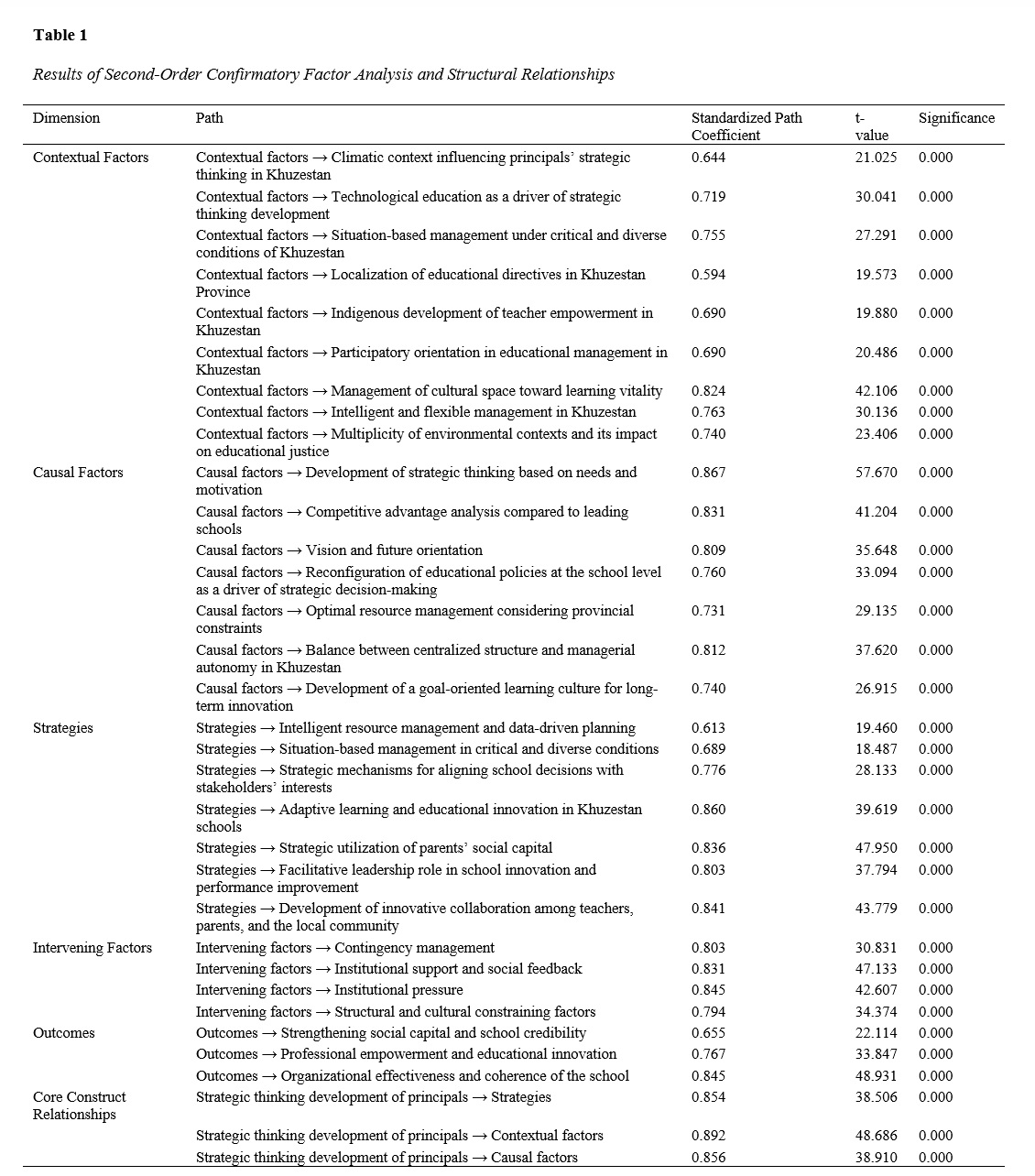
The present study was applied–developmental in terms of purpose and quantitative in terms of implementation. The statistical population consisted of all principals of primary schools under the Department of Education in Khuzestan Province. From a population of 1,688 individuals, approximately 322 participants were selected using cluster and random sampling methods. The research instrument was a researcher-developed questionnaire on principals’ strategic thinking with a competitive advantage approach in education. Data analysis methods included a one-sample t-test using SPSS software, as well as confirmatory factor analysis and structural equation modeling (SEM). The results showed that the causal factors influencing the development of strategic thinking among primary school principals with a competitive advantage approach in the education system of Khuzestan Province include the development of strategic thinking based on needs and motivation, analysis of competitive advantage in comparison with leading schools, vision and future orientation, and the reconfiguration of educational policies at the school level. Contextual factors include the climatic context affecting the strategic thinking of principals in Khuzestan Province, technological education as a facilitator of strategic thinking growth, situation-based management under the critical and diverse conditions of Khuzestan, and the localization of educational directives in the province. Intervening factors include “institutional and organizational support” from education authorities and the extent of “structural pressures and administrative bureaucracy,” which constitute the most significant interventions. The strategies identified in this study include “intelligent resource management,” “adaptive learning and educational innovation,” and “localization of communicated strategies.” Successful principals, by leveraging “parents’ social capital” and performing the role of a “facilitative leader,” achieve outcomes that include “strengthening social capital and school branding” as the first major result, leading to increased trust among families. At the internal level, this approach results in “professional empowerment of teachers” and “innovation in teaching methods.” Ultimately, “enhancement of organizational effectiveness” and the multidimensional development of students in a joyful and dynamic environment represent the most significant outcomes, stabilizing the school’s position within the educational system of Khuzestan Province.
Downloads
References
Abbasi Saymareh, K., & Moradi Niknam, A. (2021). Investigating the impact of strategic innovation on competitive advantage with the mediating role of human capital. 1st International Conference on Educational Sciences, Psychology, Sport Sciences, and Physical Education, Sari.
Alomari, Z. (2020). Does human capital moderate the relationship between strategic thinking and strategic human resource management? Management Science Letters, 10(3), 565-574. https://doi.org/10.5267/j.msl.2019.9.024
Asadpour, P., Yousefi Saeedabadi, R., & Fallah, V. (2018). Identification and ranking of strategic thinking components in education managers of Mazandaran Province. Journal of Educational Leadership and Management, 12(1), 25-39.
Bryson, J. M. (2018). Strategic Planning for Public and Non-Profit Organizations: A Guide to Strengthening and Sustaining Organizational Achievement. Wiley.
Chui, M., Manyika, J., & Miremadi, M. (2019). The Digital Dividend: First Mover Advantage in the Age of Artificial Intelligence.
Combe, I., & Greenley, G. (2004). Capabilities for strategic flexibility: a cognitive content framework. Emerald Group Publishing Limited. https://doi.org/10.1108/03090560410560191
Dixit, S., Singh, S., Dhir, S., & Dhir, S. (2022). Antecedents of strategic thinking and its impact on competitive advantage. Journal of Indian Business Research, 13(4), 437-458. https://doi.org/10.1108/JIBR-08-2020-0262
Edmizal, E., Donie, D., Barlian, E., Welis, W., Sin, T. H., Umar, U., & Bhatnagar, P. (2025). Effect of psychological skills training on reaction time and strategic thinking in competitive badminton-a systematic review. Retos, 62, 439-453. https://doi.org/10.47197/retos.v62.110746
Eisenhardt, K. M., & Zbaracki, M. J. (1992). Strategic decision making. Strategic management journal, 13(S2), 17-37. https://doi.org/10.1002/smj.4250130904
Fahmi, A. M., Khudair, A. H., & Ali Mohammed, A. A. (2020). The mediating effect of strategic thinking between strategic leadership and tourism marketing. African Journal of Hospitality, Tourism and Leisure, 9(1), 1-14.
George, B., Jacobsen, D. I., Johanson, J. E., Johnsen, Å., & Pekkola, E. (2025). User acceptance of strategic planning: Evidence from Northern European municipalities. Public Administration Review, 85(3), 752-767. https://doi.org/10.1111/puar.13874
Goldman, E. F., & Casey, A. (2010). Building a culture that encourages strategic thinking. Journal of Leadership & Organizational Studies, 17(2), 119-128. https://doi.org/10.1177/1548051810369677
Hili, P., Gani, M., Hamzah, N., & Rahman, Z. (2017). Effect of human capital and leadership on institutions performance and competitive advantages. International Journal of Management & Social Sciences, 7(3), 479-488. https://doi.org/10.21013/jmss.v7.n3.p9
Hosseini Nasab, S., & Razavi, M. (2021). The role of organizational learning in improving the strategic performance of schools. Journal of Educational Management, 13(2), 54-70.
Hunitie, M. (2018). Impact of strategic leadership on strategic competitive advantage through strategic thinking and strategic planning: a bi-meditational research. Verslas: teorija ir praktika, 19(1), 322-330. https://doi.org/10.3846/btp.2018.32
Keikhanezhad, M., Keikha, A. R., Kord, E., Salim Abadi, N., & Kord, K. (2022). Presenting a model of strategic thinking skills in Farhangian University of Mazandaran Province. Islamic Lifestyle Centered on Health, 6(1), 64-77.
Lado, A., Boyd, N., & Wright, P. (1992). A competency-based model of sustainable competitive advantage: toward a conceptual integration. Journal of Management, 18(1), 77-91. https://doi.org/10.1177/014920639201800106
Lestari, S. D., Leon, F. M., Widyastuti, S., Brabo, N. A., & Putra, A. H. P. K. (2020). Antecedents and consequences of innovation and business strategy on performance and competitive advantage of SMEs. The Journal of Asian Finance, Economics and Business, 7(6), 365-378. https://doi.org/10.13106/jafeb.2020.vol7.no6.365
Mahdi, O., & Almsafir, M. (2014). The role of strategic leadership in building sustainable competitive advantage in the academic environment. Procedia - Social and Behavioral Sciences, 129, 289-296. https://doi.org/10.1016/j.sbspro.2014.03.679
Mariani, I., Mortati, M., Rizzo, F., & Deserti, A. (2025). Design thinking as a strategic approach to e-participation: From current barriers to opportunities. Springer Nature. https://doi.org/10.1007/978-3-031-72160-1
Mohammadi, F., Hosseini, N., & Rajabi, M. (2020). Challenges of strategic thinking development in primary school managers in Tehran. Journal of Education and Development, 15(4), 85-101.
Nakhaei, M. H. (2023). Presenting a model of predictive factors of strategic thinking among senior managers using grounded theory Iran University of Science and Technology].
Nuntamanop, P., Kauranen, I., & Igel, B. (2013). A new model of strategic thinking competency. Journal of Strategy and Management, 6(3), 242-264. https://doi.org/10.1108/JSMA-10-2012-0052
Pisapia, J., Jelenc, L., & Mick, A. (2016). The foundations of strategic thinking: effectual, strategic, and causal reasoning. In Neostrategic Management (pp. 45-55). Springer, Cham. https://doi.org/10.1007/978-3-319-18185-1_4
Roshani, A., & Mousavi, F. (2020). A study of strategic thinking of school managers and construction and validation of a scale for its measurement. School Management, 8(1).
Saeed, S. A., Azam, K. O., Faraj, S. M., Mustafa, N. A., & Osman, L. N. (2025). The Impact of Stratrgic Planning and Strategic Thinking on Crisis Management: An Analytical Study on Governmental and Non-governmental Organizations in the KRI. Jurnal Manajemen Stratejik dan Simulasi Bisnis, 6(1), 45-58. https://doi.org/10.25077/mssb.6.1.45-58.2025
Sahraei, K. (2021). The impact of managers' strategic thinking skills on the readiness to create competitive advantage in municipal organizations. 4th National and 1st International Conference on New Patterns of Management and Business, Tehran.
Shaik, A. S., & Dhir, S. (2020). A meta-analytical review of factors affecting the strategic thinking of an organization. foresight, 22(2), 144-177. https://doi.org/1108/FS-08-2019-0076
Srivastava, S., & D'Souza, D. (2019). An empirical examination of the relationship between managerial strategic thinking and absorptive capacity of the organization. Journal of Strategy and Management, 13(1), 51-71. https://doi.org/10.1108/JSMA-05-2019-0077
Stoyanova, V. (2018). An Analysis of David J. Teece's Dynamic Capabilites and Strategic Management. Macat Library. https://doi.org/10.4324/9781912453191
Sudiyani, N. N., Goca, I. G. P. A. W., Putri, C. I. A. V. N., Dwijayanthi, A. A. I. A. O., & Putra, I. K. E. D. (2025). Optimizing the Competitive Advantage of Four and Five Star Hotels in Bali with Strategic Thinking and Local Wisdom. Studi Akuntansi, Keuangan, dan Manajemen, 4(2), 479-491. https://doi.org/10.35912/sakman.v4i2.3966
Wickert, C., & Muzio, D. (2025). What is the strategy of strategy to tackle climate change? Journal of Management Studies, 62(2), 954-964. https://doi.org/10.1111/joms.13114
Yaghoubi, F., & Soltani, F. (2020). Factors affecting competitive advantage in public schools of Khuzestan. Quarterly Journal of Training and Human Resources Development, 7(4), 112-129.
Zhou, K., Brown, J., & Dev, C. (2009). Market orientation, competitive advantage, and performance: a demand-based perspective. Journal of Business Research, 62(11), 1063-1070. https://doi.org/10.1016/j.jbusres.2008.10.001
Downloads
Additional Files
Publication Timeline
- Submitted
- Revised
- Accepted