Scientific Authority Indicators in Sport Management Journals: A Comparative Analysis with International Standards
DOI:
https://doi.org/10.61838/kman.aitech.5117Keywords:
Scientific authority, Bibliometrics, Sport management journals, Impact factor, H-index, InternationalizationAbstract
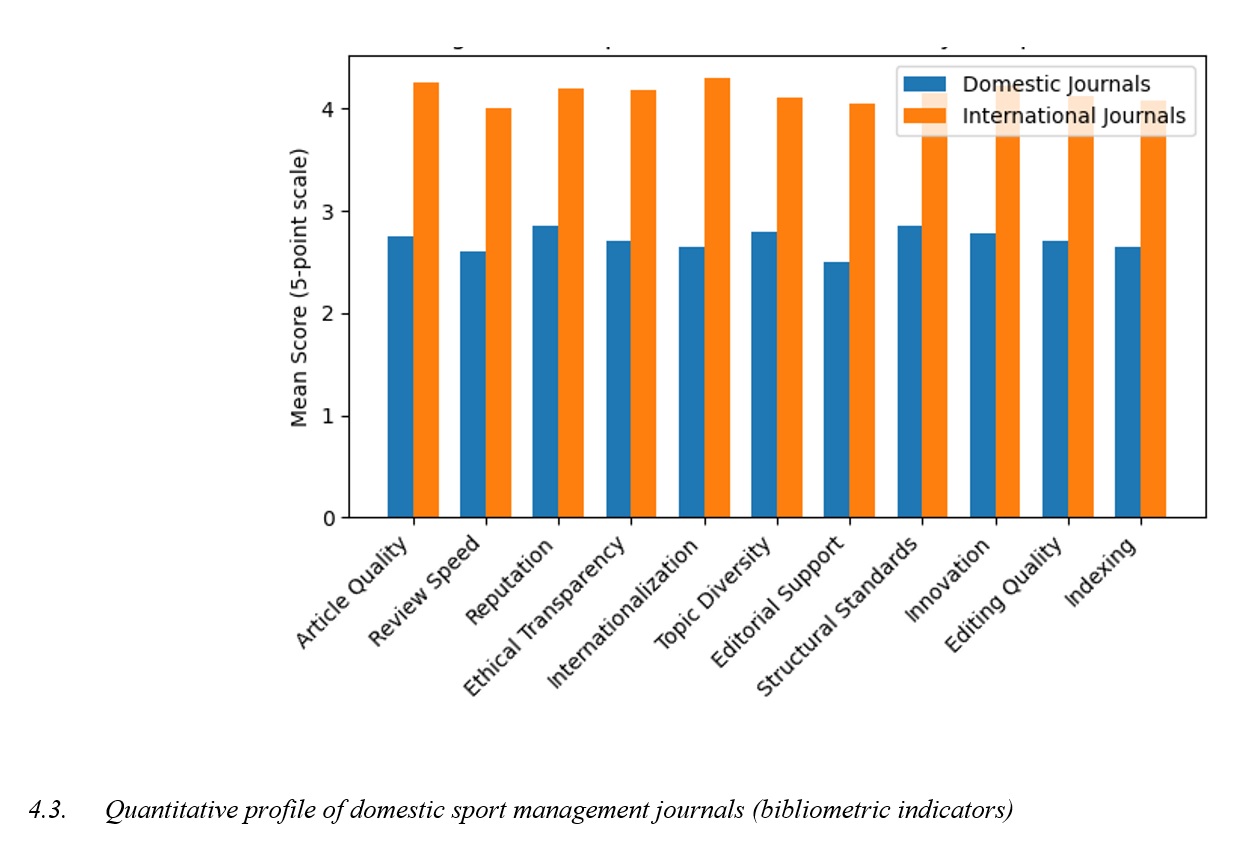
The present study aimed to examine scientific authority indicators in Iranian sport management journals and compare them with international standards. A mixed-method design was employed. In the qualitative phase, semi-structured interviews were conducted with 15 experts in scholarly publishing and sport management. Thematic analysis identified three core dimensions influencing scientific authority: content quality, structural quality, and developmental strategies. In the quantitative phase, seven bibliometric indicators—impact factor, H-index, total citations, cited half-life, acceptance rate, international collaboration, and indexing status—were analyzed across 13 Iranian and 11 international sport management journals. Independent t-tests were used to compare groups. Results revealed significant differences in impact factor (0.48 vs. 2.70, p < .01), H-index (8.5 vs. 56.8, p < .01), and acceptance rate (30.7% vs. 20.9%, p < .05), indicating a performance gap. Differences in cited half-life and international collaboration were not statistically significant. Findings suggest that while Iranian journals demonstrate growth in publication volume, structural and citation-based authority indicators remain comparatively lower. Policy recommendations include strengthening peer-review rigor, improving internationalization strategies, enhancing English-language publishing, and aligning evaluation practices with international frameworks such as DORA and the Leiden Manifesto. This study provides evidence-based guidance for improving the global visibility and scientific authority of sport management journals.
Downloads
References
Archambault, É., Amyot, D., Deschamps, P., Nicol, A., Provencher, F., Rebout, L., & Roberge, G. (2006). Proportion of open access peer-reviewed papers at the European and world levels-1996-2004. Scientometrics, 68(2), 329-342. https://doi.org/10.1007/s11192-006-0115-z
Bornmann, L., & Daniel, H. D. (2008). What do citation counts measure? A review of studies on citing behavior. Scientometrics, 78(1), 45-80. https://doi.org/10.1108/00220410810844150
Bornmann, L., & Marx, W. (2015). Methods for the generation of normalized citation impact scores in bibliometrics: Which method best reflects the judgments of experts? Scientometrics, 102(3), 1955-1970. https://doi.org/10.1016/j.joi.2015.01.006
Braun, V., & Clarke, V. (2006). Using thematic analysis in psychology. Qualitative research in psychology, 3(2), 77-101. https://doi.org/10.1191/1478088706qp063oa
Chalip, L. (2006). Toward a distinctive sport management discipline. Journal of Sport Management, 20(1), 1-21. https://doi.org/10.1123/jsm.20.1.1
Garfield, E. (2006). The history and meaning of the impact factor. Jama, 295(1), 90-93. https://doi.org/10.1001/jama.295.1.90
Glänzel, W., & Moed, H. F. (2002). Journal impact measures in bibliometric research. Scientometrics, 53(2), 171-193. https://doi.org/10.1023/A:1014848323806
Hammerschmidt, J., Calabuig, F., Kraus, S., & Uhrich, S. (2024). Tracing the state of sport management research: A bibliometric analysis. Management Review Quarterly, 74(2), 1185-1208. https://doi.org/10.1007/s11301-023-00331-x
Hicks, D., Wouters, P., Waltman, L., De Rijcke, S., & Rafols, I. (2015). Bibliometrics: The Leiden Manifesto for research metrics. Nature, 520, 429-431. https://doi.org/10.1038/520429a
Hirsch, J. E. (2005). An index to quantify an individual's scientific research output. Proceedings of the National Academy of Sciences, 102(46), 16569-16572. https://doi.org/10.1073/pnas.0507655102
Li, W., Xie, Q., Ao, J., Lin, H., Ji, S., Yang, M., & Sun, J. (2025). Systematic review: a scientometric analysis of the status, trends and challenges in the application of digital technology to cultural heritage conservation (2019-2024). npj Heritage Science, 13(1), 90. https://doi.org/10.1038/s40494-025-01636-8
Moed, H. F. (2005). Citation analysis in research evaluation. Springer. https://link.springer.com/content/pdf/10.1007/1-4020-3714-7_4.pdf
Piwowar, H., Priem, J., Larivière, V., Alperin, J. P., Matthias, L., Norlander, B., Farley, A., West, J., & Haustein, S. (2018). The state of OA: A large-scale analysis of the prevalence and impact of open access articles. PeerJ, 6, e4375. https://doi.org/10.7717/peerj.4375
Seifried, C. (2022). The evolution of sport management as an academic discipline and future research and practices In A research agenda for sport management. In (pp. 21-38). Edward Elgar Publishing. https://doi.org/10.4337/9781800378322.00009
Sohani, F., Shekofteh, M., Shahbodaghi, A., & Jambarsang, S. (2024). Article Processing Charge for Open Access Articles in Iran. Desidoc Journal of Library & Information Technology, 44(5), 298-306. https://doi.org/10.14429/djlit.44.5.19991
Ural, A., & ÖzdemİR, A. (2025). A Bibliometric Study on the Literature of Critical Pedagogy: Trends, Themes, and Future Directions. Yaşadıkça Eğitim, 39(1), 98-116. https://doi.org/10.33308/26674874.2025391793
Waltman, L. (2016). A review of the literature on citation impact indicators. Journal of Informetrics, 10(2), 365-391. https://doi.org/10.1016/j.joi.2016.02.007
Yan, Y., Edwards, B. I., & Sanmugam, M. (2025). Scientometric analysis of emerging trends and research landscape of ERNIE Bot's potentials as an educational tool: A mixed method study of a large language model. Social Sciences & Humanities Open, 12, 101729. https://doi.org/10.1016/j.ssaho.2025.101729
Downloads
Additional Files
Publication Timeline
- Submitted
- Revised
- Accepted