The Effectiveness of Cognitive Analytic Therapy for Chronic Depression with High Self-Criticism: A Digital Health Perspective
DOI:
https://doi.org/10.61838/kman.aitech.5233Keywords:
cognitive analytic therapy; chronic depression; persistent depressive disorder; self-criticism; digital mental healthAbstract
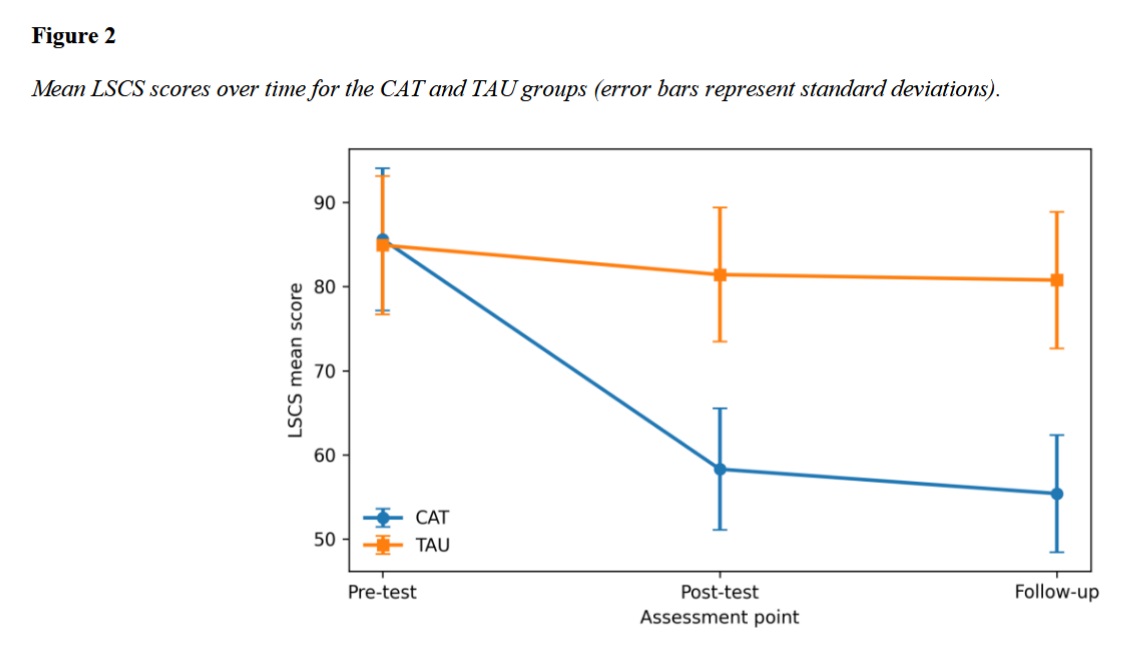
Objective: Chronic depression accompanied by high self-criticism remains difficult to treat and is often associated with persistent functional impairment. This study examined whether Cognitive Analytic Therapy (CAT), delivered with digital support tools, reduced depressive symptoms and self-criticism in adults diagnosed with persistent depressive disorder (PDD). Method: The study used a randomized pretest-posttest-follow-up design. Sixty participants with PDD and elevated self-criticism were allocated to either CAT (16 weekly sessions) or a waitlist treatment-as-usual (TAU) condition. Outcomes were assessed with the Beck Depression Inventory-II (BDI-II) and the Levels of Self-Criticism Scale (LSCS) at baseline, post-treatment, and 2-month follow-up. Data were analyzed using mixed-design analysis of variance. Results: Significant Group x Time interaction effects were observed for depression, F(2, 116) = 45.32, p < .001, eta_p^2 = .438, and self-criticism, F(2, 116) = 52.18, p < .001, eta_p^2 = .473. In the CAT group, BDI-II scores declined from 32.45 (SD = 4.12) at baseline to 18.20 (SD = 3.85) at post-test and 17.10 (SD = 3.90) at follow-up, whereas the TAU group showed only modest change. LSCS scores in the CAT group declined from 85.60 (SD = 8.45) to 58.30 (SD = 7.20) and 55.40 (SD = 6.95), while the TAU group remained comparatively stable. Conclusion: Within the limits of the present design, CAT supplemented with digital monitoring and self-help tools was associated with substantial and sustained reductions in depressive symptoms and self-critical thinking. The findings support CAT as a promising intervention for chronic depressive presentations marked by harsh self-relating.
Downloads
References
American Psychiatric, A. (2022). Diagnostic and statistical manual of mental disorders. American Psychiatric Association Publishing. https://doi.org/10.1176/appi.books.9780890425787
Beck, A. T., Steer, R. A., & Brown, G. K. (1996). Manual for the Beck Depression Inventory-II. Psychological Corporation. https://doi.org/10.1037/t00742-000
Cuijpers, P., van Straten, A., Schuurmans, J., van Oppen, P., Hollon, S. D., & Andersson, G. (2010). Psychotherapy for chronic major depression and dysthymia: A meta-analysis. Clinical Psychology Review, 30(1), 51-62. https://doi.org/10.1016/j.cpr.2009.09.003
Donkin, L., Christensen, H., Naismith, S. L., Neal, B., Hickie, I. B., & Glozier, N. (2011). A systematic review of the impact of adherence on the effectiveness of e-therapies. Journal of Medical Internet Research, 13(3), e52. https://doi.org/10.2196/jmir.1772
Dunkley, D. M., Sanislow, C. A., Grilo, C. M., & McGlashan, T. H. (2009). Self-criticism versus neuroticism in predicting depression and psychosocial impairment for 4 years in a clinical sample. Comprehensive Psychiatry, 50(4), 335-346. https://doi.org/10.1016/j.comppsych.2008.09.004
Ehret, A. M., Joormann, J., & Berking, M. (2015). Examining risk and resilience factors for depression: The role of self-criticism and self-compassion. Cognition and Emotion, 29(8), 1496-1504. https://doi.org/10.1080/02699931.2014.992394
First, M. B., Williams, J. B. W., Karg, R. S., & Spitzer, R. L. (2016). User's guide for the SCID-5-CV: Structured Clinical Interview for DSM-5 disorders, clinician version. American Psychiatric Association Publishing.
Firth, J., Torous, J., Nicholas, J., Carney, R., Pratap, A., Rosenbaum, S., & Sarris, J. (2017). The efficacy of smartphone-based mental health interventions for depressive symptoms: A meta-analysis of randomized controlled trials. World Psychiatry, 16(3), 287-298. https://doi.org/10.1002/wps.20472
Furukawa, T. A., Efthimiou, O., Weitz, E. S., Cipriani, A., Keller, M. B., Kocsis, J. H., Klein, D. N., Michalak, J., Salanti, G., Cuijpers, P., & Schramm, E. (2018). Cognitive-Behavioral Analysis System of Psychotherapy, drug, or their combination for persistent depressive disorder: Personalizing the treatment choice using individual participant data network metaregression. Psychotherapy and Psychosomatics, 87(3), 140-153. https://doi.org/10.1159/000489227
Ghassemzadeh, H., Mojtabai, R., Karamghadiri, N., & Ebrahimkhani, N. (2005). Psychometric properties of a Persian-language version of the Beck Depression Inventory-Second edition: BDI-II-PERSIAN. Depression and Anxiety, 21(4), 185-192. https://doi.org/10.1002/da.20070
Graham, S., Depp, C., Lee, E. E., Nebeker, C., Tu, X., Kim, H. C., & Jeste, D. V. (2019). Artificial intelligence for mental health and mental illnesses: An overview. Current Psychiatry Reports, 21(11), 116. https://doi.org/10.1007/s11920-019-1094-0
Hallam, C., Simmonds-Buckley, M., Kellett, S., Greenhill, B., & Jones, A. (2021). The acceptability, effectiveness, and durability of cognitive analytic therapy: Systematic review and meta-analysis. Psychology and Psychotherapy: Theory, Research and Practice, 94(S1), 8-35. https://doi.org/10.1111/papt.12286
Jobst, A., Brakemeier, E. L., Buchheim, A., Caspar, F., Cuijpers, P., Ebmeier, K. P., Falkai, P., van der Gaag, R. J., Gaebel, W., Herpertz, S., Kurimay, T., Sabaß, L., Schnell, K., Schramm, E., Torrent, C., Wasserman, D., Wiersma, J., & Padberg, F. (2016). European Psychiatric Association guidance on psychotherapy in chronic depression across Europe. European Psychiatry, 33, 18-36. https://doi.org/10.1016/j.eurpsy.2015.12.003
Kellett, S., Stockton, C., Marshall, H., Hall, J., Jennings, C., & Delgadillo, J. (2018). Efficacy of narrative reformulation during cognitive analytic therapy for depression: Randomized dismantling trial. Journal of affective disorders, 239, 37-47. https://doi.org/10.1016/j.jad.2018.05.070
Löw, C. A., Schauenburg, H., & Dinger, U. (2020). Self-criticism and psychotherapy outcome: A systematic review and meta-analysis. Clinical Psychology Review, 75, 101808. https://doi.org/10.1016/j.cpr.2019.101808
Luyten, P., Sabbe, B., Blatt, S. J., Meganck, S., Jansen, B., De Grave, C., Maes, F., & Corveleyn, J. (2007). Dependency and self-criticism: Relationship with major depressive disorder, severity of depression, and clinical presentation. Depression and Anxiety, 24(8), 586-596. https://doi.org/10.1002/da.20272
Martin, E., Byrne, G., Connon, G., & Power, L. (2021). An exploration of group cognitive analytic therapy for anxiety and depression. Psychology and Psychotherapy: Theory, Research and Practice, 94(S1), 79-95. https://doi.org/10.1111/papt.12299
Merzhvynska, M., Simmonds-Buckley, M., Delgadillo, J., & Kellett, S. (2021). Trajectories of change in the therapeutic alliance during cognitive analytic therapy for depression. Psychology and Psychotherapy: Theory, Research and Practice, 94(3), 464-480. https://doi.org/10.1111/papt.12322
Mohammadkhani, P., Forouzan, A. S., Hooshyari, Z., & Abasi, I. (2020). Psychometric properties of Persian version of Structured Clinical Interview for DSM-5-Research Version (SCID-5-RV): A diagnostic accuracy study. Iranian Journal of Psychiatry and Behavioral Sciences, 14(2), e100930. https://doi.org/10.5812/ijpbs.100930
Parry, G., Bennett, D., Roth, A. D., & Kellett, S. (2021). Developing a competence framework for cognitive analytic therapy. Psychology and Psychotherapy: Theory, Research and Practice, 94(S1), 151-170. https://doi.org/10.1111/papt.12306
Ryle, A., & Kerr, I. B. (2020). Introducing cognitive analytic therapy: Principles and practice of a relational approach to mental health. John Wiley & Sons. https://doi.org/10.1002/9781119375210
Sandhu, S. K., Kellett, S., & Hardy, G. (2017). The development of a change model of "exits" during cognitive analytic therapy for the treatment of depression. Clinical Psychology & Psychotherapy, 24(6), 1263-1272. https://doi.org/10.1002/cpp.2090
Smith, M. M., Sherry, S. B., Ray, C., Hewitt, P. L., & Flett, G. L. (2021). Is perfectionism a vulnerability factor for depressive symptoms, a complication of depressive symptoms, or both? A meta-analytic test of 67 longitudinal studies. Clinical Psychology Review, 84, 101982. https://doi.org/10.1016/j.cpr.2021.101982
Thompson, R., & Zuroff, D. C. (2004). The Levels of Self-Criticism Scale: Comparative self-criticism and internalized self-criticism. Personality and Individual Differences, 36(2), 419-430. https://doi.org/10.1016/S0191-8869(03)00106-5
Torous, J., Jän Myrick, K., Rauseo-Ricupero, N., & Firth, J. (2020). Digital mental health and COVID-19: Using technology today to accelerate the curve on access and quality tomorrow. JMIR Mental Health, 7(3), e18848. https://doi.org/10.2196/18848
Wakefield, S., Delgadillo, J., Kellett, S., White, S., & Hepple, J. (2021). The effectiveness of brief cognitive analytic therapy for anxiety and depression: A quasi-experimental case-control study. British Journal of Clinical Psychology, 60(2), 194-211. https://doi.org/10.1111/bjc.12278
Werner, A. M., Tibubos, A. N., Rohrmann, S., & Reiss, N. (2019). The clinical trait self-criticism and its relation to psychopathology: A systematic review-update. Journal of Affective Disorders, 246, 530-547. https://doi.org/10.1016/j.jad.2018.12.069
Wiersma, J. E., van Schaik, D. J. F., Hoogendoorn, A. W., Dekker, J. J. M., van, H. L., Schoevers, R. A., Blom, M. B. J., Maas, K., Smit, J. H., McCullough, J. P., Beekman, A. T. F., & van Oppen, P. (2014). The effectiveness of the cognitive behavioral analysis system of psychotherapy for chronic depression: A randomized controlled trial. Psychotherapy and Psychosomatics, 83(5), 263-269. https://doi.org/10.1159/000360795
Downloads
Publication Timeline
- Submitted
- Revised
- Accepted