Designing a Smart Manufacturing Model in Iran’s Automotive Industry Using the Internet of Things and Artificial Intelligence: A Grounded Theory Approach
DOI:
https://doi.org/10.61838/kman.aitech.5394Keywords:
Smart manufacturing, Industrial Internet of Things, Artificial Intelligence, Iran’s automotive industry, Grounded theoryAbstract
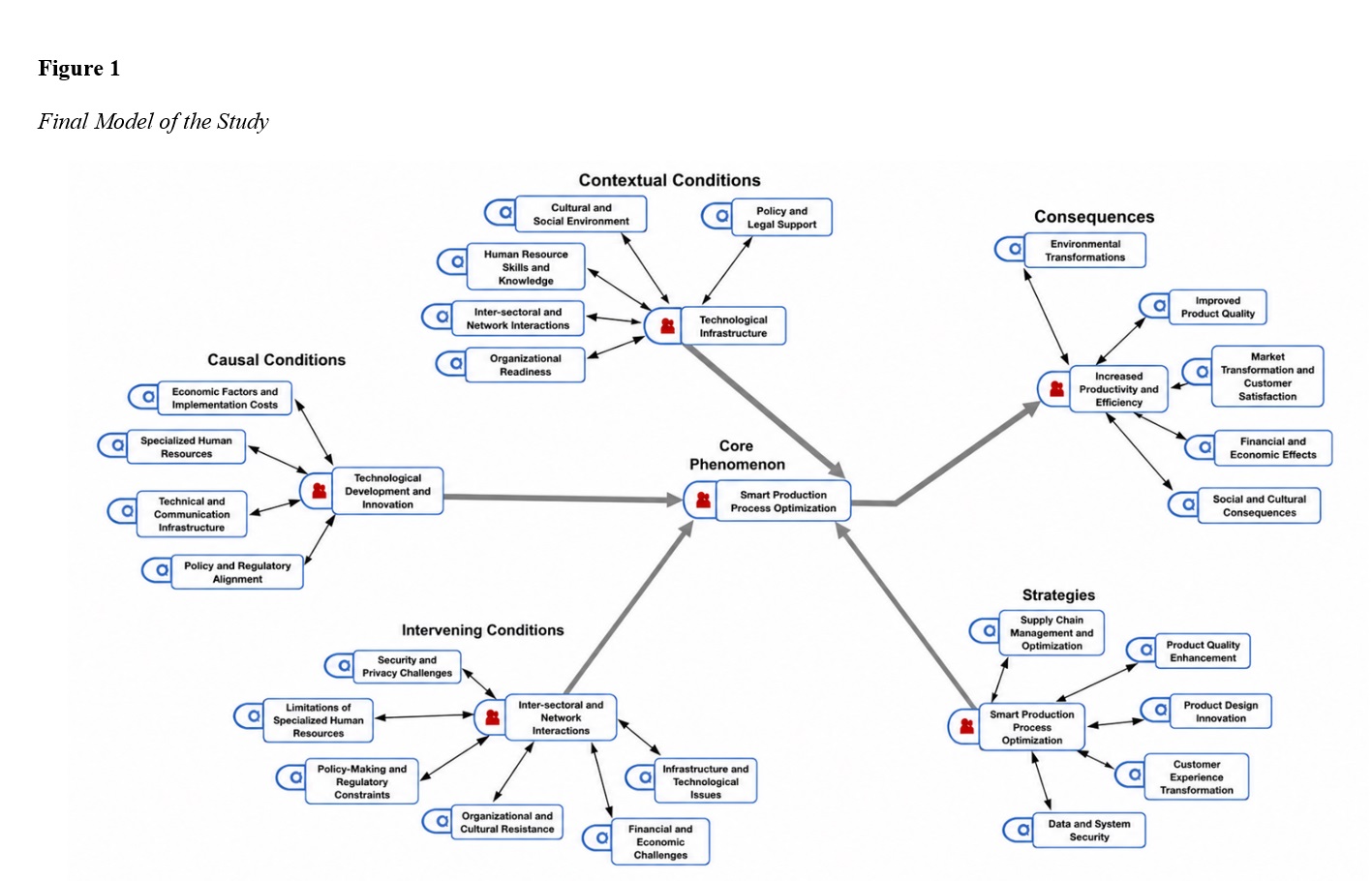
This study was conducted with the aim of designing a qualitative model of smart manufacturing in Iran’s automotive industry. This qualitative study was carried out using the grounded theory method based on the systematic approach of Anselm Strauss and Juliet Corbin (2015). Data were collected through in-depth semi-structured interviews with 12 experts, including production managers, information technology specialists, and university faculty members. Sampling was conducted using purposive and theoretical methods with a snowball strategy until theoretical saturation was achieved. Data analysis was performed using MAXQDA 2020 software in three stages: open coding, axial coding, and selective coding. To ensure the quality of the study, the criteria proposed by Yvonna Lincoln and Egon Guba (1985) were employed, and inter-coder reliability was calculated using Cohen’s kappa coefficient, which was found to be 0.86. The findings led to the identification of 313 open codes, 176 concepts, and 36 main categories within the paradigm model framework. The core phenomenon (smart manufacturing) consisted of six components: real-time data integration, predictive analytics and maintenance, autonomous robotics, mass customization, supply chain optimization, and product quality enhancement. Causal conditions (5 categories), contextual conditions (6 categories), intervening conditions (7 categories), strategies (6 categories), and consequences (6 categories) were identified. The proposed model provides an integrated and localized framework for managers and policymakers in Iran’s automotive industry and can serve as a roadmap for digital transformation in this sector. Successful implementation of this model requires special attention to technological infrastructure, the development of specialized human resources, and the alignment of supportive policies. Quantitative validation of the model using structural equation modeling is recommended for future studies.
Downloads
References
Ajithkumar, A., & Babu, D. S. (2025). Predictive maintenance of manufacturing in cars using random forest algorithm in comparison with artificial neural networks. AIP Conference Proceedings,
Elnadi, M. (2023). Industry 4.0: Critical investigations and synthesis of key technologies and organizational factors. Journal of Open Innovation, 9(1), 100010.
Falahat, M. (2023). Navigating new product development: Uncovering factors for success. Heliyon, 9(12), e23345.
Gao, Z., Li, Y., Wang, X., & Zhang, H. (2024). Artificial intelligence in manufacturing: A systematic review from design to assembly. Journal of Manufacturing Systems, 72, 123-145. https://doi.org/10.1016/j.jmsy.2024.01.005
Ghobakhloo, M. (2020). Industry 4.0, digitization, and opportunities for sustainability in the manufacturing industry: A review. Journal of Cleaner Production, 252, 119869.
Hakim, I. M., & Syahputra, R. (2023). Critical success factors for Internet of Things (IoT) implementation in automotive companies. Sustainability, 15(4), 2909.
Jannatrani, M., Rezaei, A., & Mohammadi, S. (2022). Identification of IIoT implementation requirements in automotive supply chain: A qualitative grounded theory study. Industrial Management, 14(2), 215-238.
Kodumuru, R. (2025). Artificial intelligence and Internet of Things integration in manufacturing: A review. Sensors, 25(7), 3456.
Kruachottikul, P. (2023). New product development process and case studies for deep tech. Journal of Innovation and Entrepreneurship, 12, 63.
Liao, Y., Deschamps, F., Loures, E. F. R., & Ramos, L. F. P. (2019). Past, present and future of Industry 4.0: A systematic literature review and research agenda. International Journal of Production Research, 57(9), 2824-2850.
Liu, H. (2025). Review of digital twin in the automotive industry. International Journal of Advanced Manufacturing Management, 4(2), 1-20.
Llopis-Albert, C. (2021). Impact of digital transformation on the automotive industry: An fsQCA approach. Technological Forecasting and Social Change, 162, 120354.
Moghaddasi, H., Rahimian, M., & Yousefi, S. (2020). Investigating barriers and providing solutions for implementing Industry 4.0 in Iranian manufacturing companies. Technology Growth Quarterly, 17(65), 51-66.
Morales-Matamoros, O., Hernandez-Gomez, L. H., & Torres-Reyes, P. (2025). Artificial intelligence for quality defects in the automotive industry: A systematic review. Sensors, 25(5), 1288. https://doi.org/10.3390/s25051288
Mozafari Mehr, M., & Taghavifard, M. T. (2024). Digital transformation and business model innovation: The case of Iran Khodro Group. Iranian Management Studies, 17(3), 1-28.
Rezaei, A., & Farahani, H. (2023). Identification and prioritization of key success factors in implementing smart factory in the automotive industry. Management Research in Iran, 27(1), 1-24.
Rodic, D., Kostic, N., Kostic, A., & Rodic, S. (2021). Artificial intelligence in automotive industry: A review. Journal of Manufacturing Systems, 61, 575-585.
Soori, M. (2023). Internet of Things for smart factories in Industry 4.0: A review. Journal of Manufacturing Systems Advances, 2, 100027.
Tawfeeq Saleh Al-Sammarraie, F., & Fathi, M. R. (2025). Evaluation of the environmental performance of supply chain in the automotive industry. Transactions on Data Analysis in Social Science, 7(1), 9-15. https://doi.org/10.47176/TDASS.2025.9
Tohidi, J., Hosseini Shokouh, M., Sadegh Asl, A., & Haddadi, M. (2021). Prioritization of influential factors in the selection of advanced technologies in the automotive polymer parts industry using fuzzy AHP method: Case study of Iran Khodro Company. Transactions on Data Analysis in Social Science, 3(4), 200-217. https://doi.org/10.47176/TDASS.2021.200
Wang, H., Zhang, Y., & Chen, W. (2021). IoT-based predictive maintenance model for manufacturing equipment in the automotive industry. IEEE Transactions on Industrial Informatics, 17(8), 5645-5654.
Downloads
Additional Files
Publication Timeline
- Submitted
- Revised
- Accepted