The Effect of Generative AI-Based Digital Marketing Communication Personalization on Customer Trust, Customer Experience, and Repurchase Intention: Evidence from Iranian Online Store Customers
Keywords:
generative AI, digital marketing personalization, customer trust, customer experience, repurchase intention, online storesAbstract
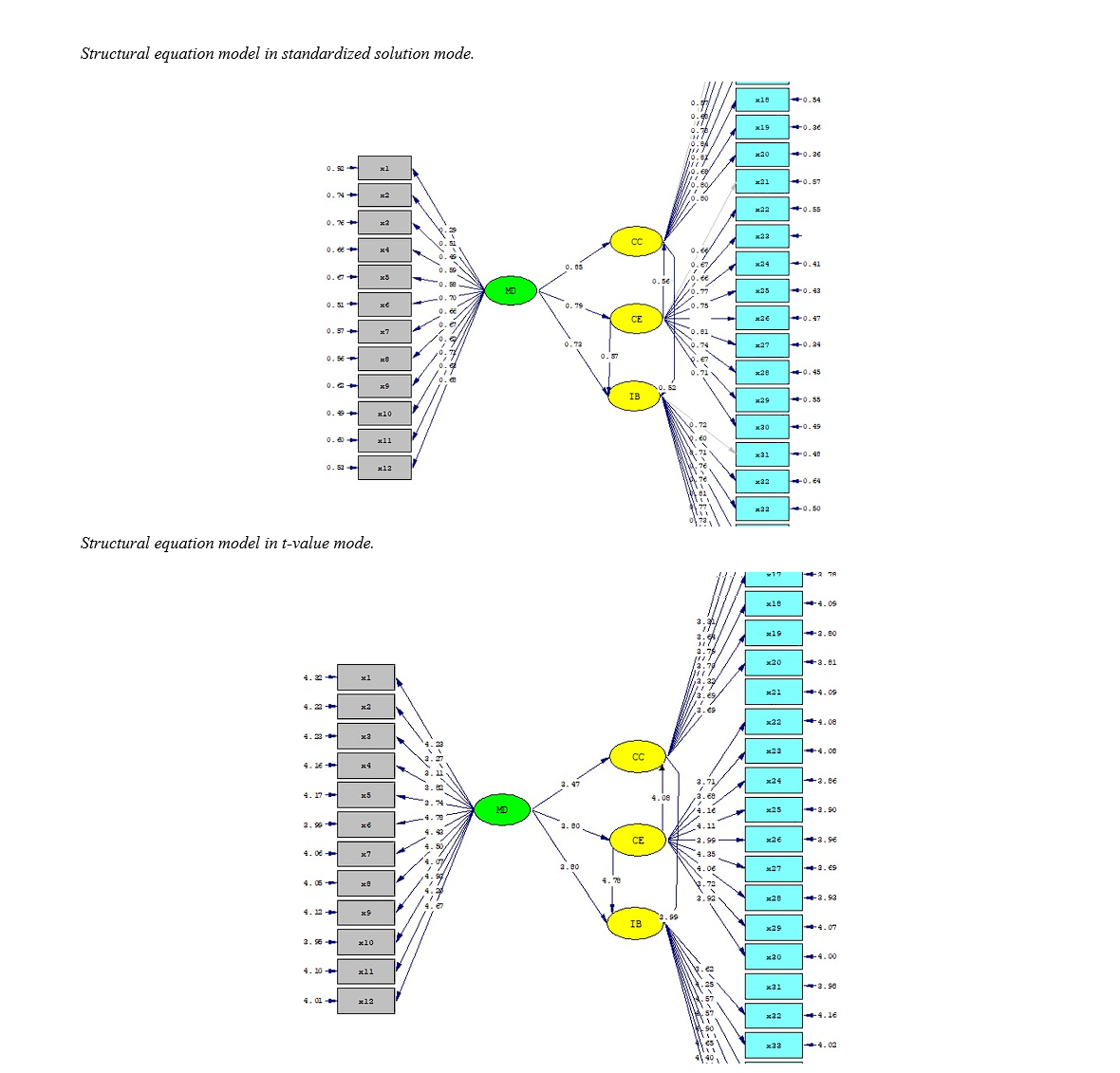
With the expansion of e-commerce and the growing role of artificial intelligence in customer interactions, understanding the effects of AI-enabled personalization has become important for online retail performance. This applied, descriptive-survey study examined the effect of generative AI-based personalization of digital marketing communication on customer trust, customer experience, and repurchase intention among customers of Iranian online stores. Data were collected from 384 online customers using a researcher-developed 39-item questionnaire. Content validity was assessed through expert review, sampling adequacy through KMO statistics, reliability through Cronbach's alpha, and structural relationships through structural equation modeling using LISREL 8.8. The results showed that generative AI-based personalization had positive and significant effects on customer trust, customer experience, and repurchase intention. Customer experience and customer trust also showed positive direct associations with repurchase intention, and customer trust significantly strengthened the relationship between customer experience and repurchase intention. The findings suggest that generative AI-based personalization can improve online customer relationships when it is perceived as relevant, trustworthy, and supportive of a positive customer experience.
Downloads
References
An, G. K., & Ngo, T. T. A. (2025). AI-powered personalized advertising and purchase intention in Vietnam's digital landscape: The role of trust, relevance, and usefulness. Journal of Open Innovation: Technology, Market, and Complexity, 11(3), 100580. https://doi.org/10.1016/j.joitmc.2025.100580
Belanche, D., Ibanez-Sanchez, S., Jordan, P., & Matas, S. (2025). Customer reactions to generative AI vs. real images in high-involvement and hedonic services. International Journal of Information Management, 85, 102954. https://doi.org/10.1016/j.ijinfomgt.2025.102954
Benk, M., Kerstan, S., von Wangenheim, F., & Ferrario, A. (2025). Twenty-four years of empirical research on trust in AI: A bibliometric review of trends, overlooked issues, and future directions. AI & SOCIETY, 40(4), 2083-2106. https://doi.org/10.1007/s00146-024-02059-y
Grewal, D., Satornino, C. B., Davenport, T., & Guha, A. (2025). How generative AI is shaping the future of marketing. Journal of the Academy of Marketing Science, 53, 702-722. https://doi.org/10.1007/s11747-024-01064-3
Hassan, N., Abdelraouf, M., & El-Shihy, D. (2025). The moderating role of personalized recommendations in the trust-satisfaction-loyalty relationship: An empirical study of AI-driven e-commerce. Future Business Journal, 11(1), 66. https://doi.org/10.1186/s43093-025-00476-z
Hermann, E., & Puntoni, S. (2024). Artificial intelligence and consumer behavior: From prediction to generation. Journal of Business Research, 180, 114720. https://doi.org/10.1016/j.jbusres.2024.114720
Huang, M. H., & Rust, R. T. (2025). Using artificial intelligence (AI) to enhance customer experience and to develop strategic marketing: An integrative synthesis. Computers in Human Behavior, 170, 108684. https://doi.org/10.1016/j.chb.2025.108684
Huynh, M. T., & Aichner, T. (2025). In generative artificial intelligence we trust: Unpacking determinants and outcomes for cognitive trust. AI & SOCIETY, 40, 5849-5869. https://doi.org/10.1007/s00146-025-02378-8
Lemmens, A., Roos, J. M. T., Gabel, S., Ascarza, E., Bruno, H. A., Gordon, B. R., Israeli, A., McDonnell Feit, E., Mela, C. F., & Netzer, O. (2025). Personalization and targeting: How to experiment, learn, and optimize. International Journal of Research in Marketing. https://doi.org/10.1016/j.ijresmar.2025.07.004
Lu, Y., & Zhang, J. (2025). Balancing identity diversity and product contexts: Understanding consumer trust in AI-enhanced chatbot services. Journal of Retailing and Consumer Services, 84, 104205. https://doi.org/10.1016/j.jretconser.2024.104205
McGrath, M. J., Duenser, A., Lacey, J., & Paris, C. (2024). Collaborative human-AI trust (CHAI-T): A process framework for active management of trust in human-AI collaboration. arXiv. https://doi.org/10.1016/j.chbah.2025.100200
Muhammad, N. S., Mansor, A. A., Rohisham, I. H., Afendy, I. H. T., Ismadi, M. Z., Azli, A. A. M., Zakaria, A. N., & Azmi, N. A. (2024). Examining the effects of e-satisfaction, e-trust and perceived value on repurchase intention among young adults. Information Management and Business Review, 16(3S(I)a), 154-163. https://doi.org/10.22610/imbr.v16i3S(I)a.4207
Nguyen, T. H., Trivedi, R. H., Fukukawa, K., & Adomako, S. (2025). Investigating drivers of customer experience with virtual conversational agents. Information Systems Frontiers, 27, 1871-1897. https://doi.org/10.1007/s10796-024-10572-0
Oliver, R. L. (1980). A Cognitive Model of the Antecedents and Consequences of Satisfaction Decisions. Journal of Marketing Research, 17(4), 460-469. https://doi.org/10.1177/002224378001700405
Pires, P. B., Prisco, M., Delgado, C., & Santos, J. D. (2024). A conceptual approach to understanding the customer experience in e-commerce: An empirical study. Journal of Theoretical and Applied Electronic Commerce Research, 19(3), 1943-1983. https://doi.org/10.3390/jtaer19030096
Rogers, E. M. (2003). Diffusion of innovations (5th ed.). Free Press.
Tan, T. L., Nguyen Chau Ngoc, K., Hien Le Thi Thanh, H., Nguyen Thi Thu, H., & Hoang, U. V. T. (2024). Enhancing repurchase intention on digital platforms based on shopping well-being through shopping value, trust and impulsive buying. SAGE Open, 14(3), 21582440241278454. https://doi.org/10.1177/21582440241278454
Zeithaml, V. A. (1988). Consumer perceptions of price, quality, and value: A means-end model and synthesis of evidence. Journal of Marketing, 52(3), 2-22. https://doi.org/10.1177/002224298805200302
Downloads
Publication Timeline
- Submitted
- Revised
- Accepted