Integrating the SQ6R Strategy into a Personalized Adaptive System for Selected Reading Subskills in Blended EFL Learning
Keywords:
adaptive learning; SQ6R; EFL reading; blended learning; reading subskillsAbstract
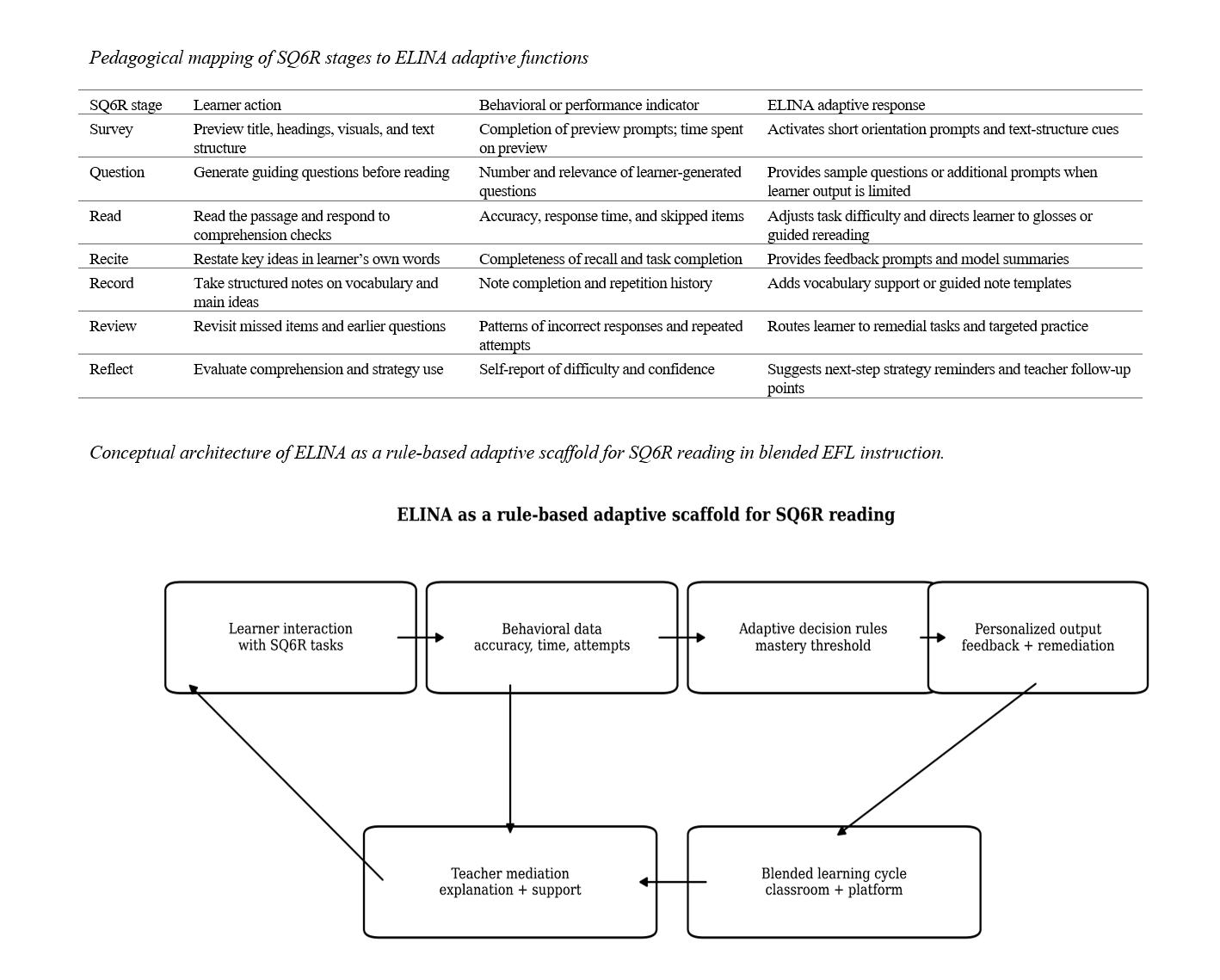
This study examined the effectiveness of ELINA, a rule-based personalized adaptive learning system that integrates the SQ6R reading strategy, for improving selected reading subskills among Iranian intermediate EFL learners in a blended learning environment. A concurrent mixed-methods quasi-experimental design was used. After screening with the Cambridge Preliminary English Test, 258 B1-level learners were assigned to an experimental group (n = 135) receiving ELINA-supported blended instruction and a control group (n = 123) receiving traditional teacher-fronted instruction. Quantitative outcomes focused on post-intervention scores for vocabulary-in-context, inferential comprehension, and overall comprehension, while qualitative evidence was collected through learner perception data and semi-structured interviews. Post-intervention comparisons showed large advantages for the experimental group in vocabulary-in-context (mean difference = 8.30, t = 11.71, p < .001, d = 1.47) and inferential comprehension (mean difference = 7.30, t = 10.87, p < .001, d = 1.37). The group difference in overall reading comprehension was small and not statistically significant (mean difference = 1.40, p = .110, d = 0.20). Qualitative findings indicated that ELINA supported motivation, perceived autonomy, feedback uptake, and reduced reading-related anxiety, while learners still valued teacher mediation for higher-order interpretation. The findings suggest that adaptive systems are most useful when they operate as pedagogically transparent scaffolds within blended instruction rather than as replacements for teachers. ELINA appears particularly effective for strengthening subskills that depend on repeated exposure, immediate feedback, and individualized remediation, whereas broader comprehension gains may require longer interventions and more explicit discourse-level instruction. Accordingly, the conclusions are limited to targeted subskill improvement rather than confirmed improvement in overall reading comprehension.
Downloads
References
Al-Jarf, R. (2021). Online technologies in English as a foreign language (EFL) instruction in Saudi Arabia. Arab World English Journal, 12(2), 198–215. https://doi.org/10.24093/awej/vol12no2.14
Brown, H. D. (2014). Principles of language learning and teaching (6th ed.). Pearson.
Chun, D. M., & Plass, J. L. (1996). Effects of multimedia annotations on vocabulary acquisition. The Modern Language Journal, 80(2), 183–198. https://doi.org/10.1111/j.1540-4781.1996.tb01159.x
Cohen, J. (1988). Statistical power analysis for the behavioral sciences (2nd ed.). Lawrence Erlbaum Associates.
Creswell, J. W., & Plano Clark, V. L. (2018). Designing and conducting mixed methods research (3rd ed.). SAGE.
Grabe, W., & Stoller, F. L. (2019). Teaching and researching reading (3rd ed.). Routledge. https://doi.org/10.4324/9781315726274
Hattie, J., & Timperley, H. (2007). The power of feedback. Review of Educational Research, 77(1), 81–112. https://doi.org/10.3102/003465430298487
Khodabakhshzadeh, H., Ghasemi, M., & Sahranavard, A. (2024). EFL teachers perception on the use of Twee for making English exams and tasks. Transactions on Data Analysis in Social Science, 6(1), 11–21. https://doi.org/10.47176/TDASS.2024.11
Kizilcec, R. F., Piech, C., & Schneider, E. (2013). Deconstructing disengagement: Analyzing learner subpopulations in massive open online courses. In Proceedings of the Third International Conference on Learning Analytics and Knowledge (pp. 170–179). Association for Computing Machinery. https://doi.org/10.1145/2460296.2460330
Robinson, F. P. (1941). Effective study. Harper & Brothers.
Roll, I., & Wylie, R. (2016). Evolution and revolution in artificial intelligence in education. International Journal of Artificial Intelligence in Education, 26(2), 582–599. https://doi.org/10.1007/s40593-016-0110-3
Siemens, G., & Baker, R. S. J. d. (2012). Learning analytics and educational data mining: Toward communication and collaboration. In Proceedings of the 2nd International Conference on Learning Analytics and Knowledge (pp. 252–254). Association for Computing Machinery. https://doi.org/10.1145/2330601.2330661
Sweller, J. (1988). Cognitive load during problem solving: Effects on learning. Cognitive Science, 12(2), 257–285. https://doi.org/10.1207/s15516709cog1202_4
Thakhulee, A., Sarnkong, R., & Athan, A. (2025). Using the SQ6R technique to enhance reading comprehension abilities for Thai 8th-graders. Journal of Education and Learning, 14(6), 157–162. https://doi.org/10.5539/jel.v14n6p157
VanLehn, K. (2011). The relative effectiveness of human tutoring, intelligent tutoring systems, and other tutoring systems. Educational Psychologist, 46(4), 197–221. https://doi.org/10.1080/00461520.2011.611369
Vygotsky, L. S. (1978). Mind in society: The development of higher psychological processes. Harvard University Press.
Wisniewski, B., Zierer, K., & Hattie, J. (2020). The power of feedback revisited: A meta-analysis of educational feedback research. Frontiers in Psychology, 10, Article 3087. https://doi.org/10.3389/fpsyg.2019.03087
Zawacki-Richter, O., Marín, V. I., Bond, M., & Gouverneur, F. (2019). Systematic review of research on artificial intelligence applications in higher education: Where are the educators? International Journal of Educational Technology in Higher Education, 16, Article 39. https://doi.org/10.1186/s41239-019-0171-0
Zimmerman, B. J. (2002). Becoming a self-regulated learner: An overview. Theory Into Practice, 41(2), 64–70. https://doi.org/10.1207/s15430421tip4102_2
Downloads
Publication Timeline
- Submitted
- Revised
- Accepted