The Effect of Managerial Ownership on Corporate Financialization: The Moderating Role of Corporate Technological Innovation
Keywords:
managerial ownership, corporate financialization, technological innovation, panel data, Tehran Stock ExchangeAbstract
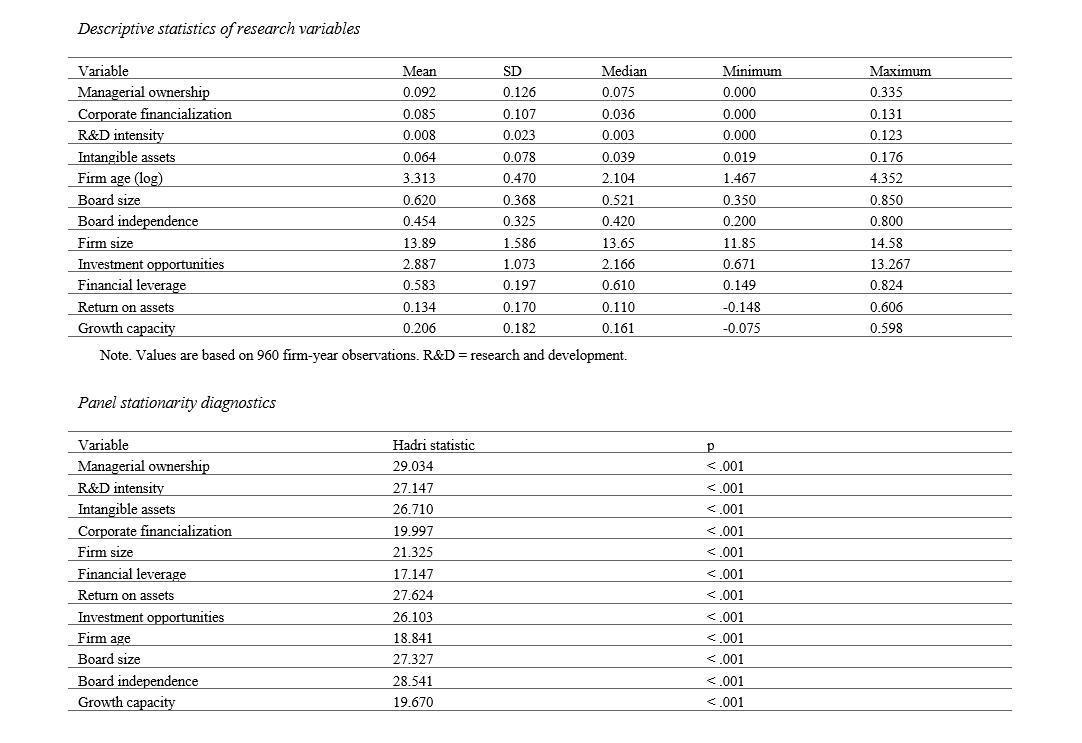
This study examines the effect of managerial ownership on corporate financialization and investigates whether corporate technological innovation moderates this relationship. Corporate financialization reflects the increasing allocation of corporate resources to financial assets and financial activities rather than to core operating activities. Using a panel dataset of 120 non-financial firms listed on the Tehran Stock Exchange from 2016 to 2023, corresponding to 960 firm-year observations, the study estimates panel regression models in which corporate financialization is measured as the ratio of financial assets to total assets. Managerial ownership is measured as the proportion of shares held by managers, while technological innovation is proxied by research and development intensity and intangible assets. The results show that managerial ownership has a significant negative association with corporate financialization. This finding suggests that when managers hold equity stakes, they may become more oriented toward preserving operational assets and long-term firm-specific resources rather than expanding financial-asset holdings. The interaction results further indicate that technological innovation significantly moderates this association: innovation weakens the negative relationship between managerial ownership and financialization. This pattern suggests that innovation-oriented firms may use financial assets not only as speculative instruments but also as liquidity buffers that support technological development and strategic flexibility. The findings contribute to the literature on corporate governance, financialization, and innovation in emerging capital markets by showing that the effect of managerial ownership on financialization depends on firms’ technological orientation.
Downloads
References
Amore, M. D., Schneider, C., & Zaldokas, A. (2013). Credit supply and corporate innovation. Journal of Financial Economics, 109(3), 835-855. https://doi.org/10.1016/j.jfineco.2013.04.006
Baradaran Hasanzadeh, R., & Taghizadeh Khanghah, V. (2023). The moderating role of internal controls in the effect of corporate financialization on financial fraud. Proceedings of the 21st National Accounting Conference of Iran and the 3rd International Accounting Conference of Iran, Tabriz, Iran.
Chang, X., Fu, K., Low, A., & Zhang, W. (2019). Non-executive employee stock options and corporate innovation. Journal of Financial Economics, 115(1), 168-188. https://doi.org/10.1016/j.jfineco.2014.09.002
Chen, C., Wang, T., & Jia, X. (2023). Short-termism in financial decision-making: Uncovering the influence of managerial myopia on corporate financial asset allocation through MD&A textual analysis. International Review of Financial Analysis, 90, 102900. https://doi.org/10.1016/j.irfa.2023.102900
Chen, Y., Shen, B., Cao, Y., & Wang, S. (2023). CEO social capital, financing constraints and corporate financialisation: Evidence from Chinese listed companies. Finance Research Letters, 58, 104456. https://doi.org/10.1016/j.frl.2023.104781
Colombo, M. G., Guerci, M., & Rovelli, P. (2022). The effects of firm financialization on human resource management: How financialization affects the design of managerial jobs. Human Resource Management Journal, 32(3), 647-663. https://doi.org/10.1111/1748-8583.12419
Feng, Y., Yao, S., Wang, C., Liao, J., & Cheng, F. (2022). Diversification and financialization of non-financial corporations: Evidence from China. Emerging Markets Review, 50, 100834. https://doi.org/10.1016/j.ememar.2021.100834
Gong, C., Gong, P., & Jiang, M. (2023). Corporate financialization and investment efficiency: Evidence from China. Pacific-Basin Finance Journal, 79, 101970. https://doi.org/10.1016/j.pacfin.2023.102045
Hsu, P. H., Tian, X., & Xu, Y. (2014). Financial development and innovation: Cross-country evidence. Journal of Financial Economics, 112(1), 116-135. https://doi.org/10.1016/j.jfineco.2013.12.002
Kang, D., Xu, J., Tong, Q., & Li, J. (2025). CEO financial background and corporate financialization. Finance Research Letters, 71, 106362. https://doi.org/10.1016/j.frl.2024.106382
Lee, Y. S., Kim, H. S., & Joo, S. H. (2020). Financialization and innovation short-termism in OECD countries. Review of Radical Political Economics, 52(2), 259-286. https://doi.org/10.1177/0486613419886409
Leng, T., Liu, Y., Xiao, Y., & Hou, C. (2023). Does firm financialization affect optimal real investment decisions? Evidence from China. Pacific-Basin Finance Journal, 79, 101970. https://doi.org/10.1016/j.pacfin.2023.101970
Li, H., Wang, Y., & Zhang, H. (2023). How does family exit affect family business financialization? Finance Research Letters, 58, 104449. https://doi.org/10.1016/j.frl.2023.104449
Li, W., Chen, L., & He, S. (2023). The effect of enterprise financialization on green innovation: Evidence from Chinese A-share non-financial listed enterprises. Environmental Science and Pollution Research, 30, 56802-56817. https://doi.org/10.1007/s11356-023-26377-8
Li, Z., & Yi, S. (2021). The impact of entity enterprise financialization on enterprise innovation investment: An analysis based on regulatory effect. Jiangxi Social Sciences, 41, 43-57. https://doi.org/10.21820/23987073.2021.3.41
Maaboudi, R., & Nazari Dareh, Z. (2022). The impact of financialization on environmental pollution in Iran. Quarterly Journal of New Economy and Trade, 17(2), 153-179.
Orhangazi, O. (2008). Financialisation and capital accumulation in the non-financial corporate sector: A theoretical and empirical investigation on the U.S. economy, 1973-2003. Cambridge Journal of Economics, 32(6), 863-886. https://doi.org/10.1093/cje/ben009
Qi, B., & Fang, P. (2023). Dynamic changes in corporate financialization during CEO tenure. Finance Research Letters, 58, 104456. https://doi.org/10.1016/j.frl.2023.104456
Rabiei, K., & Mahdianpour, M. (2025). The effect of corporate financialization on investment efficiency based on the moderating role of financing constraints in companies listed on the Tehran Stock Exchange. Financial Management Strategy, 13(49), 157-178.
Sen, S., & Dasgupta, Z. (2018). Financialisation and corporate investments: The Indian case. Review of Keynesian Economics, 6(1), 96-113. https://doi.org/10.4337/roke.2018.01.06
Wang, C. (2019). A literature review on corporate financialization. American Journal of Industrial and Business Management, 9(3), 647-657. https://doi.org/10.4236/ajibm.2019.93044
Xu, M., Albitar, K., & Li, Z. (2020). Does corporate financialization affect EVA? Early evidence from China. Green Finance, 2(4), 392-408. https://doi.org/10.3934/GF.2020021
Xue, L., Chen, C., Wang, N., & Zhang, L. (2023). Gambling culture and corporate financialization: Evidence from China's welfare lottery sales. Pacific-Basin Finance Journal, 78, 101939. https://doi.org/10.1016/j.pacfin.2023.101939
Zhang, C., & Zhang, B. (2016). The falling real investment puzzle: A view from financialization. Economic Research Journal, 51(12), 32-46.
Zhang, M., Li, W., Luo, Y., & Chen, W. (2023). Government audit supervision, financialization, and executives' excess perks: Evidence from Chinese state-owned enterprises. International Review of Financial Analysis, 89, 102716. https://doi.org/10.1016/j.irfa.2023.102716
Zhao, Y., & Su, K. (2022). Economic policy uncertainty and corporate financialization: Evidence from China. International Review of Financial Analysis, 82, 102182. https://doi.org/10.1016/j.irfa.2022.102182
Zhou, Z., Xu, L., Guo, P., & Ai, H. (2023). Environmental regulation and corporate financialization: Insight from Blue Sky Protection Campaign in China. Environmental Science and Pollution Research, 30, 54993-55008. https://doi.org/10.1007/s11356-023-26188-x
Downloads
Publication Timeline
- Submitted
- Revised
- Accepted