Intelligent Design and Validation of an Administrative Automation Evaluation Model in Government Organizations: An Exploratory Mixed-Methods Study
Keywords:
administrative automation, artificial intelligence, government organizations, Delphi method, PLS-SEM, ANFIS, public value, digital governmentAbstract
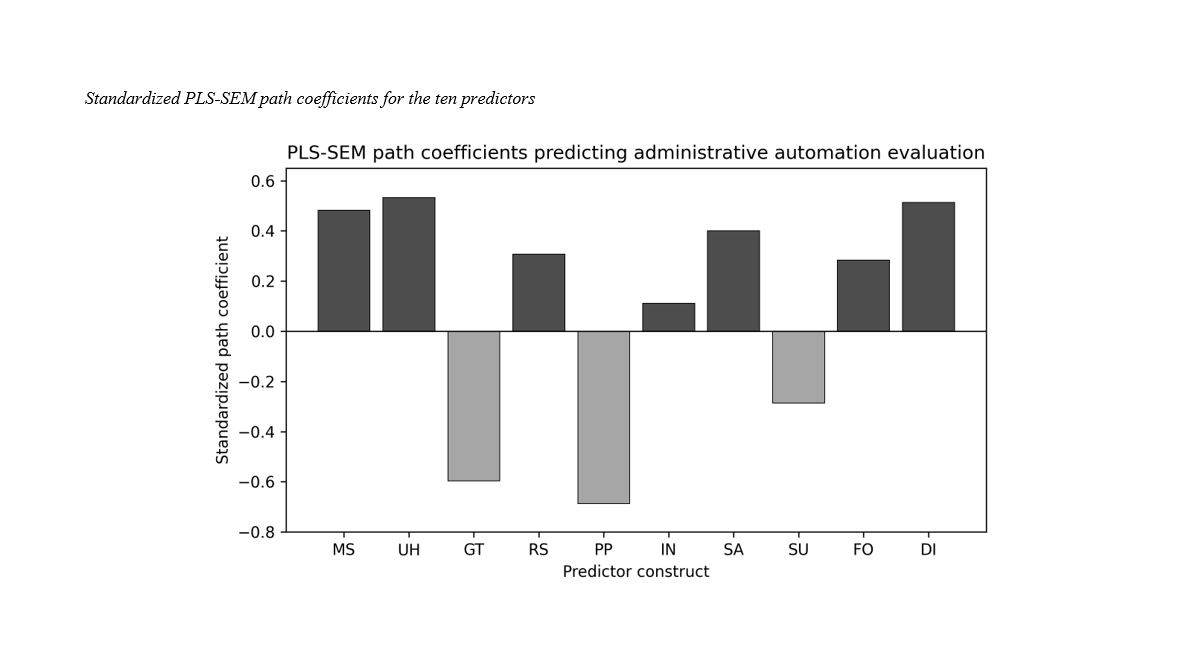
This study designed and validated a multidimensional model for evaluating administrative automation in government organizations. An exploratory mixed-methods design was used. In the qualitative phase, content analysis of documents and expert interviews was used to identify evaluation indicators; the resulting pool was refined through a two-round Delphi procedure with 20 experts. In the quantitative phase, a 41-item questionnaire was administered to 127 public-sector managers and experts familiar with administrative automation systems. Partial least squares structural equation modeling (PLS-SEM) was used to assess the measurement and structural models, and an adaptive neuro-fuzzy inference system (ANFIS) was trained to capture nonlinear prediction patterns. The qualitative phase yielded 100 operational indicators, 30 components, and 10 final dimensions. Delphi consensus exceeded 80% for all dimensions, with the highest consensus for process performance and efficiency (93%) and the lowest for sustainability and environmental impacts (80%). PLS-SEM showed statistically significant effects for all ten predictors of the automation evaluation construct, although negative coefficients for selected constructs require cautious methodological interpretation. Model fit was acceptable (SRMR = 0.041; NFI = 0.91). The ANFIS test results indicated moderate-to-good predictive performance (RMSE = 0.464; R² = .626), with strategic alignment and public value, technology maturity and scalability, user experience and human resources, and financial outcomes emerging as the most influential inputs. The findings indicate that successful administrative automation depends on the simultaneous alignment of strategy, technology maturity, process redesign, human capacity, financial value, and governance safeguards.
Downloads
References
Creswell, J. W., & Plano Clark, V. L. (2017). Designing and conducting mixed methods research (3rd ed.). SAGE. https://www.scirp.org/reference/referencespapers?referenceid=2875785
Davenport, T. H., & Ronanki, R. (2018). Artificial intelligence for the real world. Harvard Business Review, 96(1), 108-116. https://academichelptoday.com/assets/documents/Artificial_Intelligence_for_the_Real_World_-_HBR.pdf
Dwivedi, Y. K., Hughes, L., Ismagilova, E., Aarts, G., Coombs, C., Crick, T., Duan, Y., Dwivedi, R., Edwards, J., Eirug, A., Galanos, V., Ilavarasan, P. V., Janssen, M., Jones, P., Kar, A. K., Kizgin, H., Kronemann, B., Lal, B., Lucini, B., . . . Williams, M. D. (2021). Artificial intelligence (AI): Multidisciplinary perspectives on emerging challenges, opportunities, and agenda for research, practice and policy. International Journal of Information Management, 57, 101994. https://doi.org/10.1016/j.ijinfomgt.2019.08.002
Hair, J. F., Hult, G. T. M., Ringle, C. M., & Sarstedt, M. (2022). A primer on partial least squares structural equation modeling (PLS-SEM) (3rd ed.). SAGE. https://doi.org/10.1007/978-3-030-80519-7
Henseler, J., Ringle, C. M., & Sarstedt, M. (2015). A new criterion for assessing discriminant validity in variance-based structural equation modeling. Journal of the Academy of Marketing Science, 43(1), 115-135. https://doi.org/10.1007/s11747-014-0403-8
Jang, J. S. R. (1993). ANFIS: Adaptive-network-based fuzzy inference system. IEEE Transactions on Systems, Man, and Cybernetics, 23(3), 665-685. https://doi.org/10.1109/21.256541
Jarrahi, M. H. (2018). Artificial intelligence and the future of work: Human-AI symbiosis in organizational decision making. Business Horizons, 61(4), 577-586. https://doi.org/10.1016/j.bushor.2018.03.007
Pennathur, P. R., Boksa, V., Pennathur, A., Kusiak, A., & Livingston, B. A. (2024). The future of office and administrative support occupations in the era of artificial intelligence: A state-of-the-art review and future research directions. International Journal of Industrial Ergonomics, 104, 103665. https://doi.org/10.1016/j.ergon.2024.103665
Russell, S., & Norvig, P. (2021). Artificial intelligence: A modern approach (4th ed.). Pearson.
Tveita, L. J., & Hustad, E. (2025). Benefits and challenges of artificial intelligence in public sector: A literature review. Procedia Computer Science, 256, 222-229. https://doi.org/10.1016/j.procs.2025.02.115
United Nations Department of, E., & Social, A. (2024). United Nations E-Government Survey 2024: Accelerating digital transformation for sustainable development, with the addendum on artificial intelligence. United Nations. https://books.google.com/books?hl=en&lr=&id=JTcmEQAAQBAJ&oi=fnd&pg=PT15&dq=United+Nations+Department+of,+E.+and+A.+Social+(2024).+United+Nations+E-Government+Survey+2024:+Accelerating+digital+transformation+for+sustainable+development,+with+the+addendum+on+artificial+intelligence,+United+Nations.+%09&ots=iSlIpFiGU6&sig=OFkqSZPtBtTfI7se6gO8aNrQd8M
Wirtz, B. W., Weyerer, J. C., & Geyer, C. (2019). Artificial intelligence and the public sector: Applications and challenges. International Journal of Public Administration, 42(7), 596-615. https://doi.org/10.1080/01900692.2018.1498103
Downloads
Publication Timeline
- Submitted
- Revised
- Accepted