Knowledge Management, Organizational Health, and Employee Empowerment in Sport and Youth Departments: A Descriptive-Correlational Study
Keywords:
knowledge management, organizational health, employee empowerment, sport administration, Departments of Sport and Youth AffairsAbstract
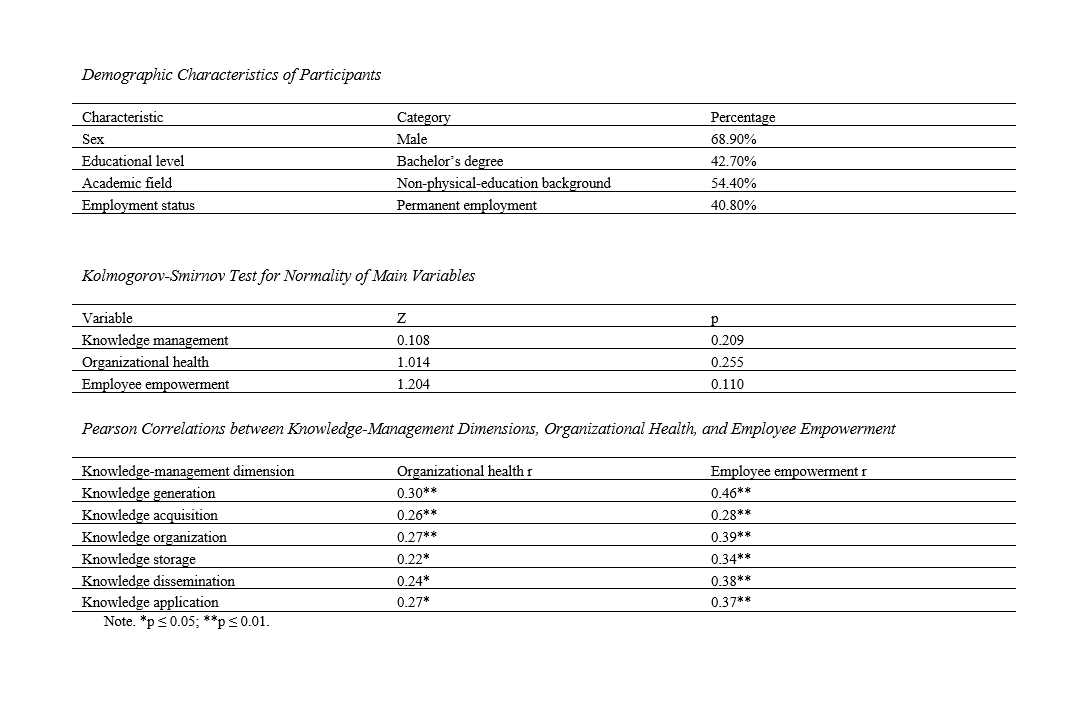
This study examined the relationships among knowledge management, organizational health, and employee empowerment among employees of the Departments of Sport and Youth Affairs in Yazd Province, Iran. The study used an applied, descriptive-correlational design. The statistical population consisted of all employees working in the provincial Departments of Sport and Youth Affairs, and because the researchers had access to the whole population, a census method was used (n = 142). Data were collected using a demographic questionnaire, Lawson’s Knowledge Management Assessment Instrument, the Organizational Health Inventory developed by Hoy and colleagues, and Spreitzer’s Psychological Empowerment Questionnaire. Content validity was confirmed by ten sport management experts, and pilot reliability coefficients were 0.70 for knowledge management, 0.91 for organizational health, and 0.83 for employee empowerment. Data were analyzed in SPSS using the Kolmogorov-Smirnov test, Pearson correlation coefficients, and regression analysis. The results showed positive and significant relationships between knowledge management and organizational health and between knowledge management and employee empowerment. All six dimensions of knowledge management—knowledge generation, knowledge acquisition, knowledge organization, knowledge storage, knowledge dissemination, and knowledge application—were positively associated with both organizational health and employee empowerment. Regression findings also indicated that overall knowledge management predicted organizational health (β = 0.295, p = 0.002) and employee empowerment (β = 0.415, p < 0.001). These findings suggest that strengthening knowledge-management processes may be associated with healthier organizational conditions and higher employee empowerment in sport and youth administrative settings.
Downloads
References
Abdelrahman, M., Papamichail, K. N., Hammady, R., Kurt, Y., Abdallah, W., Liu, L. S., & Kapser, S. (2025). Organisational culture and knowledge management systems adoption: Examining employee usage in multinational corporations. Global Journal of Flexible Systems Management, 26(3), 439-467. https://doi.org/10.1007/s40171-025-00448-w
Alavi, M., & Leidner, D. E. (2001). Review: Knowledge management and knowledge management systems: Conceptual foundations and research issues. MIS Quarterly, 25(1), 107-136. https://doi.org/10.2307/3250961
Aljuwaiber, A. (2026). An integrative systematic review of knowledge management, organizational performance, and business sustainability. Administrative Sciences, 16(4), 185. https://doi.org/10.3390/admsci16040185
Aujirapongpan, S., Vadhanasindhu, P., Chandrachai, A., & Cooparat, P. (2010). Indicators of knowledge management capability for KM effectiveness. VINE: The Journal of Information and Knowledge Management Systems, 40(2), 183-203. https://doi.org/10.1108/03055721011050677
Conger, J. A., & Kanungo, R. N. (1988). The empowerment process: Integrating theory and practice. Academy of Management Review, 13(3), 471-482. https://doi.org/10.5465/amr.1988.4306983
Gold, A. H., Malhotra, A., & Segars, A. H. (2001). Knowledge management: An organizational capabilities perspective. Journal of Management Information Systems, 18(1), 185-214. https://doi.org/10.1080/07421222.2001.11045669
Guha, S., Rabby, S. K. M. A. H., Chowdhury, S. R., & Julee, S. A. (2025). Enhancing employee innovation capabilities through high-involvement HRM: Mediating role of knowledge sharing and transformational leadership. Future Business Journal, 11, 59. https://doi.org/10.1186/s43093-025-00482-1
Hoy, W. K., & Feldman, J. A. (1987). Organizational health: The concept and its measure. Journal of Research and Development in Education, 20(4), 30-37. https://www.emerald.com/books/edited-volume/19434/chapter/104044151
Hoy, W. K., Tarter, C. J., & Kottkamp, R. B. (1991). Open schools/healthy schools: Measuring organizational climate. Sage Publications. https://cir.nii.ac.jp/crid/1970023484880810761
Khalilian, S., & Ekrami, M. (2015). Improving organizational health based on the knowledge management of university administrators. Research on Educational Leadership and Management, 2(6), 75-98. https://doi.org/10.22054/jrlat.2017.8219.1153
Lawson, S. (2003). Examining the relationship between organizational culture and knowledge management ProQuest Dissertations and Theses]. https://search.proquest.com/openview/04f0b981a84f3b83d2ea632a931e609d/1?pq-origsite=gscholar&cbl=18750&diss=y
Naseem, S., Mohsin, M., & Jamil, K. (2025). Driving job satisfaction through inclusive knowledge management: A focus on learning and communication in diverse workplaces. BMC Psychology, 13, 71. https://doi.org/10.1186/s40359-025-02404-w
Nonaka, I., & Takeuchi, H. (1995). The knowledge-creating company: How Japanese companies create the dynamics of innovation. Oxford University Press. https://doi.org/10.1093/oso/9780195092691.001.0001
Ojha, M., Kandpal, V., & Singh, A. (2025). Examining the mediating role of employee creativity: A study of how knowledge management influences and employee performance works in higher education institutions. Future Business Journal, 11, 81. https://doi.org/10.1186/s43093-025-00480-3
Seibert, S. E., Wang, G., & Courtright, S. H. (2011). Antecedents and consequences of psychological and team empowerment in organizations: A meta-analytic review. Journal of Applied Psychology, 96(5), 981-1003. https://doi.org/10.1037/a0022676
Spreitzer, G. M. (1995). Psychological empowerment in the workplace: Dimensions, measurement, and validation. Academy of Management Journal, 38(5), 1442-1465. https://doi.org/10.2307/256865
Talebpour, M., Ramezani, M., & Honari, H. (2013). The relationship between organizational health and effectiveness in faculties of physical education and sport sciences of public universities in Tehran. Sport Management Studies, 5(17), 207-218.
Thomas, K. W., & Velthouse, B. A. (1990). Cognitive elements of empowerment: An interpretive model of intrinsic task motivation. Academy of Management Review, 15(4), 666-681. https://doi.org/10.5465/amr.1990.4310926
Wulandari, D., Tunas, B., & Sunaryo, W. (2017). Relationship between knowledge management, empowerment and self-efficacy to learning organization. International Journal of Managerial Studies and Research, 5(2), 25-30. https://doi.org/10.20431/2349-0349.0502003
Downloads
Publication Timeline
- Submitted
- Revised
- Accepted