Development and Content Validation of an Expert-Informed Cognitive Performance Intervention Protocol for Children With Specific Learning Disorder: A Qualitative Protocol-Development Study
Keywords:
specific learning disorder, cognitive rehabilitation, working memory, effortful control, thematic analysis, content validity, protocol developmentAbstract
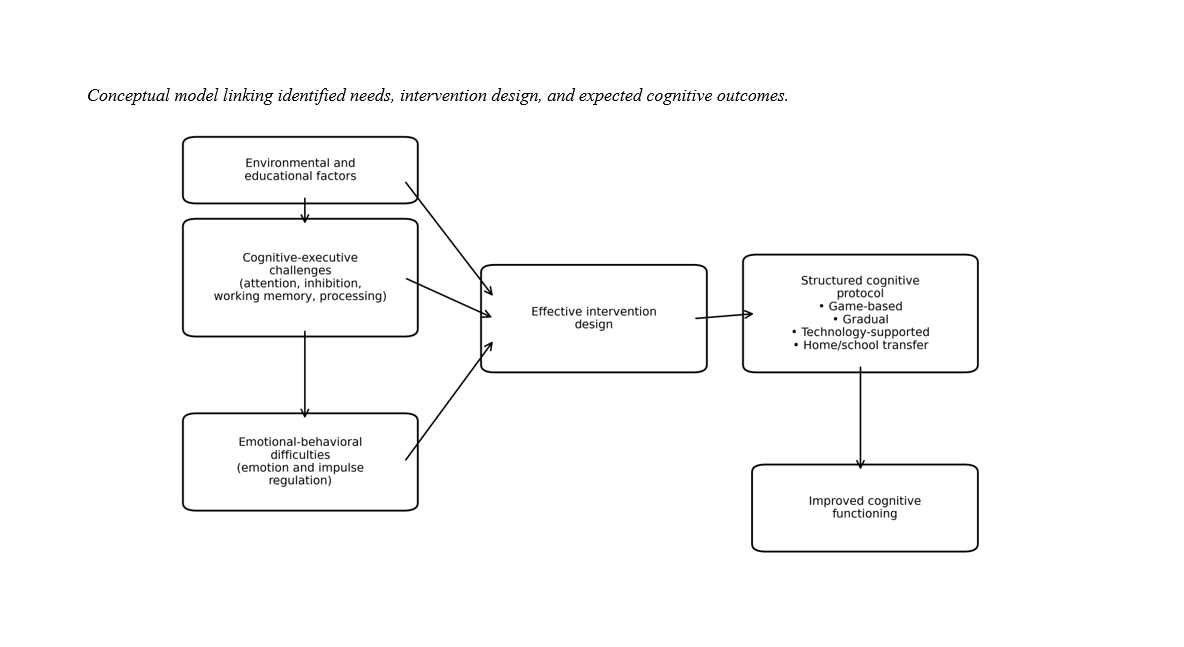
Specific learning disorder is frequently accompanied by weaknesses in executive functioning, sustained attention, inhibitory control, working memory, and cognitive organization. These cognitive vulnerabilities can interfere with academic participation and everyday learning demands, yet many available interventions target isolated skills rather than integrated cognitive needs. This study aimed to develop and examine the content validity of an expert-informed cognitive performance intervention protocol for children with specific learning disorder. A developmental qualitative protocol-development design was used. Semi-structured interviews were conducted with 10 specialists working in specific learning disorder assessment and intervention centers in Qom, Iran. Interview data were analyzed using inductive thematic analysis following Braun and Clarke's six-phase approach. Trustworthiness was supported through triangulation, participant review, and independent coding; intercoder agreement was 0.83. The extracted evidence was then used to construct a 10-session, 45-minute cognitive performance protocol targeting sustained attention, response inhibition, working memory, visual and auditory memory, simultaneous processing, cognitive organization, and emotion regulation. Expert review indicated acceptable content validity, with an overall agreement coefficient of 0.84. The findings support the protocol as a preliminary, content-validated, expert-informed intervention framework rather than evidence of clinical effectiveness. Future studies should examine feasibility, acceptability, and outcome effects through pilot and controlled implementation studies.
Downloads
References
American Psychiatric, A. (2022). Diagnostic and statistical manual of mental disorders (5th , text rev. ed.). American Psychiatric Association Publishing. https://doi.org/10.1176/appi.books.9780890425787
Baddeley, A. (2003). Working memory: looking back and looking forward. Nature Reviews Neuroscience, 4(10), 829-839. https://doi.org/10.1038/nrn1201
Braun, V., & Clarke, V. (2006). Using thematic analysis in psychology. Qualitative Research in Psychology, 3(2), 77-101. https://doi.org/10.1191/1478088706qp063oa
Di Lieto, M. C., Castro, E., Pecini, C., Inguaggiato, E., Cecchi, F., Dario, P., Cioni, G., & Sgandurra, G. (2020). Improving executive functions at school in children with special needs by educational robotics. Frontiers in Psychology, 10, 2813. https://doi.org/10.3389/fpsyg.2019.02813
Flogie, A., Aberšek, B., Kordigel Aberšek, M., Sik Lanyi, C., & Pesek, I. (2020). Development and evaluation of intelligent serious games for children with learning difficulties: Observational study. JMIR Serious Games, 8(2), e13190. https://doi.org/10.2196/13190
Gathercole, S. E., Alloway, T. P., Kirkwood, H. J., Elliott, J. G., Holmes, J., & Hilton, K. A. (2008). Attentional and executive function behaviours in children with poor working memory. Learning and Individual Differences, 18(2), 214-223. https://doi.org/10.1016/j.lindif.2007.10.003
Giofrè, D., Toffalini, E., Altoè, G., & Cornoldi, C. (2017). Intelligence measures as diagnostic tools for children with specific learning disabilities. Intelligence, 61, 140-145. https://doi.org/10.1016/j.intell.2017.01.014
Guba, E. G., & Lincoln, Y. S. (1985). Naturalistic inquiry. Sage. https://doi.org/10.1016/0147-1767(85)90062-8
Kyttälä, M., Kanerva, K., Munter, I., & Björn, P. M. (2019). Working memory resources in children: Stability and relation to subsequent academic skills. Educational Psychology, 39(6), 709-728. https://doi.org/10.1080/01443410.2018.1562046
Putnam, S. P., & Rothbart, M. K. (2006). Development of short and very short forms of the Children's Behavior Questionnaire. Journal of Personality Assessment, 87(1), 102-112. https://doi.org/10.1207/s15327752jpa8701_09
Rothbart, M. K., Ellis, L. K., Rueda, M. R., & Posner, M. I. (2003). Developing mechanisms of temperamental effortful control. Journal of Personality, 71(6), 1113-1144. https://doi.org/10.1111/1467-6494.7106009
Toffalini, E., Giofrè, D., & Cornoldi, C. (2017). Strengths and weaknesses in the intellectual profile of different subtypes of specific learning disorder: A study on 1,049 diagnosed children. Clinical Psychological Science, 5(2), 402-409. https://doi.org/10.1177/2167702616672038
Wiest, G. M., Rosales, K. P., Looney, L., Wong, E. H., & Wiest, D. J. (2022). Utilizing cognitive training to improve working memory, attention, and impulsivity in school-aged children with ADHD and SLD. Brain Sciences, 12(2), 141. https://doi.org/10.3390/brainsci12020141
Downloads
Publication Timeline
- Submitted
- Revised
- Accepted