Designing a Model for the Development of Sport for All Through Modern Technologies in Iraq
Keywords:
Sport for all, modern technologies, Iraq, grounded theory, sport developmentAbstract
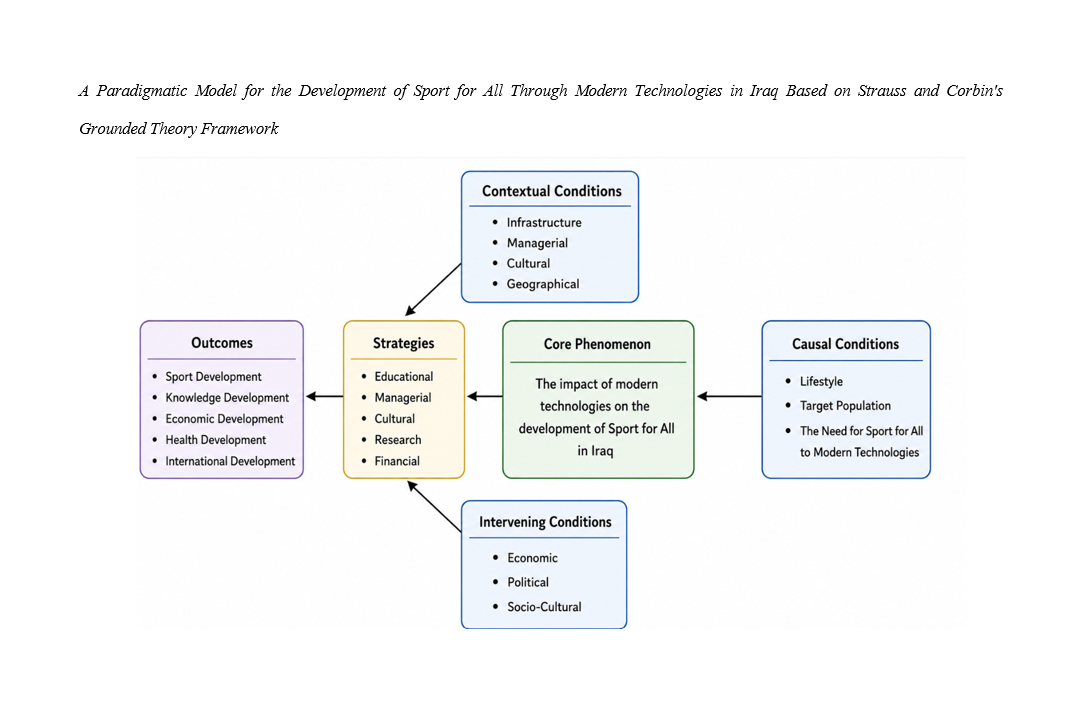
The present study aimed to design a model for the development of sport for all through modern technologies in Iraq. This study sought to identify the influencing factors, executive strategies, and consequences of using modern technologies to expand public participation in sport. This study was applied in terms of purpose and qualitative in terms of data nature. It was conducted using a grounded theory approach based on the Strauss and Corbin model. The research population included sport management experts, university professors with managerial or executive experience, senior managers of sport and youth departments, and managers of sports federations. Purposeful sampling was used and continued until theoretical saturation was reached. Data were collected through semi-structured interviews with 15 experts. Open, axial, and selective coding were used to analyze the data, and the criteria of credibility, transferability, dependability, and confirmability were applied to evaluate data quality. The findings showed that the causal factors of the model included lifestyle, target population, and the need of sport for all for modern technologies. The contextual factors were identified in four areas: infrastructural, managerial, cultural, and geographical. Economic, political, and socio-cultural factors were also identified as intervening factors. The strategies of the model included educational, managerial, cultural, research-based, and financial strategies. The consequences of the model were also classified into five dimensions: sport development, knowledge development, economic development, health development, and international development. The results showed that modern technologies can provide the basis for the sustainable development of sport for all in Iraq by increasing awareness, facilitating access to sports services, improving information management, and strengthening public participation. Therefore, strengthening technological infrastructures, educating managers and citizens, financially supporting companies active in sport technology, and coordinating sports, educational, and media institutions are necessary in Iraq’s sport-for-all policymaking.
Downloads
References
Amini Komijani, H. R., Farahani, A., Goodarzi, M., & Ghorbani, L. (2022). Policy of the tourism industry in the development documents of the Islamic Republic of Iran with emphasis on sports tourism. Applied Research in Sport Management, 11(2), 1-10. https://doi.org/10.30473/arsm.2022.8534
Babazadeh, N., & Najafzadeh, M. R. (2021). The relationship between values and lifestyle with women's sports participation. Sociology of Lifestyle Management, 7(17), 70-91. https://dor.isc.ac/dor/20.1001.1.24237558.1399.5.1.4.0
Chadwick, S. (2022). From utilitarianism and neoclassical sport management to a new geopolitical economy of sport. European Sport Management Quarterly, 22(5), 685-704. https://doi.org/10.1080/16184742.2022.2032251
Fakhrzadeh, H., Djalalinia, S., Mirarefin, M., Arefirad, T., Asayesh, H., Safiri, S., Samavat, T., Mansourian, M., & Qorbani, M. (2016). Prevalence of physical inactivity in Iran: A systematic review. Journal of Cardiovascular and Thoracic Research, 8(3), 92-97. https://doi.org/10.15171/jcvtr.2016.20
Farahani, Z., & Seyedjavadin, S. R. (2022). The impact of using electronic marketing on the performance of sports businesses: Case study of Revolution Sports Complex. Applied Research in Sport Management, 11(2), 50-58. https://doi.org/10.30473/arsm.2022.61397.3590
Fesanghari, J., Norouzi Seyed Hossini, R., Saffari, M., & Kouzechian, H. (2022). Strategies for using new technologies to develop recreational sports: From pilot to commercialization. Sport Management Journal, 14(1), 332-351. https://doi.org/10.22059/jsm.2021.311581.2591
Forberger, S., Bammann, K., Bauer, J., Boll, S., Bolte, G., Brand, T., Hein, A., Koppelin, F., Lippke, S., Meyer, J., Pischke, C. R., Voelcker-Rehage, C., & Zeeb, H. (2017). How to tackle key challenges in the promotion of physical activity among older adults (65+): The AEQUIPA network approach. International Journal of Environmental Research and Public Health, 14(4), Article 379. https://doi.org/10.3390/ijerph14040379
Fozonkhah, P., Shahbazi, M., & Monazami, A. (2021). Identifying strategic disadvantages of developing sport for all: Experts' points of view. Applied Research in Sport Management, 10(2), 101-110. https://doi.org/10.30473/arsm.2021.8237
Frevel, N., Beiderbeck, D., & Schmidt, S. L. (2022). The impact of technology on sports: A prospective study. Technological Forecasting and Social Change, 182, Article 121838. https://doi.org/10.1016/j.techfore.2022.121838
Garamvölgyi, B., Bardocz-Bencsik, M., & Dóczi, T. (2022). Mapping the role of grassroots sport in public diplomacy. Sport in Society, 25(5), 889-907. https://doi.org/10.1080/17430437.2020.1807955
Gholami, A., Zare, A., Ghalavand, A., & Shirali, R. (2017). The study of factors affecting the formation of small and medium-sized institutions in the Iranian sport industry. Applied Research in Sport Management, 6(2), 57-66. https://dor.isc.ac/dor/20.1001.1.23455551.1396.6.2.5.9
Gholami Torkesaluye, S., Zareian, H., Abdollahi, M. H., & Abolhoseini, A. (2023). Identifying the key drivers of the development of sport for all with a structural analysis approach. Sport Management Studies, 15(81), 285-308. https://doi.org/10.22089/smrj.2023.13710.3767
Gil-Espinosa, F. J., Nielsen-Rodríguez, A., Romance, R., & Burgueño, R. (2022). Smartphone applications for physical activity promotion from physical education. Education and Information Technologies, 27(8), 11759-11779. https://doi.org/10.1007/s10639-022-11108-2
Glebova, E., Gerke, A., & Book, R. (2023). The transformational role of technology in sports events. Sports management in an uncertain environment,
Irajpour, A., Mojarrad, N., & Dabbagh Rezaieh, F. (2016). Investigating the role of mass media in the cultural development of Iran's amateur and professional sports. Sport Management and Development, 5(2), 36-52. https://journals.guilan.ac.ir/article_2133.html
Keshkar, S., & Mohammadi, Z. (2022). Marketing strategies for reaching Iranian older adults: A social network based on physical activity promotion. Sport marketing in a global environment: Strategic perspectives,
Lotfi, K., Farzan, F., Khodadadi, M., & Razavi, S. M. H. (2023). Designing a model of recreational sports in the family with a grounded theory approach. Sport Management Studies, 15(79), 83-104. https://doi.org/10.22089/smrj.2021.10406.3393
Lubysheva, L. I., & Pashchenko, L. G. (2022). Modern social contradictions of mass sport. Theory and Practice of Physical Culture, 9, 3-6. https://tpfk.ru/index.php/TPPC/article/view/378
Mamo, Y., Su, Y., & Andrew, D. P. S. (2022). The transformative impact of big data applications in sport marketing: Current and future directions. International Journal of Sports Marketing and Sponsorship, 23(3), 594-611. https://doi.org/10.1108/IJSMS-03-2021-0073
Matolić, T., Jurakić, D., Podnar, H., Radman, I., & Pedišić, Ž. (2023). Promotion of health-enhancing physical activity in the sport sector: A study among representatives of 536 sports organisations from 36 European countries. BMC Public Health, 23, Article 750. https://doi.org/10.1186/s12889-023-15589-9
Mohebi, F., Mohajer, B., Yoosefi, M., Sheidaei, A., Zokaei, H., Damerchilu, B., Rezaei, N., Shafiee, G., Gohari, K., Rezaei, N., Mansourian, M., Larijani, B., & Farzadfar, F. (2019). Physical activity profile of the Iranian population: STEPS survey, 2016. BMC Public Health, 19, Article 1266. https://doi.org/10.1186/s12889-019-7592-5
Moshtaghi, M., Ghasemi, H., & Rasekh, N. (2021). Designing the role of mass media in the development of public sports of the country and its strategies. Sport Management Studies, 13(66), 363-392. https://doi.org/10.22089/smrj.2020.8214.2813
Patel, D., Shah, D., & Shah, M. (2020). The intertwine of brain and body: A quantitative analysis on how big data influences the system of sports. Annals of Data Science, 7(1), 1-16. https://doi.org/10.1007/s40745-019-00239-y
Rahbari, S., Khodayari, A., Honari, H., & Amirtash, A. M. (2021). Codification of effective strategies and consequences of sport for all sponsorship in Iran. Strategic Studies on Youth and Sports, 20(51), 113-134. https://sid.ir/paper/412786/fa
Ramon, X., & Rojas-Torrijos, J. L. (2022). Public service media, sports and cultural citizenship in the age of social media: An analysis of BBC Sport agenda diversity on Twitter. International Review for the Sociology of Sport, 57(6), 918-939. https://doi.org/10.1177/10126902211043995
Rodriguez-Salvador, M., & Castillo-Valdez, P. F. (2021). Integrating science and technology metrics into a competitive technology intelligence methodology. Journal of Intelligence Studies in Business, 11(1), 69-77. https://doi.org/10.37380/jisib.v1i1.696
Shilbury, D., O'Boyle, I., & Ferkins, L. (2016). Towards a research agenda in collaborative sport governance. Sport Management Review, 19(5), 479-491. https://doi.org/10.1016/j.smr.2016.04.004
Torabi, F., & Mohammadi, M. (2023). Institutionalizing the effective factors of the general culture of public sports in society: Case study of Tehran province. Applied Research in Sport Management, 12(2), 15-30. https://doi.org/10.30473/arsm.2023.65980.3719
Woods, J., Hartwell, M., Oldham, L., & House-Niamke, S. (2023). Centering the self, doing the sport, and being the brand: The self-branding of lifestyle athletes on Instagram. International Journal of Sport Communication, 16(2), 159-167. https://doi.org/10.1123/ijsc.2022-0168
Yuldashev, M. (2021). Innovative aspects for healthy lifestyle formation and development of sports. Current Research Journal of Pedagogics, 2(5), 102-107. https://doi.org/10.37547/pedagogics-crjp-02-05-18
Downloads
Publication Timeline
- Submitted
- Revised
- Accepted