Developing and Evaluating a Cultural Model of Environmental Behavior in Iran: An Exploratory Sequential Mixed-Methods Study
Keywords:
environmental behavior, environmental culture, environmental education, environmental ethics, grounded theory, mixed methods, PLS-SEM, public participationAbstract
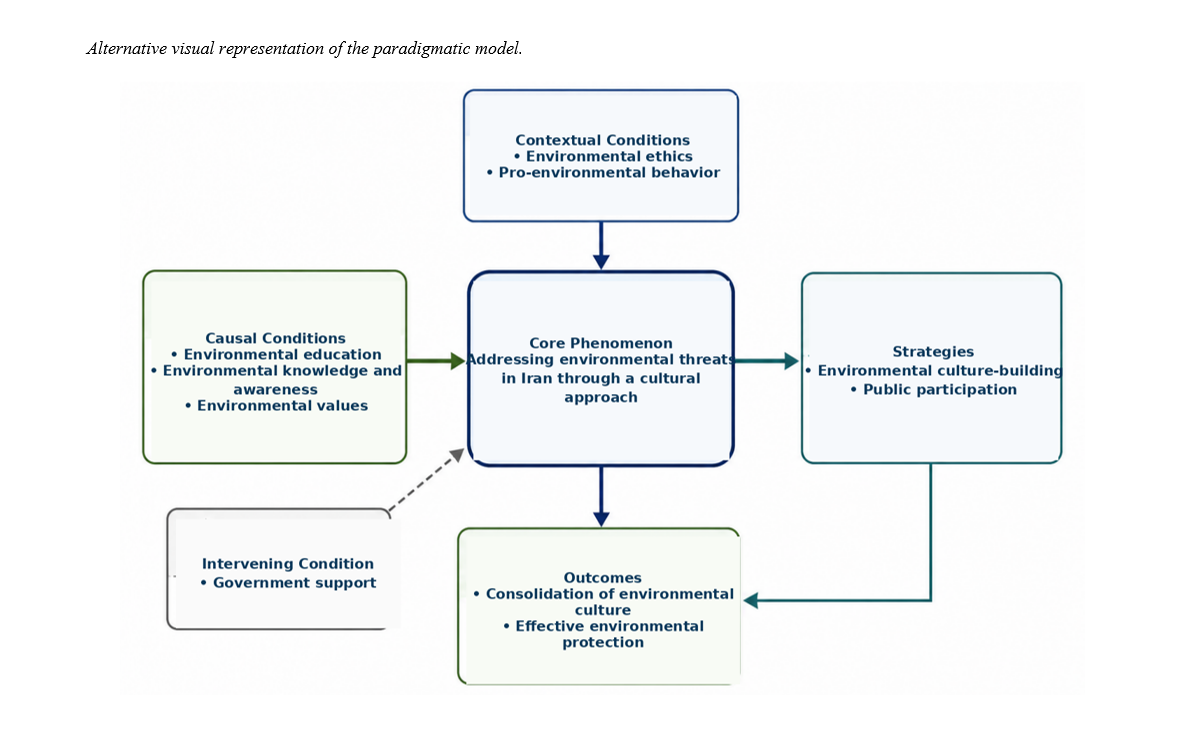
Environmental crises require not only technical and regulatory responses but also sustained changes in citizens’ values, norms, and everyday practices. This exploratory sequential mixed-methods study developed a culturally grounded model for addressing environmental threats in Iran and conducted a preliminary quantitative evaluation of selected model relationships. In the qualitative phase, academic and professional experts were recruited purposively and through snowball sampling, and semi-structured interviews were analyzed through open, axial, and selective coding. The resulting paradigmatic model identified environmental education, knowledge and awareness, and environmental values as causal conditions; environmental ethics and pro-environmental behavior as contextual conditions; government support as an intervening condition; environmental culture-building and public participation as strategies; and consolidation of environmental culture and effective environmental protection as outcomes. In the quantitative phase, 390 residents of District 12 of Tehran completed a questionnaire derived from the qualitative categories and relevant literature. Partial least squares structural equation modeling indicated positive associations of environmental education, environmental values, environmental knowledge and awareness, public participation, and pro-environmental behavior with the capacity to address environmental threats. The primary endogenous construct had R² = .847 and adjusted R² = .842; communality was .390 and redundancy was .330. Because the design was cross-sectional and complete coefficient-level results were not available for every proposed relationship, the findings should be interpreted as preliminary model support rather than causal confirmation. The study highlights the need to connect environmental education with ethical responsibility, participatory opportunities, and institutional support.
Downloads
References
Ajzen, I. (1991). The theory of planned behavior. Organizational Behavior and Human Decision Processes, 50(2), 179-211. https://doi.org/10.1016/0749-5978(91)90020-T
Ardoin, N. M., Bowers, A. W., & Gaillard, E. (2020). Environmental education outcomes for conservation: A systematic review. Biological Conservation, 241, 108224. https://doi.org/10.1016/j.biocon.2019.108224
Creutzig, F., Niamir, L., Bai, X., Callaghan, M., Cullen, J., Díaz-José, J., Figueroa, M., Grubler, A., Lamb, W. F., Leip, A., Masanet, E., Mata, É., Mattauch, L., Minx, J. C., Mirasgedis, S., Mulugetta, Y., Nugroho, S. B., Pathak, M., Perkins, P., . . . Ürge-Vorsatz, D. (2022). Demand-side solutions to climate change mitigation consistent with high levels of well-being. Nature Climate Change, 12, 36-46. https://doi.org/10.1038/s41558-021-01219-y
Gifford, R. (2011). The dragons of inaction: Psychological barriers that limit climate change mitigation and adaptation. American Psychologist, 66(4), 290-302. https://doi.org/10.1037/a0023566
Intergovernmental Panel on Climate, C. (2023). Climate Change 2023: Synthesis Report. Contribution of Working Groups I, II and III to the Sixth Assessment Report of the Intergovernmental Panel on Climate Change.
Kollmuss, A., & Agyeman, J. (2002). Mind the gap: Why do people act environmentally and what are the barriers to pro-environmental behavior? Environmental Education Research, 8(3), 239-260. https://doi.org/10.1080/13504620220145401
Li, X., Liu, Z., & Wuyun, T. (2022). Environmental value and pro-environmental behavior among young adults: The mediating role of risk perception and moral anger. Frontiers in Psychology, 13, 771421. https://doi.org/10.3389/fpsyg.2022.771421
Lou, X., & Li, L. M. W. (2023). The relationship of environmental concern with public and private pro-environmental behaviours: A pre-registered meta-analysis. European Journal of Social Psychology, 53(1), 1-14. https://doi.org/10.1002/ejsp.2879
Meng, Y., Chung, D., & Zhang, A. (2023). The effect of social media environmental information exposure on the intention to participate in pro-environmental behavior. PLoS One, 18(11), e0294577. https://doi.org/10.1371/journal.pone.0294577
Miller, L. B., & Rice, R. E. (2024). (Mis)matched direct and moderating relationships among pro-environmental attitudes, environmental efficacy, and pro-environmental behaviors across and within 11 countries. PLoS One, 19(6), e0304945. https://doi.org/10.1371/journal.pone.0304945
Niu, N., Fan, W., Ren, M., Li, M., & Zhong, Y. (2023). The role of social norms and personal costs on pro-environmental behavior: The mediating role of personal norms. Psychology Research and Behavior Management, 16, 2059-2069. https://doi.org/10.2147/PRBM.S411640
Piao, X., & Managi, S. (2024). Determinants of pro-environmental behaviour: Effects of socioeconomic, subjective, and psychological well-being factors from 37 countries. Humanities and Social Sciences Communications, 11, 1255. https://doi.org/10.1057/s41599-024-03790-z
Saracevic, S., & Schlegelmilch, B. B. (2021). The impact of social norms on pro-environmental behavior: A systematic literature review of the role of culture and self-construal. Sustainability, 13(9), 5156. https://doi.org/10.3390/su13095156
Shen, J., & Zhang, H. (2024). Individuals' social identity and pro-environmental behaviors: Cross-cultural evidence from 48 regions. Sustainability, 16(24), 11299. https://doi.org/10.3390/su162411299
Shipley, N. J., & van Riper, C. J. (2022). Pride and guilt predict pro-environmental behavior: A meta-analysis of correlational and experimental evidence. Journal of Environmental Psychology, 79, 101753. https://doi.org/10.1016/j.jenvp.2021.101753
Steg, L., & Vlek, C. (2009). Encouraging pro-environmental behaviour: An integrative review and research agenda. Journal of Environmental Psychology, 29(3), 309-317. https://doi.org/10.1016/j.jenvp.2008.10.004
Stern, P. C. (2000). Toward a coherent theory of environmentally significant behavior. Journal of Social Issues, 56(3), 407-424. https://doi.org/10.1111/0022-4537.00175
Stern, P. C., Dietz, T., Abel, T., Guagnano, G. A., & Kalof, L. (1999). A value-belief-norm theory of support for social movements: The case of environmentalism. Human Ecology Review, 6(2), 81-97. https://www.jstor.org/stable/24707060
Tamar, M., Wirawan, H., Arfah, T., & Putri, R. P. S. (2021). Predicting pro-environmental behaviours: The role of environmental values, attitudes and knowledge. Management of Environmental Quality: An International Journal, 32(2), 328-343. https://doi.org/10.1108/MEQ-12-2019-0264
Tian, H., & Liu, X. (2022). Pro-environmental behavior research: Theoretical progress and future directions. International Journal of Environmental Research and Public Health, 19(11), 6721. https://doi.org/10.3390/ijerph19116721
United Nations Educational, S., & Cultural, O. (2020). Education for sustainable development: A roadmap. https://unesdoc.unesco.org/ark:/48223/pf0000374802.locale=en
United Nations Environment Programme. (2021). Making peace with nature: A scientific blueprint to tackle the climate, biodiversity and pollution emergencies. https://doi.org/10.18356/9789280738377
United Nations Environment Programme. (2024). Global resources outlook 2024: Bend the trend-Pathways to a liveable planet as resource use spikes. https://mediatum.ub.tum.de/doc/1764930/document.pdf
Zhao, Y., Liu, X., & Han, X. (2024). Enhancing pro-environmental behavior through nature-contact environmental education: An empirical analysis based on randomized controlled experiment design. Frontiers in Environmental Science, 12, 1491780. https://doi.org/10.3389/fenvs.2024.1491780
Downloads
Publication Timeline
- Submitted
- Revised
- Accepted