Identifying and Prioritizing the Dimensions of AI-Enabled Human Resource Empowerment in Government Organizations: Evidence from Semnan Province, Iran
Keywords:
artificial intelligence, human resource empowerment, public organizations, organizational culture, digital leadership, Analytic Hierarchy ProcessAbstract
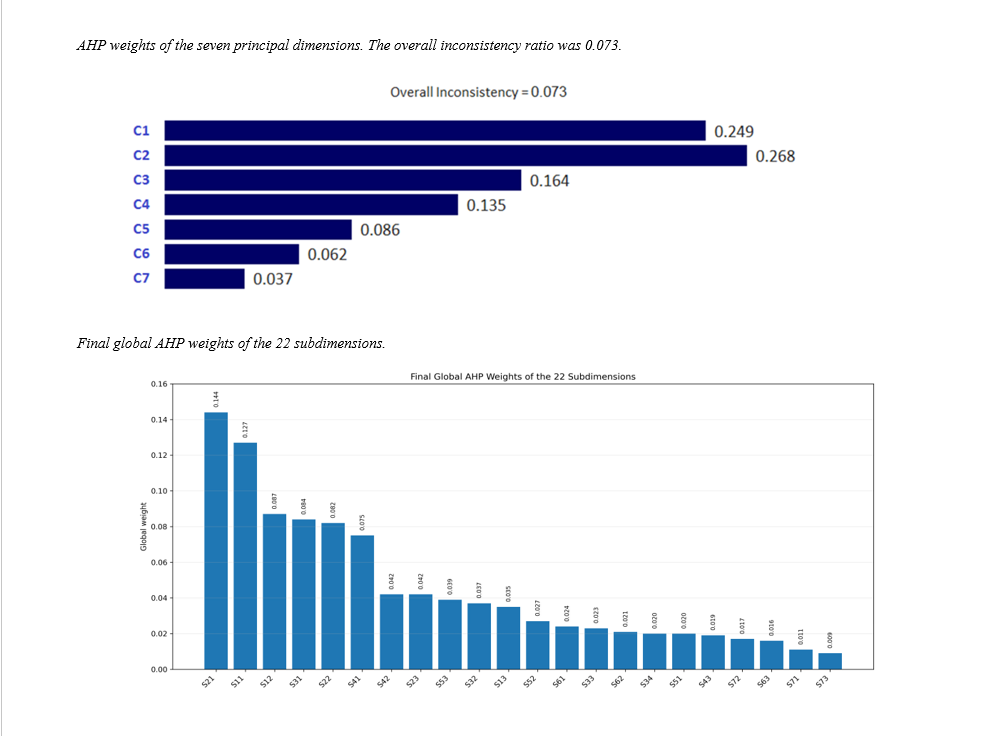
This study identified and prioritized the dimensions of human resource empowerment in the context of artificial intelligence adoption in government organizations in Semnan Province, Iran. An exploratory sequential mixed-methods design was used. In the qualitative phase, semi-structured interviews were conducted with 20 academic and administrative experts selected purposively. The interview data were analyzed thematically to derive the major dimensions and subdimensions of AI-enabled human resource empowerment. In the quantitative prioritization phase, 20 managers and human resource experts completed pairwise comparisons, and the Analytic Hierarchy Process was used to calculate relative weights. Seven major dimensions and 22 subdimensions were identified. Organizational culture and attitudes received the highest weight (0.268), followed by technological infrastructure (0.249), digital competency development (0.164), digital leadership (0.135), AI-enabled human resource processes (0.086), continuous learning and development (0.062), and strategic governance (0.037). The highest-ranked subdimensions were promoting a culture of innovation and digital transformation (0.144), developing digital and computational infrastructure (0.127), creating integrated organizational data repositories (0.087), training employees in data analytics and artificial intelligence (0.084), and promoting acceptance of AI technologies (0.082). AI-enabled employee empowerment in public organizations depends primarily on organizational readiness, technological foundations, and employee capabilities. The proposed framework should be interpreted as a context-specific prioritization model rather than a validated causal model.
Downloads
References
Braun, V., & Clarke, V. (2006). Using thematic analysis in psychology. Qualitative Research in Psychology, 3(2), 77-101. https://doi.org/10.1191/1478088706qp063oa
Brougham, D., & Haar, J. (2018). Smart technology, artificial intelligence, robotics, and algorithms (STARA): Employees' perceptions of our future workplace. Journal of Management & Organization, 24(2), 239-257. https://doi.org/10.1017/jmo.2016.55
Conger, J. A., & Kanungo, R. N. (1988). The empowerment process: Integrating theory and practice. Academy of Management Review, 13(3), 471-482. https://doi.org/10.5465/amr.1988.4306983
Davis, F. D. (1989). Perceived usefulness, perceived ease of use, and user acceptance of information technology. MIS Quarterly, 13(3), 319-340. https://doi.org/10.2307/249008
Dwivedi, Y. K., Hughes, L., Ismagilova, E., & et al. (2021). Artificial intelligence (AI): Multidisciplinary perspectives on emerging challenges, opportunities, and agenda for research, practice and policy. International Journal of Information Management, 57, 101994. https://doi.org/10.1016/j.ijinfomgt.2019.08.002
Gong, Q., Fan, D., & Bartram, T. (2025). Integrating artificial intelligence and human resource management: A review and future research agenda. The International Journal of Human Resource Management, 36(1), 103-141. https://doi.org/10.1080/09585192.2024.2440065
Jarrahi, M. H. (2018). Artificial intelligence and the future of work: Human-AI symbiosis in organizational decision making. Business Horizons, 61(4), 577-586. https://doi.org/10.1016/j.bushor.2018.03.007
Kellogg, K. C., Valentine, M. A., & Christin, A. (2020). Algorithms at work: The new contested terrain of control. Academy of Management Annals, 14(1), 366-410. https://doi.org/10.5465/annals.2018.0174
Khan, A. N., Wang, Y., Khan, N. A., & Ahmad, A. (2025). Digital leadership enhances employee empowerment, techno-work engagement, and sustainability: SEM analysis in public healthcare. INQUIRY, 62, 00469580251317653. https://doi.org/10.1177/00469580251317653
Kim, S. (2025). Strategic human resource management in the era of algorithmic technologies: Key insights and future research agenda. Human Resource Management. https://doi.org/10.1002/hrm.22268
Marler, J. H., & Fisher, S. L. (2013). An evidence-based review of e-HRM and strategic human resource management. Human Resource Management Review, 23(1), 18-36. https://doi.org/10.1016/j.hrmr.2012.06.002
Mergel, I., Edelmann, N., & Haug, N. (2019). Defining digital transformation: Results from expert interviews. Government Information Quarterly, 36(4), 101385. https://doi.org/10.1016/j.giq.2019.06.002
Mikalef, P., & Gupta, M. (2021). Artificial intelligence capability: Conceptualization, measurement calibration, and empirical study on its impact on organizational creativity and firm performance. Information & Management, 58(3), 103434. https://doi.org/10.1016/j.im.2021.103434
Raisch, S., & Krakowski, S. (2021). Artificial intelligence and management: The automation-augmentation paradox. Academy of Management Review, 46(1), 192-210. https://doi.org/10.5465/amr.2018.0072
Saaty, T. L. (2008). Decision making with the analytic hierarchy process. International Journal of Services Sciences, 1(1), 83-98. https://doi.org/10.1504/IJSSCI.2008.017590
Spreitzer, G. M. (1995). Psychological empowerment in the workplace: Dimensions, measurement, and validation. Academy of Management Journal, 38(5), 1442-1465. https://doi.org/10.5465/256865
Taheri, M. (2023). Shaping the future together: The inaugural vision for AI and tech in behavioral and social sciences. AI and Tech in Behavioral and Social Sciences, 1(1), 1-3. https://doi.org/10.61838/kman.aitech.1.1.1
Tambe, P., Cappelli, P., & Yakubovich, V. (2019). Artificial intelligence in human resources management: Challenges and a path forward. California Management Review, 61(4), 15-42. https://doi.org/10.1177/0008125619867910
Thomas, K. W., & Velthouse, B. A. (1990). Cognitive elements of empowerment: An interpretive model of intrinsic task motivation. Academy of Management Review, 15(4), 666-681. https://doi.org/10.5465/amr.1990.4310926
Unesco. (2021). Recommendation on the Ethics of Artificial Intelligence. https://www.unesco.org/en/articles/recommendation-ethics-artificial-intelligence
Venkatesh, V., Morris, M. G., Davis, G. B., & Davis, F. D. (2003). User acceptance of information technology: Toward a unified view. MIS Quarterly, 27(3), 425-478. https://doi.org/10.2307/30036540
Wirtz, B. W., Weyerer, J. C., & Geyer, C. (2019). Artificial intelligence and the public sector-applications and challenges. International Journal of Public Administration, 42(7), 596-615. https://doi.org/10.1080/01900692.2018.1498103
Downloads
Publication Timeline
- Submitted
- Revised
- Accepted