Balanced Scorecard and Performance-Based Budgeting in Healthcare: A Bibliometric Mapping of Research from 2000 to 2024
Keywords:
Balanced scorecard, Bibliometric analysis, Healthcare performance management, Meta-analytic indicators, Performance-based budgeting, Publication trends, VOSviewerAbstract
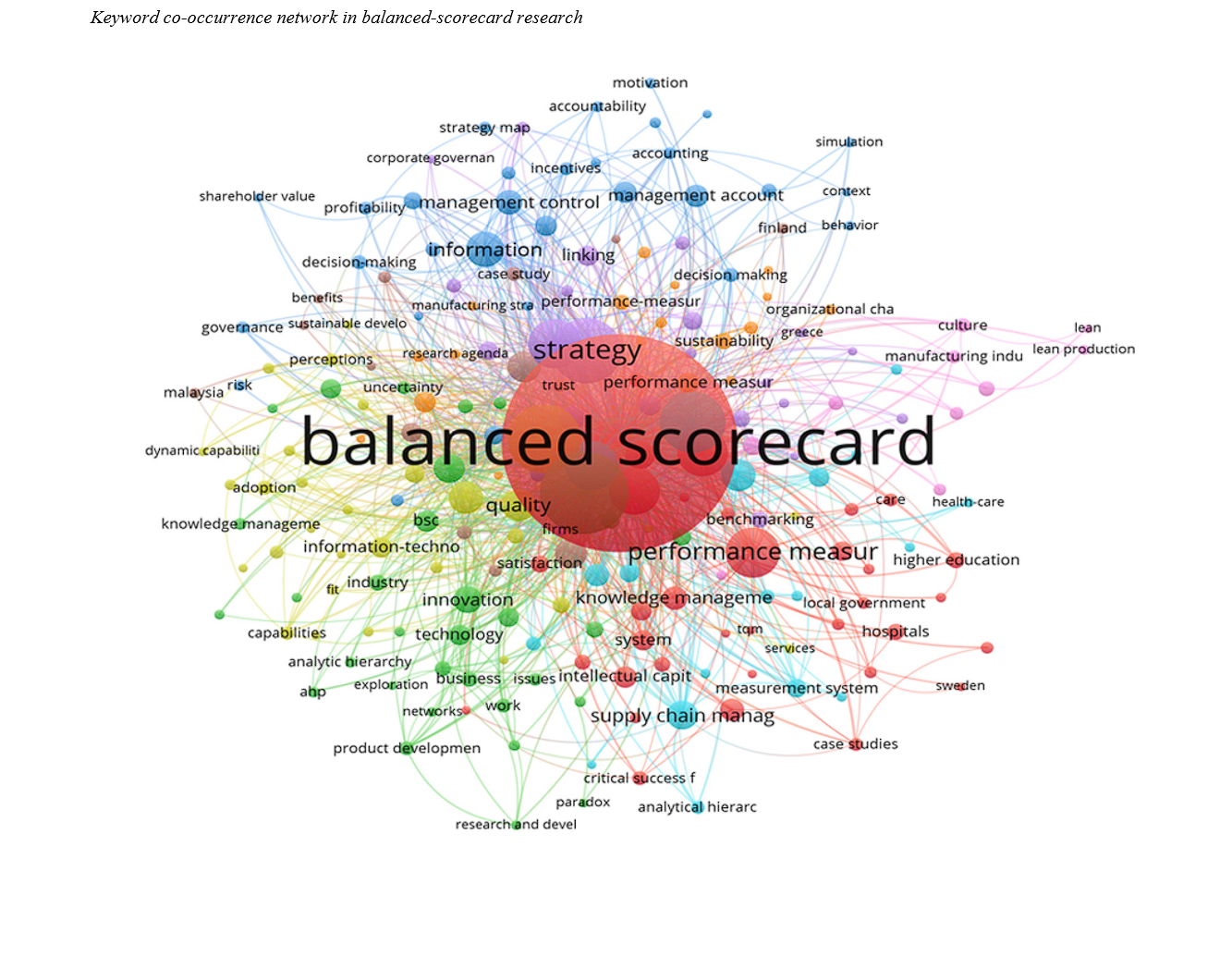
Healthcare organizations require performance-management systems that connect strategic objectives, resource allocation, service quality, and evidence-informed decision-making. The balanced scorecard (BSC) and performance-based budgeting (PBB) offer complementary approaches to aligning organizational strategy with financial and non-financial performance. This study mapped the growth and conceptual structure of research on BSC and PBB in healthcare between 2000 and 2024. A bibliometric corpus of 280 articles was compiled from Web of Science, Google Scholar, SID, Noormags, and Ensani. Publication trends, keyword co-occurrence, and thematic clusters were examined using VOSviewer. Publication output increased gradually until 2018 and accelerated thereafter, reaching 43 articles in 2024. BSC occupied the central position in the co-word network and was strongly connected with strategy, performance measurement, management control, information, knowledge management, innovation, technology, healthcare, hospitals, and decision-making. Five thematic areas were identified: strategy and performance measurement; information and decision-making; innovation and technology; operations and supply chain; and public-sector and healthcare applications. The literature has progressively positioned BSC as a strategic performance-governance framework rather than solely a reporting instrument. Its connection with PBB may support more integrated approaches to resource allocation and organizational accountability in healthcare. Digital and artificial-intelligence applications remain prospective research directions rather than findings directly established by this review.
Downloads
References
Anvari, A., Moghimi, R., & Anvari, A. (2020). Clarification and evaluation of the effectiveness of company strategies using a combined BSC and FAHP model. Transactions on Data Analysis in Social Science, 2(2), 102–111. https://doi.org/10.47176/TDASS.2020.102
Donthu, N., Kumar, S., Mukherjee, D., Pandey, N., & Lim, W. M. (2021). How to conduct a bibliometric analysis: An overview and guidelines. Journal of Business Research, 133, 285–296. https://doi.org/10.1016/j.jbusres.2021.04.070
Kaplan, R. S., & Norton, D. P. (1992). The balanced scorecard: Measures that drive performance. Harvard Business Review, 70(1), 71–79.
Kaplan, R. S., & Norton, D. P. (1996). The balanced scorecard: Translating strategy into action. Harvard Business School Press.
Robinson, M. (Ed.). (2007). Performance budgeting: Linking funding and results. Palgrave Macmillan.
U.S. Food and Drug Administration. (2022). Clinical Decision Support Software: Guidance for Industry and Food and Drug Administration Staff. FDA.
van Eck, N. J., & Waltman, L. (2010). Software survey: VOSviewer, a computer program for bibliometric mapping. Scientometrics, 84, 523–538. https://doi.org/10.1007/s11192-009-0146-3
Waltman, L., van Eck, N. J., & Noyons, E. C. M. (2010). A unified approach to mapping and clustering of bibliometric networks. Journal of Informetrics, 4(4), 629–635. https://doi.org/10.1016/j.joi.2010.07.002
World Health Organization. (2024). Ethics and governance of artificial intelligence for health: Guidance on large multi-modal models. World Health Organization.
Downloads
Publication Timeline
- Submitted
- Revised
- Accepted