Associations of Perceived Couple-Communication Quality and Internet Use With Marital Satisfaction Among Married Adults
Keywords:
marital satisfaction, couples’ communication quality, internet use, social media, couplesAbstract
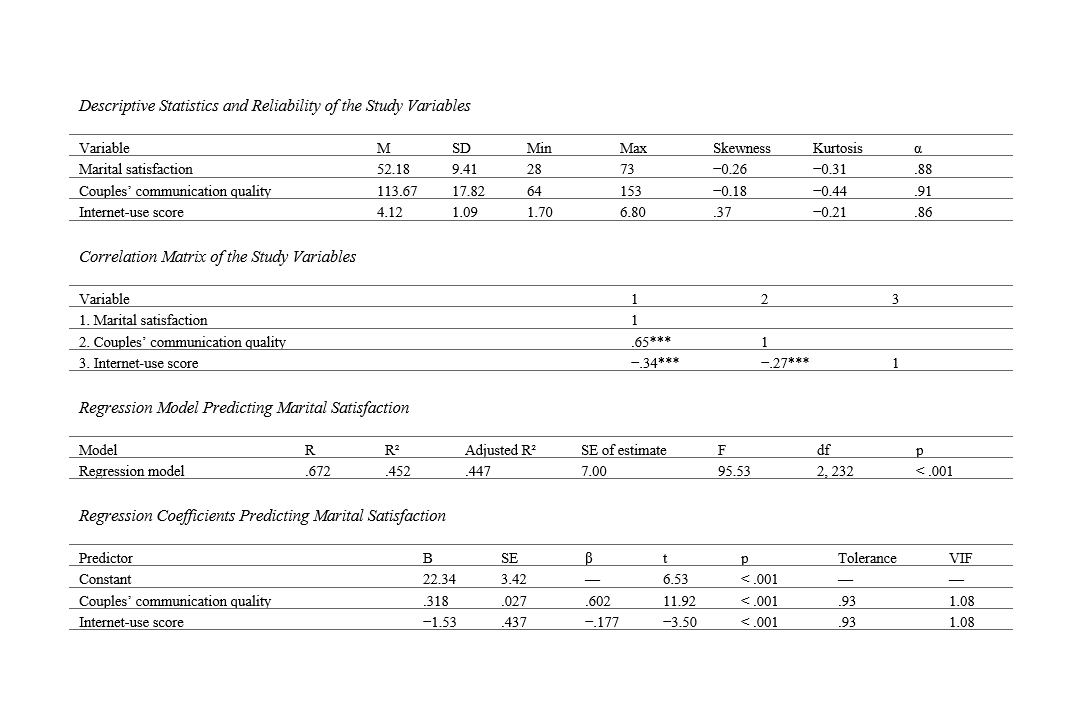
This cross-sectional predictive-correlational study examined the associations of perceived couple-communication quality and internet use with marital satisfaction among married adults in Ardabil, Iran. The target population comprised all married adults living in Ardabil during the Iranian calendar year 1404 (2025–2026), of whom 235 were recruited through convenience sampling. Participants completed the ENRICH Marital Satisfaction Questionnaire, the Couples’ Communication Quality Questionnaire, and the Internet Use Questionnaire. Data were analyzed using descriptive statistics, Pearson correlations, and simultaneous multiple regression. Perceived couple-communication quality was positively associated with marital satisfaction, whereas the internet-use score was negatively associated with marital satisfaction. Together, the two predictors explained 45.2% of the variance in marital satisfaction. Communication quality (β = .602) was the strongest positive predictor, while the internet-use score had a smaller significant negative coefficient. These findings suggest that the quality of couple interactions is more consequential for marital satisfaction than the internet-use score. Communication-skills training and deliberate, mutually agreed management of technology during shared couple time may therefore be useful components of counseling and relationship-enrichment programs.
Downloads
References
Azarnik, M., Rafeipour, A., Hatami, M., & Mousavi, M. S. (2024). Communication and sexual skills in marital functioning and satisfaction and reduced marital conflicts among Iranian couples: A systematic review. Journal of Education and Health Promotion, 13, 202. https://doi.org/10.4103/jehp.jehp_1182_22
Darvizeh, Z., Ranjbar, Z., & Naraghizadeh, A. (2011). The comparison of quantity and quality of internet use in relation to mental health and academic achievement of students in Tehran. Psychological Studies, 7(2), 11-36. https://doi.org/10.22051/psy.2011.1547
Denecker, F., Frackowiak, M., Perneel, S., Vanden Abeele, M., Ponnet, K., & De Marez, L. (2024). A dyadic multimethod study of 'partner phubbing,' smartphone conflict, and relationship quality in opposite-sex couples from Belgium. Current Psychology, 43(44), 34109-34126. https://doi.org/10.1007/s12144-024-06893-7
Esfahani, B., Falihi, R., Jafaripour, A., & Rostapishe, S. (2024). Evaluating the impact of attachment-based couple therapy intervention on enhancing emotional security in marital relationships. Quarterly of Experimental and Cognitive Psychology, 1(1), 222-236. https://doi.org/10.61838/qecp.5936
Fowers, B. J., & Olson, D. H. (1989). ENRICH Marital Inventory: A Discriminant Validity and Cross-Validation Assessment. Journal of marital and family therapy, 15(1), 65-79. https://doi.org/10.1111/j.1752-0606.1989.tb00777.x
Ghahremani, F., Ahmadi Doulabi, M., Eslami, M., & Shekarriz-Foumani, R. (2017). Correlation between number and gender composition of children and marital satisfaction in women presenting to health centers in Tehran-Iran, 2015. Iranian Journal of Psychiatry and Behavioral Sciences, 11(2), e9598. https://doi.org/10.5812/ijpbs.9598
Karaman, H. B., & Arslan, C. (2024). The mediating role of social media addiction and phubbing in basic psychological needs in relationships and relationship satisfaction. Frontiers in Psychology, 15, 1291638. https://doi.org/10.3389/fpsyg.2024.1291638
Khoshkam, S., Ahmadi, S. A., & Abedi, M. R. (2007). The effect of communication training on the relationships of newly married couples in Isfahan. Counseling Research and Developments, 6(24), 123-136.
Lee, T. H., & Ng, T. K. (2024). Stress communication, communication satisfaction, and relationship satisfaction: An actor-partner interdependence mediation model. The Journal of Social Psychology, 164(5), 755-768. https://doi.org/10.1080/00224545.2023.2171848
Ni, N., Ahrari, S., Zaremohzzabieh, Z., Zarean, M., & Roslan, S. (2025). A meta-analytic study of partner phubbing and its antecedents and consequences. Frontiers in Psychology, 16, 1561159. https://doi.org/10.3389/fpsyg.2025.1561159
Rashidi Vala, Z., Mohammadi Ghasrian, N., Kooshki, N., & Mazaheri, M. (2024). Examining the impact of couples therapy on improving emotional and social communication among couples. Cognition, Behavior, Learning, 1(2), 127-141. https://doi.org/10.61838/jcbl.1.2.8
Riahifar, M., Abdollahi, A., & Vakili, S. (2024a). Determining the relationship between interpersonal mindfulness, social media use, and marital satisfaction. Journal of Assessment and Research in Applied Counseling, 6(4), 65-74. https://doi.org/10.61838/kman.jarac.6.4.8
Riahifar, M., Abdollahi, A., & Vakili, S. (2024b). The moderating role of interpersonal mindfulness in the relationship between social media use and marital satisfaction. Applied Family Therapy Journal, 5(3), 14-23. https://doi.org/10.61838/kman.aftj.5.3.2
Roberts, J. A., & David, M. E. (2024). Partner phubbing and relationship satisfaction among high and low reward romantic partners: An expectancy violations theory perspective. International Journal of Human-Computer Interaction, 40(18), 5493-5502. https://doi.org/10.1080/10447318.2023.2238341
Shahmirzad, N., Miller, W. B., Farid, M., & Akbari Kamrani, M. (2025). Communication skills, understanding intellectual coordination and marital satisfaction on childbearing motivation in reproductive-age Iranian couples. Scientific Reports, 15, 6278. https://doi.org/10.1038/s41598-025-90358-9
Tan, K., Jarnecke, A. M., & South, S. C. (2023). Social anhedonia, communication, and marital satisfaction in newlywed couples. Journal of Personality, 91(5), 1239-1252. https://doi.org/10.1111/jopy.12798
Togar, E. M., Vanden Abeele, M. M. P., van Wijk, C. H., Yasin, R. M., & Antheunis, M. L. (2023). An actor-partner model of partner phubbing, mobile phone conflict, and relationship satisfaction between romantic partners in Liberia. Journal of Social and Personal Relationships, 40(10), 3147-3170. https://doi.org/10.1177/02654075231169701
Downloads
Publication Timeline
- Submitted
- Revised
- Accepted