Investigating the Effect of Dynamic Information Technology Capabilities and Competitive Intelligence on the Sustainable Competitive Advantage of Managers of Non-Governmental Secondary Schools in West Azerbaijan Province: The Mediating Role of Organizational Agility
Keywords:
Dynamic Information Technology Capabilities, Competitive Intelligence, Sustainable Competitive Advantage, Organizational Agility, Non-Governmental SchoolsAbstract
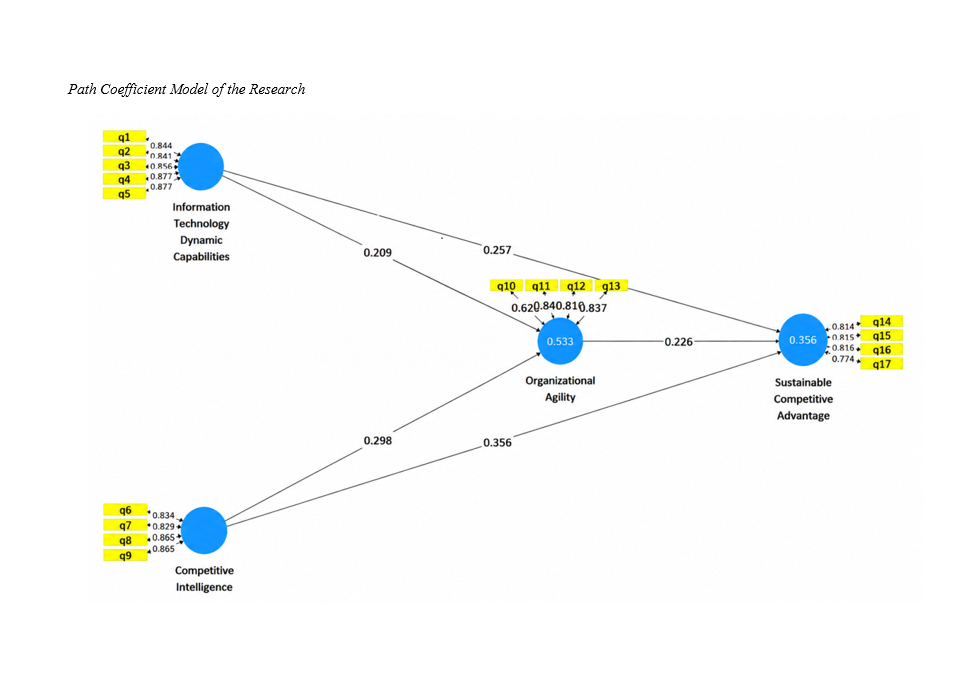
The purpose of the present study was to investigate the effect of dynamic information technology capabilities and competitive intelligence on the sustainable competitive advantage of managers of non-governmental secondary schools in West Azerbaijan Province, with organizational agility as a mediating variable. In terms of purpose, the study was applied, and in terms of methodology, it employed a descriptive-correlational design based on structural equation modeling. The statistical population consisted of 263 managers of non-governmental secondary schools in West Azerbaijan Province, from whom 170 participants were selected as the sample using the Cochran formula and random sampling. Data were collected using four standardized instruments: the Dynamic Information Technology Capabilities Questionnaire developed by Mikalef and Pateli (2017), consisting of 20 items; the Competitive Intelligence Questionnaire developed by Rouach and Santi (2001), consisting of 22 items; the Sustainable Competitive Advantage Questionnaire developed by Singh (2012), consisting of 22 items; and the Organizational Agility Questionnaire developed by Sharifi and Yang (2000), consisting of 28 items. Data were analyzed using partial least squares structural equation modeling (PLS-SEM) and SmartPLS software, and the direct and indirect relationships among the variables, as well as the mediating role of organizational agility, were examined. The findings of the structural model indicated that dynamic information technology capabilities and competitive intelligence had positive and significant effects on organizational agility and sustainable competitive advantage. Furthermore, organizational agility had a positive and significant effect on sustainable competitive advantage. The results of the indirect effects analysis also indicated that organizational agility played a significant mediating role in the relationship between dynamic information technology capabilities and sustainable competitive advantage, as well as in the relationship between competitive intelligence and sustainable competitive advantage. Accordingly, creating sustainable competitive advantage in non-governmental schools cannot be achieved solely through access to technology or the possession of competitive information; rather, it requires the ability of schools to transform these capabilities into rapid, flexible, and context-appropriate responses to environmental changes. Overall, the findings emphasize the importance of simultaneously developing technological capabilities, competitive intelligence, and organizational agility to enhance the sustainable competitive position of non-governmental secondary schools.
Downloads
References
Ahmadpour Dariani, M., Abdoli Mohammadabadi, T., & Sokhdari, K. (2020). Designing a model for developing dynamic capabilities in dynamic businesses. Journal of Entrepreneurship Development, 13(2), 161-180. https://jed.ut.ac.ir/article_77831.html
Arin-far, M., & Rajabi-farjad, H. (2022). Investigating the effect of information technology mechanisms on organizational agility with the role of IT ambidexterity. Journal of Information Technology Management, 8(2), 169-202. https://www.sid.ir/fa/VEWSSID/J_pdf/4045514010207.pdf
Awwad, A. S., Ababneh, O. M. A., & Karasneh, M. (2022). The mediating impact of information technology capabilities on the association between dynamic capabilities and organizational agility: The case of the Jordanian information technology sector. Global Journal of Flexible Systems Management, 23(3), 315-330. https://doi.org/10.1007/s40171-022-00303-2
Bagherzadeh, M. S. N., Kafashpour, A., Bahrami, M., & Pourkian, S. (2023). Investigating the effect of strategic leadership on creating sustainable competitive advantage with the mediating role of innovation ambidexterity and human capital in companies of Ferdowsi University of Mashhad Science and Technology Park. Journal of Transformation Management, 15(1), 99-125. https://www.sid.ir/paper/1509815/fa
Bayat, F., Gholichli, B., & Alam Tabriz, A. (2020). Customer orientation capability and competitive advantage with service innovation. Journal of Business Management Explorations, 12(24), 239-257. https://www.sid.ir/paper/962664/fa
Cepeda, J., & Arias-Pérez, J. (2019). Information technology capabilities and organizational agility: The mediating effects of open innovation capabilities. Multinational Business Review, 27(2), 198-216. https://doi.org/10.1108/MBR-11-2017-0088
Chahal, H., & Dhiman, S. (2024). Mediating role of capabilities in organisational agility and performance in higher education institutions: Insights from J&K, India. International Journal of Educational Management, 38(7), 1862-1883. https://doi.org/10.1108/IJEM-08-2023-0397
Chamba, L. T., & Chinakidzwa, M. (2023). Resources and capability needs for learning and assessment in dynamic technological environments: Evidence from schools in Harare. Journal of Advanced Education and Sciences, 3(3), 5-15.
Chinakidzwa, M., & Chamba, L. T. (2024). Resources and capability needs for teaching in dynamic technological environments: Evidence from schools in Harare, Zimbabwe. E-Learning and Digital Media, 21(6), 593-609. https://doi.org/10.1177/20427530231217040
Delbaze, H., Sadeh, E., & Paghe, A. (2021). Investigating the sustainable competitive advantage model based on technological entrepreneurial capabilities in cooperative companies of dairy industries of Mazandaran and Golestan provinces. Journal of Entrepreneurship in Agriculture, 8(1), 85-104. https://www.sid.ir/fileserver/jf/39930-284582-x-1367235.pdf
Forghani, M., & Shafiei, N. (2024). Investigating the effect of open innovation on sustainable competitive advantage considering the role of organizational learning, ambidexterity and knowledge management capacity: A case study of Yazd University of Medical Sciences. Journal of New Research Approaches in Management and Accounting, 8(29), 1252-1271. https://www.majournal.ir/index.php/ma/article/view/2757
Mehrani, H., Sadeghi, M., & Safdari, M. (2019). Investigating the relationship between dimensions of systems thinking and business intelligence and competitive intelligence of industrial companies' managers. Journal of Andisheh Amad, 18(68), 107-141. https://www.sid.ir/paper/379144/fa
Miri, M., Mehdati, M. M., & Hassanvand Mofrad, M. (2023). Explaining the organizational agility approach based on religious teachings. Journal of Religion, Spirituality and Management, 10(19), 55-82. https://journals.rihu.ac.ir/article_1934.html
Prabowo, H., Sriwidadi, T., & Ikhsan, R. B. (2021). The influence of dynamic capability on sustainable competitive advantage. The Journal of Asian Finance, Economics and Business, 8(6), 949-959.
Probojakti, W., Utami, H. N., Prasetya, A., & Riza, M. F. (2024). Building sustainable competitive advantage in banking through organizational agility. Sustainability, 16(19), 8327. https://doi.org/10.3390/su16198327
Rahimi, M. (2020). The mediating role of organizational agility in the relationship between knowledge management and organizational innovation among employees of District 10 Municipality of Shiraz. Journal of Applied Research in Management and Accounting, 20, 23-33. https://www.sid.ir/paper/527545/fa
Rahmani, M., Zakipour, M., & Abedi, H. (2022). Investigating the effect of dynamic information technology capabilities on the performance of small and medium enterprises through the moderating role of transformational leadership and the mediating role of innovative capability. Journal of Management and Sustainable Development Studies, 2(3), 81-108. https://www.noormags.ir/view/en/articlepage/2028543/
Rezaeimanesh, H. A., Rezaeian, A., AmirKabiri, A. R., & Fartoukzadeh, H. R. (2021). Determining effective components on achieving sustainable competitive advantage through business intelligence. Journal of Business Management, 52, 174-193. https://www.noormags.ir/view/en/articlepage/2010484/
Safavi, S., Piran, A., & Taherzadeh Mousavian, S. F. (2021). Investigating the relationship between competitive intelligence and employee empowerment and organizational responsiveness of Tehran Science and Technology Parks staff. Journal of New Research in Entrepreneurship Management and Business Development, 2, 261-288. https://www.noormags.ir/view/en/articlepage/1800396/
Satar, A., Al Musadieq, M., & Hutahayan, B. (2023). Enhancing sustainable competitive advantage: The role of dynamic capability and organizational agility in technology and knowledge management: Indonesian Stock Exchange evidence. International Journal of Operations and Quantitative Management, 29(2), 431-457.
Shamsi Goshki, S., Yazdani, H. R., Hajipour, B., & Soltani, M. (2020). Designing a strategic agility framework with dynamic capabilities approach: Examining the role of thinking, strategic learning and IT capability. Journal of Interdisciplinary Studies in Strategic Knowledge, 6(4), 387-414. http://journals.sndu.ac.ir/article_1201.html?lang=en
Tayebi Abolhasani, S. A., & Ebrahimi, M. (2019). Rethinking the concept of dynamic capabilities. Journal of International Business Management, 2(1), 101-147. https://www.sid.ir/paper/268547/fa
Van Hoang, D., Thi Hien, N., Van Thang, H., Nguyen Truc Phuong, P., & Thi-Thuy Duong, T. (2025). Digital capabilities and sustainable competitive advantages: The case of emerging market manufacturing small and medium-sized enterprises. SAGE Open, 15(2), 21582440251329967. https://doi.org/10.1177/21582440251329967
Yavari, M., Jafari, P., Gholighorchian, N., & Zamani, A. (2022). Presenting a model for promoting competitive intelligence of top industrial universities in Tehran: A case study of Sharif, Amirkabir and Khajeh Nasir Toosi Universities of Technology. Iranian Journal of Engineering Education, 24(96), 31-51. https://www.sid.ir/paper/1084470/fa
Zarif, E., Khalili, A. R., & Ranjbar, M. (2023). Investigating the effect of human resource development on sustainable competitive advantage with the mediating role of organizational innovation: A case study of Parsian Gas Refining Company. Journal of Human Resource Training and Development, 4(3), 67-81.
Downloads
Publication Timeline
- Submitted
- Revised
- Accepted