Media Literacy and Scientific Thinking: The Mediating Role of Science Learning Motivation among Lower Secondary School Students
Keywords:
media literacy, scientific thinking, science learning motivation, lower secondary education, mediation analysisAbstract
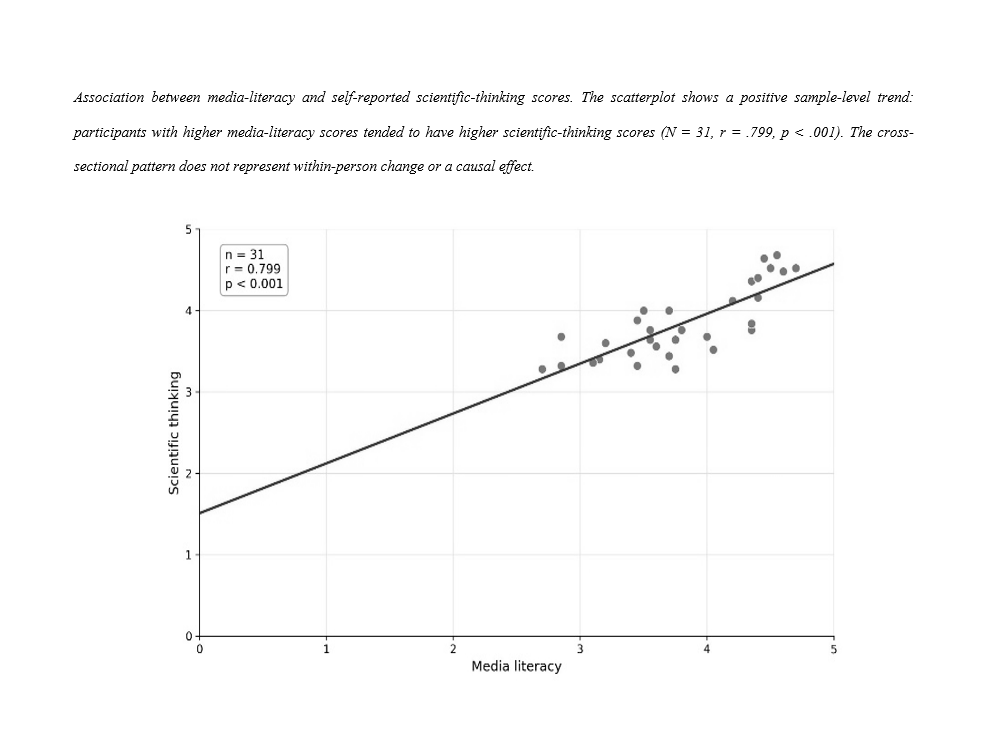
Media-rich environments have expanded adolescents’ access to scientific information while also increasing exposure to unsupported claims and misinformation. This exploratory pilot study examined associations among self-reported media literacy, science learning motivation, and scientific-thinking tendencies in 31 students in Grades 7–9. Participants completed an anonymous online 65-item researcher-developed questionnaire comprising media literacy (20 items), scientific-thinking tendencies (25 items), and science learning motivation (20 items), each rated on a five-point scale. Pearson correlations, simple and multiple linear regression, and a 5,000-resample bootstrap analysis were used. Media-literacy scores correlated with science-learning-motivation scores (r = .730) and scientific-thinking scores (r = .799); motivation also correlated with scientific-thinking scores (r = .767), all p < .001. Media literacy predicted motivation (B = .554, β = .730, t = 5.755, p < .001, R² = .533). In the adjusted model, media literacy (B = .392, β = .510, p = .002) and motivation (B = .400, β = .395, p = .013) were associated with scientific-thinking scores (R² = .710). The estimated indirect association was .221 (95% bootstrap CI [.020, .447]). Because the sample was small and non-probability based, all measures were collected concurrently by self-report, and the newly assembled instrument had not undergone full psychometric validation, these estimates should be interpreted as preliminary score associations rather than causal or population-level effects.
Downloads
References
Deci, E. L., & Ryan, R. M. (2000). The "what" and "why" of goal pursuits: Human needs and the self-determination of behavior. Psychological Inquiry, 11(4), 227-268. https://doi.org/10.1207/S15327965PLI1104_01
Hobbs, R. (2010). Digital and Media Literacy: A Plan of Action. Aspen Institute. https://www.aspeninstitute.org/wp-content/uploads/2010/11/Digital_and_Media_Literacy.pdf
Hobbs, R. (2017). Create to learn: Introduction to digital literacy. Wiley. https://doi.org/10.1002/9781394260201
Kubsch, M., Fortus, D., Neumann, K., Nordine, J., & Krajcik, J. (2023). The interplay between students' motivational profiles and science learning. Journal of Research in Science Teaching, 60(1), 3-25. https://doi.org/10.1002/tea.21789
Kuhn, D., & Franklin, S. (2006). The second decade: What develops in cognition? Cognitive Development, 21(2), 157-162. https://doi.org/10.1016/j.cogdev.2006.01.003
Livingstone, S. (2004). Media literacy and the challenge of new information and communication technologies. The Communication Review, 7(1), 3-14. https://doi.org/10.1080/10714420490280152
Nacaroğlu, O., Kızkapan, O., & Demir, H. (2025). Middle school students' motivations and learning competencies in science: Mediating role of digital literacy. Psychology in the Schools, 62(5), 1475-1487. https://doi.org/10.1002/pits.23400
Pintrich, P. R. (2003). A motivational science perspective on the role of student motivation in learning and teaching contexts. Journal of Educational Psychology, 95(4), 667-686. https://doi.org/10.1037/0022-0663.95.4.667
Potter, W. J. (2019). Media literacy (9th ed.). SAGE Publications. https://books.google.com/books?hl=en&lr=&id=aeyoDwAAQBAJ&oi=fnd&pg=PP1&dq=Potter,+W.+J.+(2019).+Media+literacy,+SAGE+Publications.++&ots=AzK0NrLMyV&sig=YBgz-G9OiKdyRTcjwPOxMKM9WuE
Ryan, R. M., & Deci, E. L. (2020). Intrinsic and extrinsic motivation from a self-determination theory perspective: Definitions, theory, practices, and future directions. Contemporary Educational Psychology, 61, 101860. https://doi.org/10.1016/j.cedpsych.2020.101860
Tuan, H. L., Chin, C. C., & Shieh, S. H. (2005). The development of a questionnaire to measure students' motivation towards science learning. International Journal of Science Education, 27(6), 639-654. https://doi.org/10.1080/0950069042000323737
Zhang, F., Bae, C. L., Broda, M. D., & Koenka, A. C. (2023). Factor structure of student science-learning motivation: Evidence from TIMSS U.S. data. Sustainability, 15(17), 13230. https://doi.org/10.3390/su151713230
Zimmerman, C. (2007). The development of scientific thinking skills in elementary and middle school. Developmental Review, 27(2), 172-223. https://doi.org/10.1016/j.dr.2006.12.001
Downloads
Publication Timeline
- Submitted
- Revised
- Accepted