Designing and Validating a Neuromarketing-Informed Model of the Effects of Banking Service Advertising on Customer Preferences: A Mixed-Methods Study
Keywords:
Neuromarketing, Banking advertising, Customer preferences, Grounded theory, Structural equation modelingAbstract
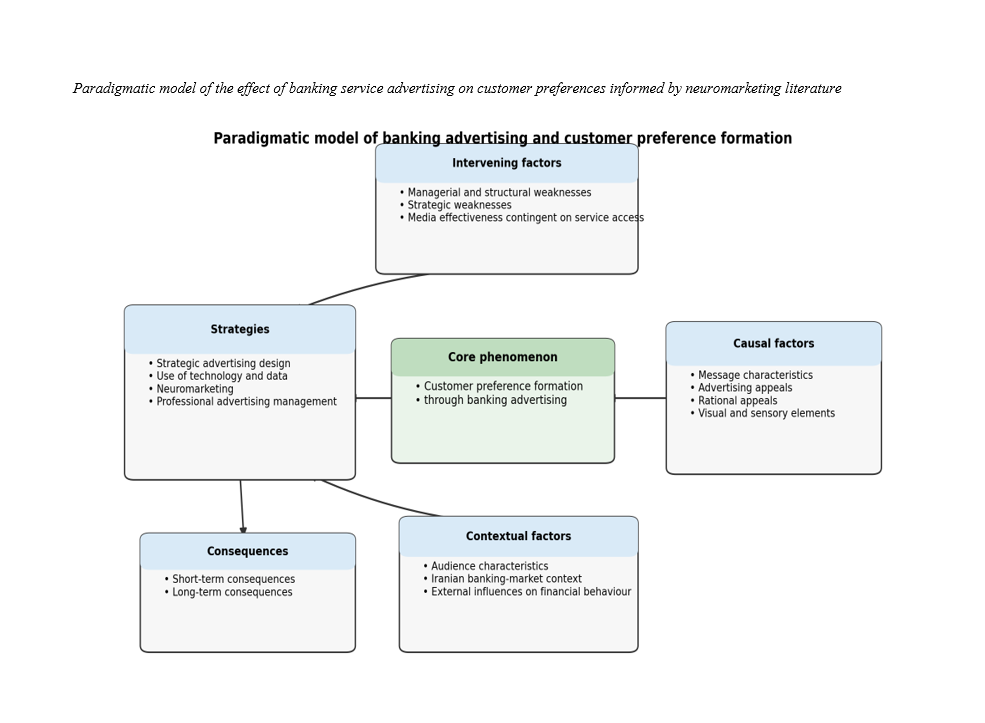
Given the growing role of banking services advertising in shaping customer perceptions and preferences, coupled with the paucity of research on the underlying mechanisms of advertising impact through a neuromarketing perspective, this study aimed to design and explain the process of banking advertising impact and customer preference formation. A sequential mixed-methods approach was employed. In the qualitative phase, semi-structured interviews were conducted with 19 domain experts, and data were analyzed using systematic Grounded Theory via MAXQDA software. This led to the identification of "customer preference formation" as the core category, framed within cognitive mechanisms, implicit memory, emotional processing, causal, contextual, and intervening conditions, as well as strategies and outcomes. In the quantitative phase, the qualitative model was validated through a two-wave longitudinal survey design ($n = 384$ per wave), with data analyzed using Structural Equation Modeling via SmartPLS. The qualitative findings informed the proposed theoretical framework. The quantitative analysis supported the hypothesized effect of causal factors on customer preference formation (beta = 0.744) and identified longitudinal relationships among selected constructs. The estimated moderating effect was negative (beta = -0.271). However, the high correlations between several constructs and the path coefficient exceeding 1.0 indicate that the longitudinal structural estimates should be interpreted cautiously. The study proposes an integrative, context-specific framework for understanding the relationship between banking advertising and customer preferences. The model offers preliminary guidance for advertising strategy, although its measurement distinctiveness and longitudinal estimates require further validation.
Downloads
References
Alsharif, A. H., & Mohd Isa, S. (2024). Revolutionizing consumer insights: The impact of fMRI in neuromarketing research. Future Business Journal, 10, Article 79. https://doi.org/10.1186/s43093-024-00371-z
Alsharif, A. H., Salleh, N. Z. M., Abdullah, M., Khraiwish, A., & Ashaari, A. (2023). Neuromarketing tools used in the marketing mix: A systematic literature and future research agenda. SAGE Open, 13(1), 1-23. https://doi.org/10.1177/21582440231156563
Amiri, S., & Davari, A. (2022). Analyzing the driving and inhibiting factors of neuromarketing in advertising: A cognitive approach. New Marketing Research, 12(1), 89-107. https://doi.org/10.22108/nmrj.2021.130428.2535
Ariely, D., & Berns, G. S. (2010). Neuromarketing: The Hope and Hype of Neuroimaging in Business. Nature Reviews Neuroscience, 11(4), 284-292. https://doi.org/10.1038/nrn2795
Corbin, J., & Strauss, A. (2008). Basics of qualitative research: Techniques and procedures for developing grounded theory (3rd ed.). SAGE Publications. https://doi.org/10.4135/9781452230153
Guba, E. G., & Lincoln, Y. S. (1985). Naturalistic inquiry. SAGE Publications. https://doi.org/10.1016/0147-1767(85)90062-8
Gupta, R., Kapoor, A. P., & Verma, H. V. (2025). Exploring consumer neuroscience in marketing research: Theoretical foundations, methodological aspects, and future research directions. Journal of Marketing Theory and Practice, 1-27. https://doi.org/10.1080/10696679.2025.2493816
Hair, J. F., Hult, G. T. M., Ringle, C. M., & Sarstedt, M. (2014). A Primer on Partial Least Squares Structural Equation Modeling (PLS-SEM). Sage Publications. https://doi.org/10.54055/ejtr.v6i2.134
Harris, J. M., Ciorciari, J., & Gountas, J. (2018). Consumer neuroscience for marketing researchers. Journal of Consumer Behaviour, 17(3), 239-252. https://doi.org/10.1002/cb.1710
Henseler, J., Ringle, C. M., & Sarstedt, M. (2015). A new criterion for assessing discriminant validity in variance-based structural equation modeling. Journal of the Academy of Marketing Science, 43(1), 115-135. https://doi.org/10.1007/s11747-014-0403-8
Hosseini, S. A. (2023). Analysis of brain responses to marketing stimuli using EEG signals in neuromarketing applications. Computational Intelligence in Electrical Engineering, 14(1), 135-150. https://doi.org/10.22108/isee.2022.130154.1503
Javor, A., Koller, M., Lee, N., Chamberlain, L., & Ransmayr, G. (2013). Neuromarketing and consumer neuroscience: Contributions to neurology. BMC Neurology, 13, Article 13. https://doi.org/10.1186/1471-2377-13-13
Kontot, K., Hamali, J., & Abdullah, F. (2016). Determining factors of customers' preferences: A case of deposit products in Islamic banking. Procedia - Social and Behavioral Sciences, 224, 167-175. https://doi.org/10.1016/j.sbspro.2016.05.435
Kotler, P., Keller, K. L., & Cunningham, P. H. (2008). A framework for marketing management (Canadian ed.). Pearson Prentice Hall.
Kumar, S. (2015). Neuromarketing: The new science of advertising. Universal Journal of Management, 3(12), 524-531. https://doi.org/10.13189/ujm.2015.031208
Lajante, M., Droulers, O., Derbaix, C., & Poncin, I. (2020). Looking at aesthetic emotions in advertising research through a psychophysiological perspective. Frontiers in Psychology, 11, Article 553100. https://doi.org/10.3389/fpsyg.2020.553100
Lee, N., Broderick, A. J., & Chamberlain, L. (2007). What is "neuromarketing"? A discussion and agenda for future research. International Journal of Psychophysiology, 63(2), 199-204. https://doi.org/10.1016/j.ijpsycho.2006.03.007
Montakhab Madani, M., Rahmati Ghaffari, Y., Yousefzadeh Chabok, S., & Saberi Haghighat, R. A. (2025). Neural responses to native advertising based on cognitive and behavioral components: A neuromarketing approach. Intelligent Marketing Management, 6(2), 138-170. https://www.magiran.com/paper/2873943
Morin, C. (2011). Neuromarketing: The new science of consumer behavior. Society, 48(2), 131-135. https://doi.org/10.1007/s12115-010-9408-1
Nazari Ghazvini, S., Vakil Al-Raaya, Y., & Bin Baharoon Ahbas, R. (2022). The role of electroencephalography (EEG) in neuromarketing research and consumer behavior. Proceedings of the Fourth National Conference and the First International Conference on New Studies in Entrepreneurship and Business Management, Semnan, Iran.
Pilelienė, L., Alsharif, A. H., & Alharbi, I. B. (2022). Scientometric analysis of scientific literature on neuromarketing tools in advertising. Baltic Journal of Economic Studies, 8(5), 1-12. https://doi.org/10.30525/2256-0742/2022-8-5-1-12
Rahili, M., Shirkhodaei, M., Namdartejari, S., & Farzan, F. (2020). Neuromarketing: Investigating the effect of color on brain waves in the frontal region with emphasis on the role of gender: A case study of enamel-painted plates. Organizational Resource Management Research, 10(1), 93-112. https://sid.ir/paper/369380/fa
Salari Far, M., Vakil Al-Raaya, Y., Danaei, A., Riazi, G., & Mora Angarasia, J. (2021). Comparison of cognitive processes in men and women during purchasing: Investigating the effect of brand using eye-tracking technology. Journal of Business Management, 12(2), 422-435. https://doi.org/10.22059/jibm.2019.282704.3523
Shakeri, S., Norouzi Seyedhosseini, R., & Farahani, H. (2025). A systematic review of neuromarketing and its tools in Iran. New Marketing Research, 15(4), 31-72. https://doi.org/10.22108/nmrj.2025.145340.3192
Stanton, S. J., Sinnott-Armstrong, W., & Huettel, S. A. (2017). Neuromarketing: Ethical implications of its use and potential misuse. Journal of Business Ethics, 144(4), 799-811. https://doi.org/10.1007/s10551-016-3059-0
Stasi, A., Songa, G., Mauri, M., Ciceri, A., Diotallevi, F., Nardone, G., & Russo, V. (2018). Neuromarketing empirical approaches and food choice: A systematic review. Food Research International, 108, 650-664. https://doi.org/10.1016/j.foodres.2017.11.049
Strauss, A., & Corbin, J. (1998). Basics of qualitative research: Techniques and procedures for developing grounded theory (2nd ed.). SAGE Publications. https://www.academia.edu/download/47236857/Basics_of_Qualitative_Research__Techniques_and_Procedures_for_Developing_Grounded_Theory.pdf
Venkatraman, V., Dimoka, A., Pavlou, P. A., Vo, K., Hampton, W., Bollinger, B., Hershfield, H. E., Ishihara, M., & Winer, R. S. (2015). Predicting Advertising Success Beyond Traditional Measures: New Insights from Neurophysiological Methods and Market Response Modeling. Journal of Marketing Research, 52(4), 436-452. https://doi.org/10.1509/jmr.13.0593
Publication Timeline
- Submitted
- Revised
- Accepted