Modeling the Implementation of Third-Generation Universities Based on Technological Transformation and Innovation: A Grounded Theory Approach at Mazandaran University of Medical Sciences
Keywords:
Third-Generation University; Technological Transformation; Innovation; Medical University; Grounded TheoryAbstract
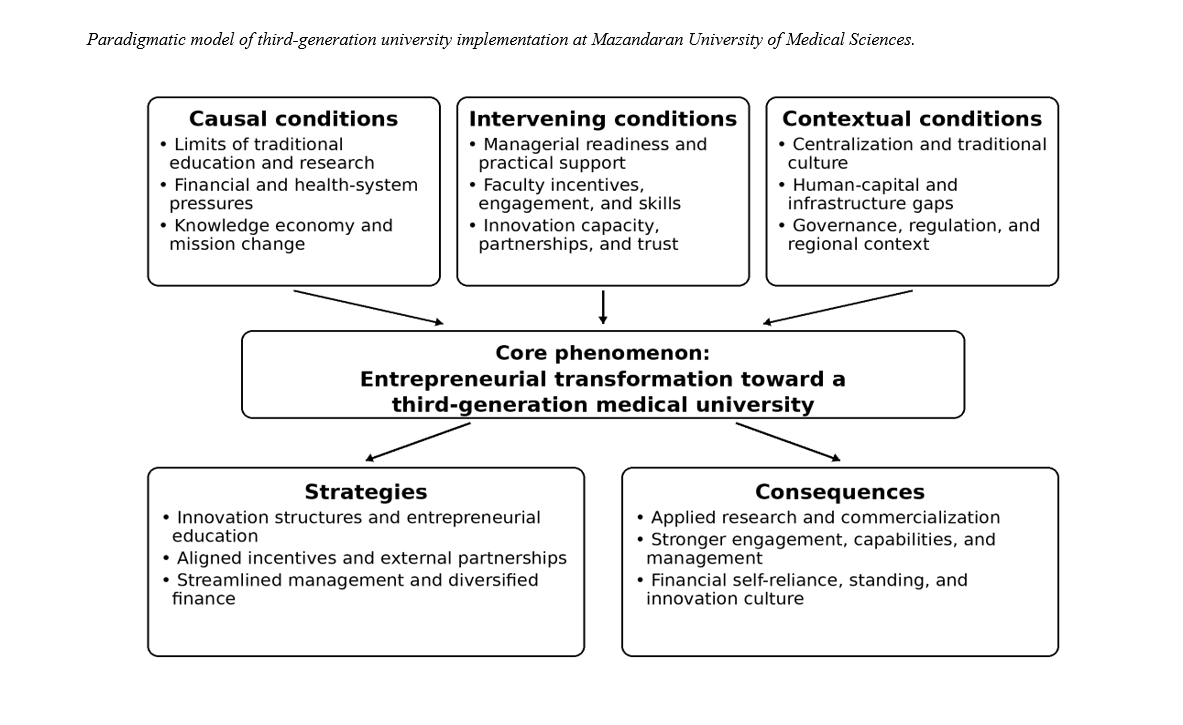
This study aimed to develop a model for implementing a third-generation university based on technological transformation and innovation at Mazandaran University of Medical Sciences. The study was applied in purpose and qualitative in design. Using the grounded theory approach of Strauss and Corbin, data were collected in 2021 through semi-structured interviews with 15 faculty members and university managers at Mazandaran University of Medical Sciences. Data were analyzed through open, axial, and selective coding using MAXQDA to identify causal, contextual, and intervening conditions, strategies, and consequences and to develop the study's paradigmatic model. The findings showed that implementation of a third-generation university was influenced by causal conditions including the inefficiency of traditional educational and research models, economic pressures, the increasing complexity of health-system needs, the emergence of the knowledge-based economy, and the need to redefine the university mission. Contextual conditions included a centralized and bureaucratic structure, a teaching- and publication-oriented culture, limited entrepreneurial skills, insufficient technological infrastructure, managerial instability, complex regulations, regional characteristics, and weak institutional interactions. Key intervening conditions included managerial attitudes and support, faculty responses, incentive and promotion systems, institutional capacity for innovation, external collaboration, executive capabilities, and organizational trust and learning. The identified strategies emphasized entrepreneurship and innovation structures, educational reform, incentive systems, university-industry-society linkages, human-resource empowerment, managerial reengineering, financial diversification, and an innovation-oriented culture. The consequences included improved research effectiveness, knowledge commercialization, stronger university-society and health-system interaction, enhanced capabilities, improved management, greater financial self-reliance, improved institutional standing, and a stronger culture of innovation and organizational learning. The core category was 'entrepreneurial transformation of the medical university toward the third generation.'
Downloads
References
Audretsch, D. B. (2014). From the entrepreneurial university to the university for the entrepreneurial society. The Journal of Technology Transfer, 39(3), 313-321. https://doi.org/10.1007/s10961-012-9288-1
Clark, B. R. (1998). Creating entrepreneurial universities: Organizational pathways of transformation. Pergamon Press. https://eric.ed.gov/?id=ED421938
Cunningham, J. A., Menter, M., & O'Kane, C. (2018). Value creation in the quadruple helix: A micro level conceptual model of principal investigators as value creators. R&D Management, 48(1), 136-147. https://doi.org/10.1111/radm.12310
Etzkowitz, H. (2003). Research groups as 'quasi-firms': The invention of the entrepreneurial university. Research Policy, 32(1), 109-121. https://doi.org/10.1016/S0048-7333(02)00009-4
Etzkowitz, H., & Leydesdorff, L. (2000). The dynamics of innovation: From National Systems and 'Mode 2' to a Triple Helix of university-industry-government relations. Research Policy, 29(2), 109-123. https://doi.org/10.1016/S0048-7333(99)00055-4
Etzkowitz, H., & Zhou, C. (2017). The Triple Helix: University-industry-government innovation and entrepreneurship. Routledge. https://doi.org/10.4324/9781315620183
Gibbons, M., Limoges, C., Nowotny, H., Schwartzman, S., Scott, P., & Trow, M. (1994). The new production of knowledge: The dynamics of science and research in contemporary societies. SAGE. https://www.torrossa.com/gs/resourceProxy?an=5017649&publisher=FZ7200
Guerrero, M., Siegel, D., Terjesen, S., Feldman, M., & Lockett, A. (2024). Assessing the impact of university innovation and entrepreneurial ecosystems: Managerial and policy implications. Academy of Management Perspectives, 38(4), 441-452. https://doi.org/10.5465/amp.2024.0282
Guerrero, M., Urbano, D., & Fayolle, A. (2016). Entrepreneurial activity and regional competitiveness: Evidence from European entrepreneurial universities. The Journal of Technology Transfer, 41(1), 105-131. https://doi.org/10.1007/s10961-014-9377-4
Lincoln, Y. S., & Guba, E. G. (1985). Naturalistic inquiry. SAGE. https://books.google.com/books?hl=en&lr=&id=2oA9aWlNeooC&oi=fnd&pg=PA7&dq=Lincoln,+Y.+S.+and+E.+G.+Guba+(1985).+Naturalistic+inquiry,+SAGE.+%09&ots=0vsvXaU7us&sig=JOQaYVNoYCfbvNhU2cni6pkxRiY
Rothaermel, F. T., Agung, S. D., & Jiang, L. (2007). University entrepreneurship: A taxonomy of the literature. Industrial and Corporate Change, 16(4), 691-791. https://doi.org/10.1093/icc/dtm023
Strauss, A., & Corbin, J. (1998). Basics of qualitative research: Techniques and procedures for developing grounded theory (2nd ed.). SAGE. https://www.academia.edu/download/47236857/Basics_of_Qualitative_Research__Techniques_and_Procedures_for_Developing_Grounded_Theory.pdf
Wissema, J. G. (2009). Towards the third generation university: Managing the university in transition. Edward Elgar Publishing. https://doi.org/10.4337/9781848446182
Wright, M., Siegel, D. S., & Mustar, P. (2017). An emerging ecosystem for student start-ups. The Journal of Technology Transfer, 42(4), 909-922. https://doi.org/10.1007/s10961-017-9558-z
Publication Timeline
- Submitted
- Revised
- Accepted