Developing a Digital Governance and Policy-Making Model to Enhance Educational System Resilience in the Face of Crises: A Grounded Theory Study
Keywords:
digital governance; educational policy-making; educational resilience; digital transformation; educational technology; crisis management; grounded theoryAbstract
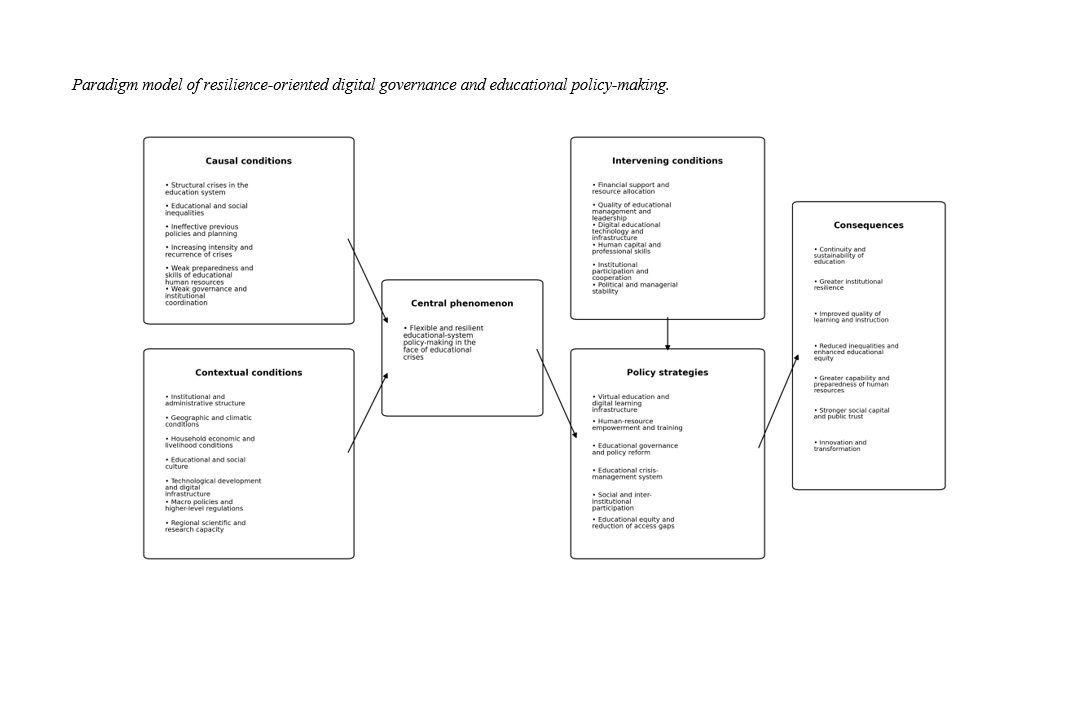
This applied qualitative study aimed to develop a digital governance and policy-making model to enhance the resilience of the educational system in the face of crises. A grounded-theory approach based on the Strauss and Corbin paradigm was used. The study population comprised senior educational managers and policymakers, crisis-management experts, university faculty members, school and district administrators, experienced educational personnel, and other experts in education and crisis management in Mazandaran Province, Iran. Participants were selected purposively on the basis of theoretical saturation. Semi-structured interviews were conducted with 15 experts; theoretical saturation was reached after approximately 12 interviews, and interviewing continued to the fifteenth participant to strengthen data adequacy. Data were organized and analyzed in MAXQDA through open, axial, and selective coding. The findings showed that policy-making for educational system resilience is shaped by causal, contextual, and intervening conditions. The main causal conditions were structural crises in the education system, educational and social inequalities, ineffective past policies and planning, the increasing intensity and recurrence of natural and social crises, weak preparedness and skills among educational human resources, and weak governance and institutional coordination. Contextual conditions involved the institutional and administrative structure of education, geographic and climatic conditions, household economic circumstances, educational and social culture, digital infrastructure, higher-level policies and regulations, and regional scientific capacity. Intervening conditions included financial support and resource allocation, the quality of educational management and leadership, digital technology and infrastructure, human capital and professional skills, institutional participation, and political and managerial stability. Six policy strategies were identified: developing virtual education and digital learning infrastructure, empowering educational human resources, reforming educational governance and policy structures, developing an educational crisis-management system, strengthening social and inter-institutional participation, and promoting educational equity while reducing access gaps. Consequences included continuity of education during crises, greater institutional resilience, improved learning quality, reduced inequalities, stronger human-resource preparedness, greater social capital and public trust, and educational innovation and transformation. The resulting paradigm model positions flexible, participatory, future-oriented, and risk-informed policy-making as the central mechanism through which educational systems can sustain essential functions and adapt under crisis conditions.
Downloads
References
Ahmady, S., Shahbazi, S., & Heidari, M. (2020). Transition to virtual learning during the coronavirus disease-2019 crisis in Iran: Opportunity or challenge? Disaster Medicine and Public Health Preparedness, 14(3), e11-e12. https://doi.org/10.1017/dmp.2020.142
Aitsi-Selmi, A., Murray, V., Wannous, C., Dickinson, C., Johnston, D., Kawasaki, A., Stevance, A. S., & Yeung, T. (2016). Reflections on a science and technology agenda for 21st century disaster risk reduction. International Journal of Disaster Risk Science, 7, 1-29. https://doi.org/10.1007/s13753-016-0081-x
Ansell, C., & Gash, A. (2008). Collaborative governance in theory and practice. Journal of Public Administration Research and Theory, 18(4), 543-571. https://doi.org/10.1093/jopart/mum032
Bonfield, C. A., Salter, M., Longmuir, A., Benson, M., & Adachi, C. (2020). Transformation or evolution? Education 4.0, teaching and learning in the digital age. Higher Education Pedagogies, 5(1), 223-246. https://doi.org/10.1080/23752696.2020.1816847
Darling-Hammond, L., Hyler, M. E., & Gardner, M. (2017). Effective teacher professional development. Learning Policy Institute. https://doi.org/10.54300/122.311
Francis, D. V., & Weller, C. E. (2022). Economic inequality, the digital divide, and remote learning during COVID-19. The Review of Black Political Economy, 49(1), 41-60. https://doi.org/10.1177/00346446211017797
Golden, A. R., Srisarajivakul, E. N., Hasselle, A. J., Pfund, R. A., & Knox, J. (2023). What was a gap is now a chasm: Remote schooling, the digital divide, and educational inequities resulting from the COVID-19 pandemic. Current Opinion in Psychology, 52, 101632. https://doi.org/10.1016/j.copsyc.2023.101632
Harris, A., & Jones, M. (2020). COVID 19 - school leadership in disruptive times. School Leadership & Management, 40(4), 243-247. https://doi.org/10.1080/13632434.2020.1811479
Heydari, M., Mousazadeh, Y., Salmani, R., & Mehraeen, E. (2023). Assessment of virtual education during the COVID-19 pandemic from the perspective of faculty members and students: A cross-sectional descriptive study in northwest Iran. BMC Medical Education, 23, 398. https://doi.org/10.1186/s12909-023-04378-y
Hodges, C., Moore, S., Lockee, B., Trust, T., & Bond, A. (2020). The difference between emergency remote teaching and online learning. Educause Review. https://er.educause.edu/articles/2020/3/the-difference-between-emergency-remote-teaching-and-online-learning
Holling, C. S. (1973). Resilience and stability of ecological systems. Annual Review of Ecology and Systematics, 4, 1-23. https://doi.org/10.1146/annurev.es.04.110173.000245
Reimers, F. M., & Schleicher, A. (2020). A framework to guide an education response to the COVID-19 pandemic of 2020. OECD Publishing. https://doi.org/10.1787/6ae21003-en
Strauss, A., & Corbin, J. (1998). Basics of qualitative research: Techniques and procedures for developing grounded theory (2nd ed.). Sage. https://www.academia.edu/download/47236857/Basics_of_Qualitative_Research__Techniques_and_Procedures_for_Developing_Grounded_Theory.pdf
Unesco. (2021). Reimagining our futures together: A new social contract for education.
Vicente, I., Pastor, J. M., & Soler, Á. (2021). Improving educational resilience in the OECD countries: Two convergent paths. Journal of Policy Modeling, 43(6), 1149-1166. https://doi.org/10.1016/j.jpolmod.2021.09.007
Vincent-Lancrin, S., Cobo Romaní, C., & Reimers, F. M. (2022). How learning continued during the COVID-19 pandemic: Global lessons from initiatives to support learners and teachers. OECD Publishing. https://doi.org/10.1787/bbeca162-en
Weick, K. E., & Sutcliffe, K. M. (2011). Managing the unexpected: Resilient performance in an age of uncertainty (2nd ed.). Jossey-Bass. https://books.google.com/books?hl=en&lr=&id=GU55MJOp1OcC&oi=fnd&pg=PP1&dq=Weick,+K.+E.+and+K.+M.+Sutcliffe+(2011).+Managing+the+unexpected:+Resilient+performance+in+an+age+of+uncertainty,+Jossey-Bass.+%09&ots=0HA3gdzVKn&sig=-_3iDYr11Dg5Iex73wFrJuWDqcM
World Bank. (2024). Ensuring learning continuity during crises: Applying lessons from the COVID-19 pandemic to shape resilience and adaptability. https://www.worldbank.org/en/results/2024/10/30/learning-education-continuity-during-crises-covid19
World Bank Unesco Unicef. (2021). The state of the global education crisis: A path to recovery.
Zhao, Y. (2020). COVID-19 as a catalyst for educational change. Prospects, 49(1-2), 29-33. https://doi.org/10.1007/s11125-020-09477-y
Publication Timeline
- Submitted
- Revised
- Accepted