Application of Artificial Intelligence in Transforming Marketing Strategies in Sports Tourism in Iraq
Keywords:
Sports tourism, digital marketing, artificial intelligence, digital ecosystem development, information technology infrastructureAbstract
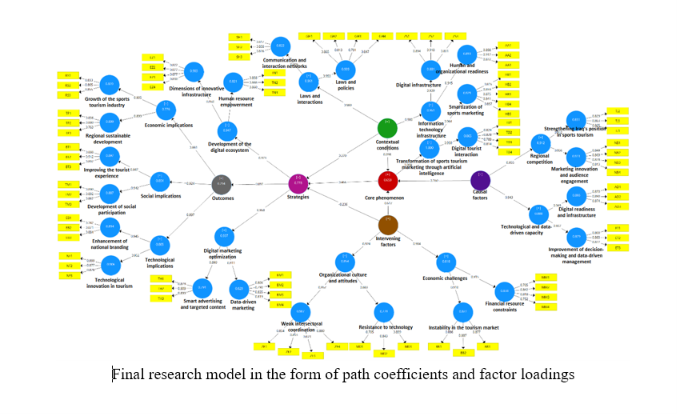
This study aimed to examine the role of artificial intelligence in transforming sports tourism marketing in Iraq. The research adopted a quantitative approach based on structural equation modeling, and data were collected through a questionnaire and analyzed using the partial least squares method (PLS-SEM) in Smart PLS software. The results indicated that causal conditions, including increasing competition among tourism destinations, growing demand for personalized experiences, and the expansion of emerging technologies, have a positive and significant effect on the formation of the central phenomenon, namely the transformation of AI-based marketing. In contrast, contextual conditions did not show a significant effect on the central phenomenon, whereas intervening factors had a negative and significant impact on it. Furthermore, the central phenomenon had a positive and significant effect on the development of marketing strategies, and these strategies, in turn, generated positive economic, managerial, and experiential outcomes for the sports tourism industry. Overall, the findings demonstrate that artificial intelligence, by enabling data-driven, predictive, and intelligent marketing, plays a crucial role in enhancing competitiveness, improving tourist experiences, and promoting the sustainable development of sports tourism.
Downloads