Modeling Bank Failure with System Dynamics and Genetic-Algorithm Optimization: Evidence from Bank Melli Iran
Keywords:
bank failure, system dynamics, genetic algorithm, accumulated losses, bank capital, Article 141, Bank Melli IranAbstract
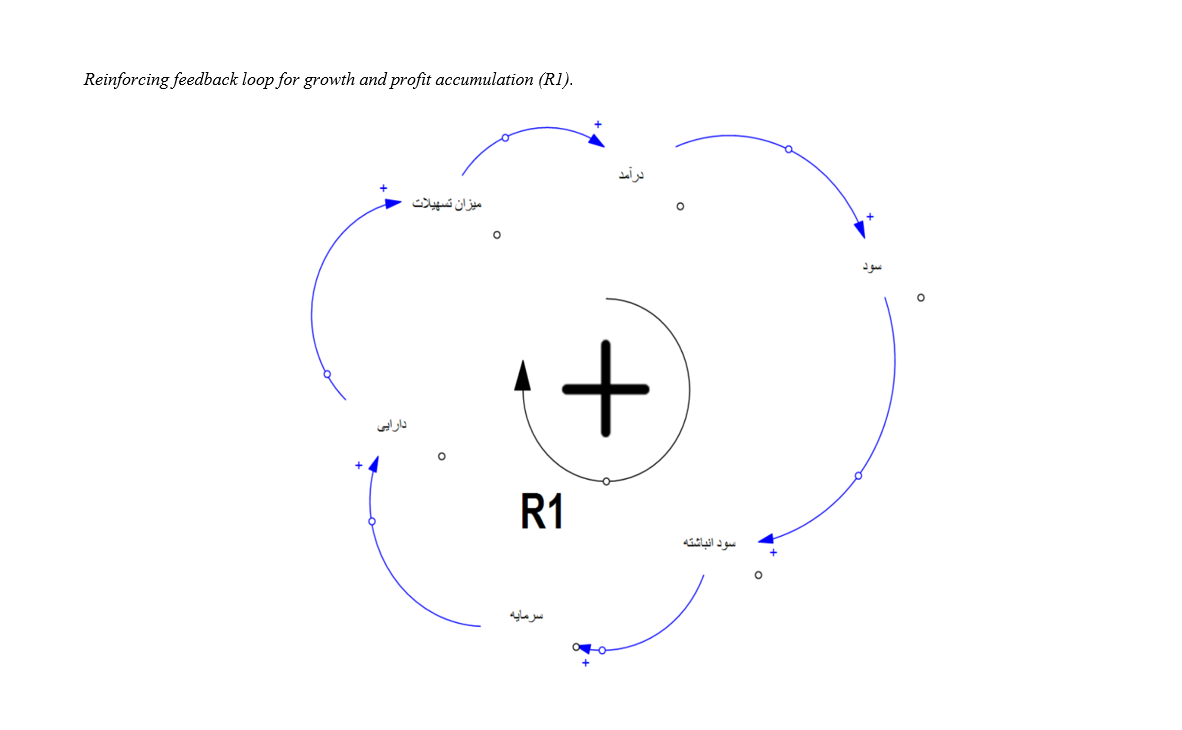
Bank failure develops through interacting balance-sheet, operational, and macroeconomic mechanisms, yet conventional early-warning models often represent these mechanisms as static predictors. This study models the drivers of bank failure from the perspective of capital distress and accumulated losses and evaluates policy combinations using an integrated system-dynamics and genetic-algorithm approach. An applied mixed-method design was used. Candidate factors were identified through a literature review and semi-structured interviews with 11 senior banking managers, researchers, and academics selected purposively and by availability. Three rounds of fuzzy Delphi screening were followed by expert validation of the causal structure. Institutional data for Bank Melli Iran covered Iranian years 1390–1403 (approximately 2011–2024). A Vensim model represented resource mobilization, funding composition, credit efficiency, income, costs, capital, and accumulated losses. A genetic algorithm then assessed two multi-lever policy scenarios. The multi-lever scenario that jointly optimized resource mobilization, funding composition, and credit efficiency generated a feasible solution for all 13 simulated transitions within the defined policy domain; its minimum accumulated-loss-to-capital ratio was approximately −0.49996. When final lever effectiveness was capped at 1, no feasible solution existed for 1395–1398, even at the maximum permissible intervention. Inflation had the largest mean absolute sensitivity (0.178), and credit efficiency was the most influential policy lever. Historical reproduction yielded a correlation of approximately 0.92 and a mean error below 9%. The integrated model supports time-dependent diagnosis and comparison of intervention pathways. Its outputs should be interpreted as conditional policy evidence rather than a guarantee that bank failure will be prevented.
Downloads
References
Alzayed, N., Eskandari, R., & Yazdifar, H. (2023). Bank failure prediction: Corporate governance and financial indicators. Review of Quantitative Finance and Accounting, 61(2), 601-631. https://doi.org/10.1007/s11156-023-01158-z
Barlas, Y. (1996). Formal aspects of model validity and validation in system dynamics. System Dynamics Review, 12(3), 183-210. https://doi.org/10.1002/(SICI)1099-1727(199623)12:3<183::AID-SDR103>3.0.CO;2-4
Basel Committee on Banking Supervision. (2024). Core principles for effective banking supervision.
Bastan, M., Tavakkoli-Moghaddam, R., & Bozorgi-Amiri, A. (2024). Resilient banking: Model-based assessment of business continuity policies on commercial banks. Kybernetes, 53(12), 5325-5357. https://doi.org/10.1108/K-07-2022-0981
Cipollini, A., & Fiordelisi, F. (2012). Economic value, competition and financial distress in the European banking system. Journal of Banking & Finance, 36(11), 3101-3109. https://doi.org/10.1016/j.jbankfin.2012.07.014
Citterio, A. (2024). Bank failure prediction models: Review and outlook. Socio-Economic Planning Sciences, 92, 101818. https://doi.org/10.1016/j.seps.2024.101818
Correia, S., Luck, S., & Verner, E. (2026). Failing banks. The Quarterly Journal of Economics, 141(1), 147-204. https://doi.org/10.1093/qje/qjaf044
Ekinci, A., & Sen, S. (2024). Forecasting bank failure in the U.S.: A cost-sensitive approach. Computational Economics, 64, 3161-3179. https://doi.org/10.1007/s10614-023-10537-6
Fatone, L., & Mariani, F. (2020). Systemic risk governance in a dynamical model of a banking system with stochastic assets and liabilities. Journal of Economic Interaction and Coordination, 15(1), 183-219. https://doi.org/10.1007/s11403-019-00277-y
Hu, W., Shao, C., & Zhang, W. (2025). Predicting U.S. bank failures and stress testing with machine learning algorithms. Finance Research Letters, 75, 106802. https://doi.org/10.1016/j.frl.2025.106802
Huhtilainen, M. (2020). The determinants of bank insolvency risk: Evidence from Finland. Journal of Financial Regulation and Compliance, 28(2), 315-335. https://doi.org/10.1108/JFRC-02-2019-0021
International Monetary Fund. (2023). Global financial stability report: Financial and climate policies for a high-interest-rate era.
Ishikawa, A., Amagasa, M., Shiga, T., Tomizawa, G., Tatsuta, R., & Mieno, H. (1993). The max-min Delphi method and fuzzy Delphi method via fuzzy integration. Fuzzy Sets and Systems, 55(3), 241-253. https://doi.org/10.1016/0165-0114(93)90251-C
Jiang, E. X., Matvos, G., Piskorski, T., & Seru, A. (2024). Monetary tightening and U.S. bank fragility in 2023: Mark-to-market losses and uninsured depositor runs? Journal of Financial Economics, 159, 103899. https://doi.org/10.1016/j.jfineco.2024.103899
Katoch, S., Chauhan, S. S., & Kumar, V. (2021). A review on genetic algorithm: Past, present, and future. Multimedia Tools and Applications, 80(5), 8091-8126. https://doi.org/10.1007/s11042-020-10139-6
Lagasio, V., Pampurini, F., Pezzola, A., & Quaranta, A. G. (2022). Assessing bank default determinants via machine learning. Information Sciences, 618, 87-97. https://doi.org/10.1016/j.ins.2022.10.128
Le, H. H., Viviani, J. L., & Fauzi, F. (2023). Why do banks fail? An investigation via text mining. Cogent Economics & Finance, 11(2), 2251272. https://doi.org/10.1080/23322039.2023.2251272
Legal Bill Amending Parts of the Commercial Code of Iran, art. 141, (1968).
Lin, C. C., & Yang, S. L. (2016). Bank fundamentals, economic conditions, and bank failures in East Asian countries. Economic Modelling, 52, 960-966. https://doi.org/10.1016/j.econmod.2015.10.035
Modiri, M., Shiramin, M. D., & Shirazi, H. K. (2019). Identification and prioritization of influencing factors on safety performance with a hybrid fuzzy DEMATEL and analytical network process approach. Journal of Health & Safety at Work, 9(1), 49-65.
Najari Forushani, M., Hafezi, B., & Rajabi, M. (2024). Predicting and comparing the probability of bank bankruptcy in selected Islamic and non-Islamic countries. Islamic Economics, 24(93), 169-189. https://eghtesad.iict.ac.ir/article_714877_en.html
Olmstead-Rumsey, J., & Ravalli, G. (2026). Country banks and the Panic of 1825. Explorations in Economic History, 101, 101774. https://doi.org/10.1016/j.eeh.2026.101774
Ozili, P. K. (2025). Reflecting on the recent banking crisis, what are the new financial stability determinants? Economic Notes, 54(2), e70014. https://doi.org/10.1111/ecno.70014
Petropoulos, A., Siakoulis, V., Stavroulakis, E., & Vlachogiannakis, N. E. (2020). Predicting bank insolvencies using machine learning techniques. International Journal of Forecasting, 36(3), 1092-1113. https://doi.org/10.1016/j.ijforecast.2019.11.005
Son, B., Lee, J., & Kim, H. (2026). Explaining determinants of bank failure prediction via neural additive model. Applied Economics Letters, 33(11), 1755-1760. https://doi.org/10.1080/13504851.2024.2449551
Sterman, J. D. (2000). Business dynamics: Systems thinking and modeling for a complex world. Irwin/McGraw-Hill. https://go.gale.com/ps/i.do?id=GALE%7CA122262927&sid=googleScholar&v=2.1&it=r&linkaccess=abs&issn=00922102&p=AONE&sw=w
Taheri Haft Asyabi, R., Naderi, A., & Piri, P. (2025). A hybrid model for predicting bankruptcy of Iranian banks: Combining artificial intelligence with spatial econometrics. Quarterly Journal of Quantitative Economics. https://doi.org/10.22055/jqe.2025.48811.2684
van Egmond, N. D., & de Vries, B. J. M. (2024). Reforming the Eurozone financial system: A system-dynamics approach. International Review of Financial Analysis, 93, 103192. https://doi.org/10.1016/j.irfa.2024.103192
Wu, Q., & Cole, R. A. (2024). Macroeconomic conditions and bank failure. Journal of Forecasting, 43(5), 1212-1234. https://doi.org/10.1002/for.3066
Zomchak, L., & Seniv, A. (2026). Financial health assessment of Ukrainian banks: A logistic regression model for bankruptcy prediction. In N. Shpak, O. Kuzmin, & M. Bublyk (Eds.), Data-centric business and applications: Modern trends in financial and innovation data processes 2025 (Vol. 1, pp. 121-135). Springer. https://doi.org/10.1007/978-3-032-10153-2_7
Publication Timeline
- Submitted
- Revised
- Accepted