Contextual Acceptance of Artificial Intelligence in Commercial Policy-Making: An Integrated Model of Acceptance, Resistance, and Institutional Factors
Keywords:
artificial intelligence; commercial policy-making; contextual acceptance; digital leadership; institutional trust; technological resistanceAbstract
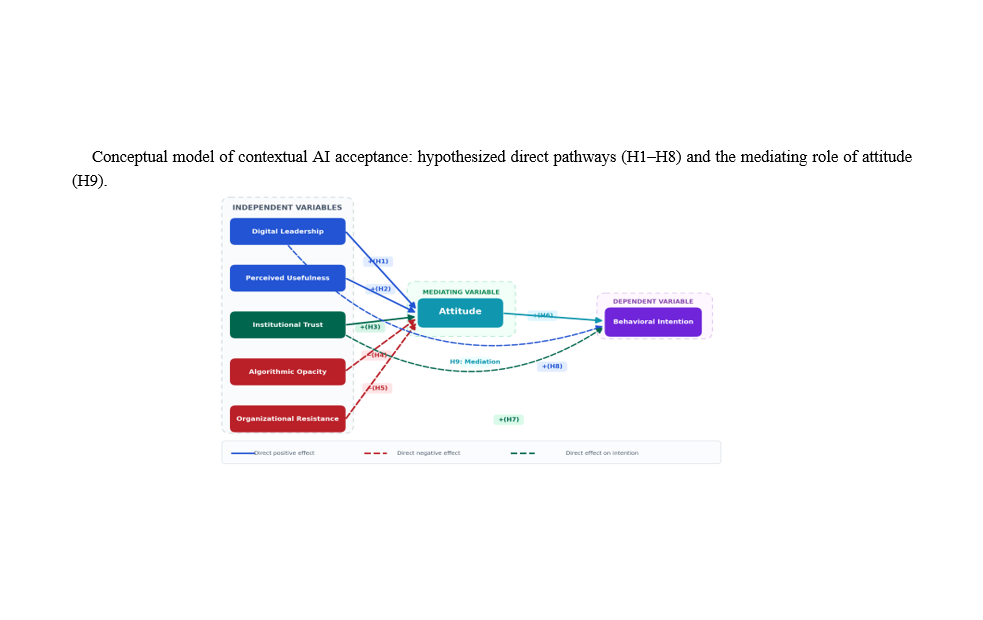
This study examines how senior decision-makers in Iranian commercial policy institutions evaluate and respond to artificial intelligence (AI), with particular attention to the interplay of adoption, resistance, and institutional considerations. It develops the notion of contextual acceptance to describe the importance of whether AI-supported decisions can be justified to relevant stakeholders. An exploratory sequential mixed-methods design was used. The qualitative phase involved 18 semi-structured interviews with experts in commercial policy, information technology, and academia. The authors report thematic saturation after the fourteenth interview and four additional interviews to consolidate the themes. In the quantitative phase, a 27-item five-point Likert questionnaire was completed by 248 senior managers and specialists selected through stratified random sampling. The reported analysis used partial least squares structural equation modeling (PLS-SEM) in SmartPLS 4. The qualitative analysis identified digital leadership, perceived usefulness, institutional trust, algorithmic opacity, organizational resistance, and perceived risk. In the structural model, digital leadership (β = 0.36, t = 6.3), perceived usefulness (β = 0.34, t = 5.9), and institutional trust (β = 0.28, t = 4.7) were positively associated with attitudes toward AI. Algorithmic opacity (β = −0.22, t = 3.8) and organizational resistance (β = −0.19, t = 3.4) were negatively associated with attitudes. The reported R² values were 0.64 for attitude and 0.69 for behavioral intention, with an overall GOF value of 0.61. All nine hypotheses were reported as supported, although the indirect-effect coefficient and test statistic for mediation were not provided. The findings are consistent with a context-sensitive account of AI acceptance in which perceived institutional accountability and the defensibility of algorithm-supported decisions complement assessments of technical usefulness. Potential implications include clearer accountability arrangements, explainable AI systems, and digital leadership development; causal and policy-effectiveness claims require further study.
Downloads
References
Alon-Barkat, S., & Busuioc, M. (2023). Human-AI interactions in public sector decision making: "Automation bias" and "selective adherence" to algorithmic advice. Journal of Public Administration Research and Theory, 33(1), 153-169. https://doi.org/10.1093/jopart/muac007
Ataei, E. (2024). Identifying the Factors Affecting Human Resource Productivity. Transactions on Data Analysis in Social Science, 6(2), 127-139. https://doi.org/10.47176/tdass.2024.127
Burrell, J. (2016). How the machine 'thinks': Understanding opacity in machine learning algorithms. Big Data & Society, 3(1), 1-12. https://doi.org/10.1177/2053951715622512
Davis, F. D. (1989). Perceived usefulness, perceived ease of use, and user acceptance of information technology. MIS Quarterly, 13(3), 319-340. https://doi.org/10.2307/249008
Dwivedi, Y. K., Kshetri, N., Hughes, L., Slade, E. L., Jeyaraj, A., & Kar, A. K. (2023). Opinion paper: So what if ChatGPT wrote it? International Journal of Information Management, 71, 102642. https://doi.org/10.1016/j.ijinfomgt.2023.102642
Grimmelikhuijsen, S. (2023). Explaining why the computer says no: Algorithmic transparency affects the perceived trustworthiness of automated decision-making. Public Administration Review, 83(2), 241-262. https://doi.org/10.1111/puar.13483
Janssen, M., Hartog, M., Matheus, R., Yi Ding, A., & Kuk, G. (2020). Will algorithmic governance cause the downfall of democracy? Government Information Quarterly, 37(3), 101504.
Kim, H. W., & Kankanhalli, A. (2009). Investigating user resistance to information systems implementation: A status quo bias perspective. MIS Quarterly, 33(3), 567-582. https://doi.org/10.2307/20650309
Lapointe, L., & Rivard, S. (2005). A multilevel model of resistance to information technology implementation. MIS Quarterly, 29(3), 461-491. https://doi.org/10.2307/25148692
Mergel, I., Edelmann, N., & Haug, N. (2019). Defining digital transformation: Results from expert interviews. Government Information Quarterly, 36(4), 101385. https://doi.org/10.1016/j.giq.2019.06.002
Rouhani, A., Amin-Kazemi, B., & Arasteh, M. (2024). Developing scenarios for the use of artificial intelligence in human resource recruitment in Iran. Transactions on Data Analysis in Social Science, 6(3), 185-197. https://doi.org/10.47176/TDASS.2024.185
Simon, H. A. (1997). Administrative Behavior (4th ed.). Free Press. https://www.scirp.org/reference/referencespapers?referenceid=3499046
Venkatesh, V., Morris, M. G., Davis, G. B., & Davis, F. D. (2003). User acceptance of information technology: Toward a unified view. MIS Quarterly, 27(3), 425-478. https://doi.org/10.2307/30036540
Venkatesh, V., Thong, J. Y. L., & Xu, X. (2012). Consumer acceptance and use of information technology: Extending the unified theory of acceptance and use of technology. MIS Quarterly, 36(1), 157-178. https://doi.org/10.2307/41410412
Vial, G. (2019). Understanding digital transformation: A review and a research agenda. Journal of Strategic Information Systems, 28(2), 118-144. https://doi.org/10.1016/j.jsis.2019.01.003
Wirtz, B. W., Weyerer, J. C., & Sturm, B. J. (2020). The dark side of artificial intelligence: An integrated AI governance framework for public administration. International Journal of Public Administration, 43(9), 818-829. https://doi.org/10.1080/01900692.2020.1749851
Young, M., Bullock, J., & Lecy, J. (2019). Artificial discretion as a tool of governance: A framework for understanding the impact of artificial intelligence on public administration. Perspectives on Public Management and Governance, 2(4), 301-313. https://doi.org/10.1093/ppmgov/gvz014
Publication Timeline
- Submitted
- Revised
- Accepted